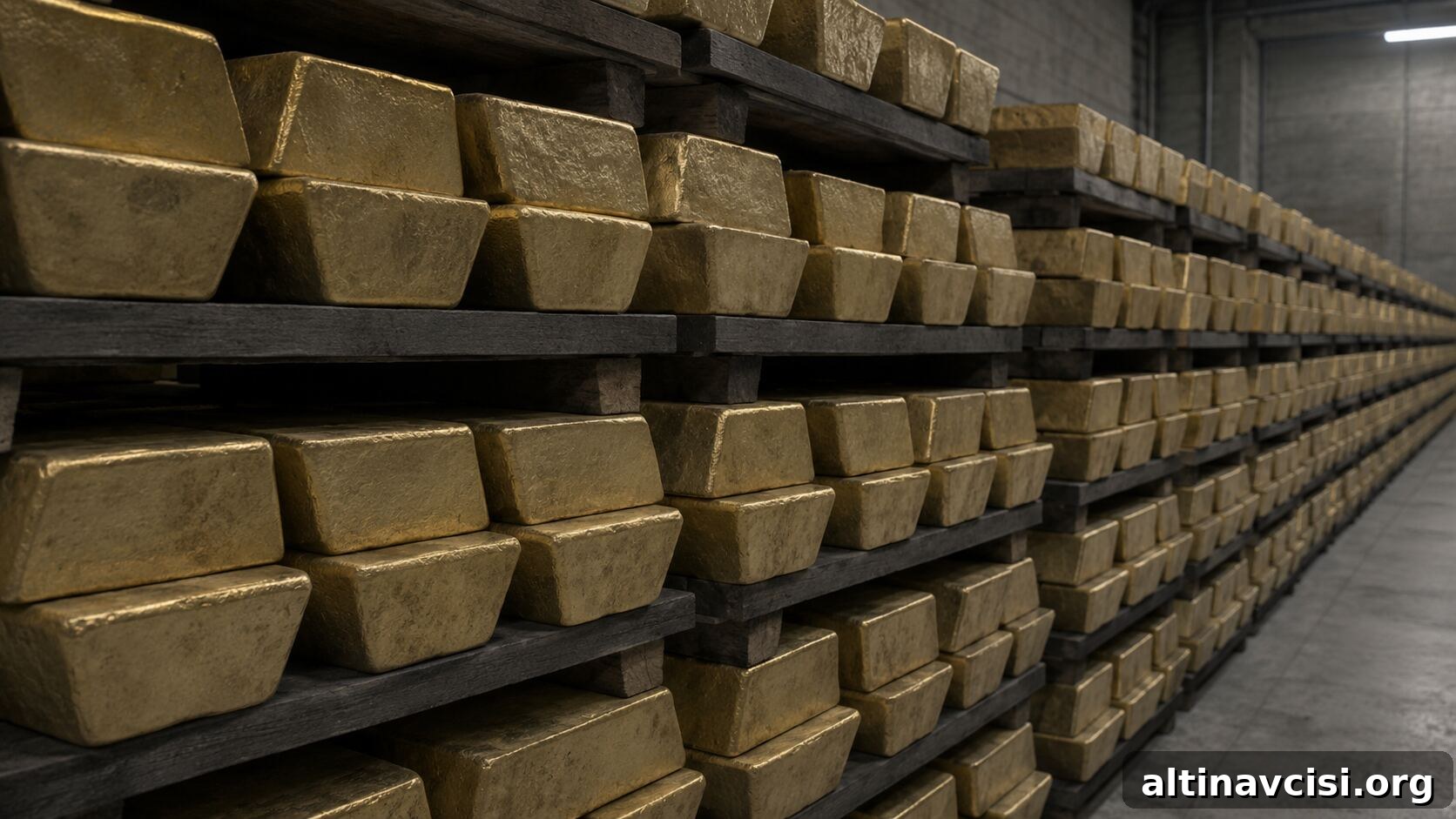
Five signals, one narrative. The European Central Bank confirmed a historic shift in global reserves. India’s government denied a Bloomberg report about gold sales in real time. Reuters data shows gold trading below the consensus of its own analysts. U.S. labor market data set up a crucial decision point for Friday’s jobs report. And the Iran conflict continues to exert downward pressure on gold even as its long-term case strengthens. Together, these developments point to a single conclusion: the world is repricing what “sound money” means. Today’s gold price reflects the friction of that transition, not its ultimate direction.
Why did central banks shift away from U.S. Treasuries?
They haven’t abandoned Treasuries entirely, but reserve allocations are signaling a meaningful change. An ECB report published June 2 shows gold now comprises roughly 27% of global central bank reserves, up from about 20% a year earlier. Over the same period, U.S. Treasuries fell to around 22% from 25%. For the first time since the mid-1990s, gold ranks above Treasuries as a reserve asset.
The ECB linked this reallocation directly to geopolitical risk. President Christine Lagarde pointed to the acceleration after Washington froze Russia’s dollar reserves in 2022, which prompted many governments to reassess the risks of holding dollar-denominated assets. Central banks now hold more than 36,000 tonnes of gold — a level approaching what was common in the Bretton Woods era when currencies retained convertibility to gold.
For decades, Treasuries were treated as the world’s safest reserve asset. The institutions that manage sovereign wealth are quietly signaling a different preference.
The Edge Every Investor Needs
Smarter precious metals investing starts here. The Nuggets Newsletter delivers market insights, Fed updates, global trends, educational videos, and timely analysis.
Did India’s central bank actually sell $12 billion in gold?
No — not according to India’s government, which issued a formal denial the same day the Bloomberg analysis appeared. On June 2, Bloomberg Economics suggested the Reserve Bank of India may have sold about $12 billion in gold during the two weeks ending May 22, inferring this from an apparent divergence in publicly available reserve data and speculating the RBI acted to defend the rupee amid pressure from higher oil prices related to the Hormuz closure.
India’s Press Information Bureau quickly labeled the claim false and pointed to official RBI figures showing gold’s share of India’s foreign exchange reserves actually rose, from 13.92% in September 2025 to 16.85% as of May 22, 2026. The matter may be clarified further when the RBI releases its next Monthly Bulletin, but the episode underscores how closely the market now watches central bank gold movements. A Bloomberg inference moved markets before a sovereign rebuttal arrived — a sign of heightened sensitivity.
That sensitivity reflects gold’s growing importance in sovereign finance.
Why is gold falling if the structural case remains intact?
The near-term weakness in gold is driven largely by a specific transmission mechanism tied to the Iran conflict. Reuters reported that expectations for a “higher for longer” monetary policy cycle pushed gold to a two-month low in late May, as rising U.S. real yields reduce the appeal of a non-yielding asset. Reuters also identified the course of U.S.-Iran talks as the single largest short-term influence on gold prices.
The mechanism is straightforward: higher oil prices from threats to Hormuz increase inflation pressures, which in turn keeps the Federal Reserve between cutting rates and hiking. Elevated real yields raise the opportunity cost of holding gold, prompting short-term selling. This does not negate the long-term thesis for gold; it simply creates a temporary headwind that makes cash holdings relatively more attractive for some investors.
At the same time, structural demand is strong. The World Gold Council reported 244 tonnes of net central bank purchases in Q1 2026, and that buying occurred at price levels well above current spots. Gold is up roughly 36% over the past year and about 90% over the past two years, confirming that long-term drivers remain firmly in place.
In short: the immediate headwind is geopolitical; the structural case endures.
What does the Reuters analyst poll say about gold in 2026?
The Reuters poll suggests gold should be trading higher than it is. A survey of 30 analysts produced a median forecast of $4,746.50 per troy ounce for 2026, the highest annual consensus since Reuters began polling in 2012. Yet spot gold is trading near $4,461 this morning — nearly $300 below that median.
By comparison, a year ago the same survey forecasted just $2,700 for 2026. That dramatic change in analyst expectations illustrates how rapidly the structural case for gold has strengthened. Late-May analyst estimates showed average annual targets in the $4,900–$5,243 range, with many year-end targets even higher, driven by central bank accumulation, monetary debasement concerns, and dollar weakness.
Thus, the divergence between today’s price and the consensus is not confusion among analysts; it measures the near-term suppressing effect of the Iran conflict. The key question is whether the current price reflects the temporary cost of that headwind or a discount before the structural drivers resume dominance.
What does the JOLTS report mean for gold prices this week?
It makes Friday’s May jobs report the week’s pivotal event. On Tuesday, the Bureau of Labor Statistics reported job openings rose to 7.62 million in April, up 731,000 from March and the highest level since May 2024 — well above forecasts of 6.87 million. On the surface, that signals a strong labor market.
But the report’s internals painted a more nuanced picture: voluntary quits fell to their lowest level since the pandemic and both hiring and layoffs retreated. That combination — more openings but fewer workers moving — suggests a low-hire, low-fire dynamic that masks caution among employers and employees.
Following the JOLTS release, gold failed to hold gains above $4,500. A resilient but hesitant labor market gives the Fed latitude to delay easing, while U.S.-Iran tensions pushing oil higher reinforce a more restrictive policy outlook. May payrolls are due Friday at 8:30 a.m. ET; Bloomberg’s consensus sits at 85,000 new jobs. A print below 75,000 coupled with still-elevated inflation would be a classic stagflation signal — historically one of the most durable macro environments for gold. Conversely, a strong print above 150,000 would sustain rate-hike pressure and likely keep gold range-bound. This week, one number may decide the near-term direction.
Stay On Top of Gold & Silver Prices
Get important market alerts sent straight to your inbox.
SOURCES
1. nFusion Solutions — Gold & Silver Spot Price Data
2. Canadian Mining Journal — Gold Overtakes US Treasuries in Global Reserve Shift
3. Bloomberg — RBI May Have Sold Gold to Save Foreign Reserves, BE Analysis Shows
4. NewsX — Did RBI Sell $12 Billion in Gold to Protect Forex Reserves? What Govt Said
5. CNBC — Gold Falls to Two-Month Low as War-Driven Inflation Fuels Rate-Hike Bets
6. World Gold Council — Gold Demand Trends Q1 2026: Central Banks
7. U.S. Bureau of Labor Statistics — Job Openings and Labor Turnover Survey, April 2026
8. CNBC — Gold Falls on Oil-Driven Inflation Worries as US-Iran Peace Talks Falter
9. Yahoo Finance — May 2026 Jobs Report: Labor Market Live Updates
Disclaimer: This article is for informational purposes only and does not constitute financial or investment advice. Consult a qualified financial adviser before making investment decisions.
You May Also Like:
- Factory Costs Hit 82.1. That Number Is Now Working for Your Gold.
- Gold at $4,500: What Fort Knox, China, and Silver Are Telling You
- Silver Has Two Engines. Stagflation Is the One Condition That Fires Both at Once.
- The Buyer List for Gold Just Got Longer. These Countries Have Never Bought Before.
- PCE Hit 3.8%. GDP: 1.6%. Gold Went Up. Here’s the Mechanism.
- Gold Targets Are Falling. The $8,000 Forecast Isn’t.
- Gold Radar: 5 Stories the Price Chart Isn’t Telling You
- Silver Lost 3.3% While Gold Lost 1.6%. That Gap Is Not Random.
- Gold Down 1.2%, Silver Down 2.8% — The Floor Holds
- UBS Just Cut Its Gold Target by $400. The Part They Kept Is the Real Story.