
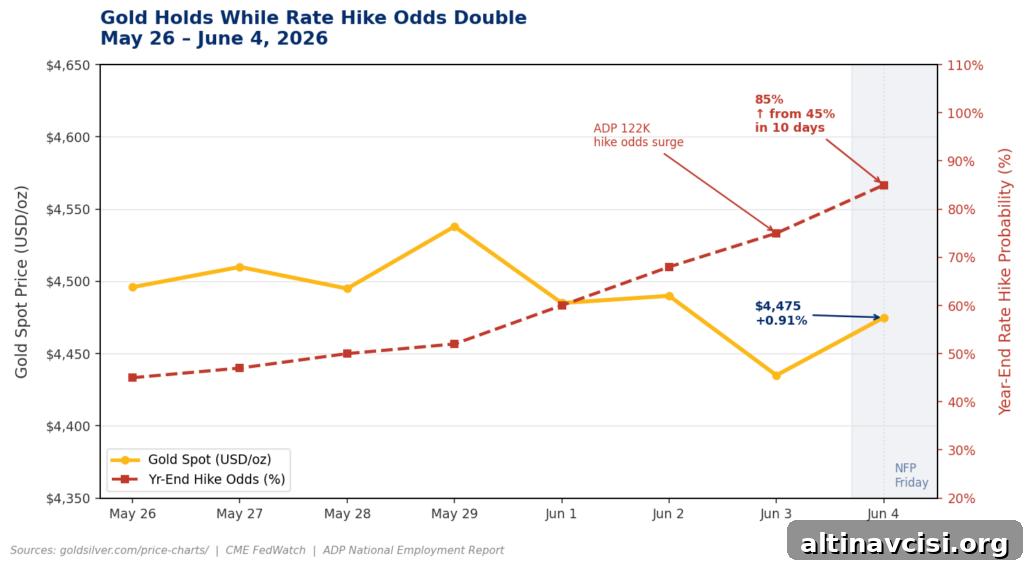
Tomorrow morning at 8:30 a.m. ET the Bureau of Labor Statistics will publish the May nonfarm payrolls (NFP) report — the final major data point before the Federal Reserve’s June meeting and a number likely to define gold’s near-term direction. Gold is trading around $4,481 today, while futures markets have been pricing in a meaningful chance of a Fed rate hike before year-end for the first time since 2023. Ordinarily, rising odds of hikes push gold down. This cycle has been different: gold has held up despite higher priced-in hike risk. That divergence is the backdrop for Friday’s jobs print.
Gold’s resilience as rate-hike odds are repriced isn’t accidental — it reflects a clear mechanism. Understanding that mechanism before the report arrives gives a cleaner framework than headlines alone.
At 8:30 a.m. ET on Friday the Bureau of Labor Statistics releases the May jobs report, the last major clue before the Federal Reserve convenes on June 16–17. Gold sits squarely in the report’s crosshairs.
Gold is near $4,481 as of Thursday afternoon (June 4, 2026), roughly 1% higher on the day. On the surface that looks routine, but it’s notable because gold is holding these levels even as futures markets have repriced material rate-hike risk into the forward curve. In prior tightening cycles such a shift would typically push gold notably lower. The fact that it hasn’t is the key story, and Friday’s jobs number will be the next test of this dynamic.
What Does Wall Street Expect From the NFP Jobs Report?
The consensus on Wall Street expects roughly 80,000 payroll gains in May and an unchanged unemployment rate at 4.3%. That would be below April’s 115,000 increase and consistent with a cooling, though not collapsing, labor market.
ADP’s private-sector payrolls for May, released Wednesday, showed an increase of 122,000, beating consensus and described by ADP’s chief economist as broader than recent gains. JOLTS data this week also revealed that April job openings rose to nearly a two-year high. Taken together, these indicators suggest the labor market entered Friday’s report in more resilient shape than some expected — which is why markets have moved to price higher odds of a Fed hike in recent weeks.
Not every jobs print has the same market impact. Below are three scenarios and what each would likely mean for gold.
Scenario 1: Hot Print (above 120K jobs; wage growth above 0.3% m/m)
A strong payroll print accompanied by accelerating wages would reinforce the case for a Fed hike before year-end. In that environment the dollar would probably strengthen, nominal yields would push higher, and gold would face near-term downward pressure. Expect a test of the $4,400–$4,425 support zone. The crucial issue is whether gold quickly bounces from that area, as it has several times this year, or breaks it. A hold would reinforce the argument that a structural floor is forming under the metal.
Scenario 2: In-Line Print (75K–120K jobs; wages ~0.3% m/m)
Markets have already priced considerable hike risk, so an in-line print would likely confirm a “higher for longer” Fed narrative without materially escalating it. In that case gold would probably consolidate, trading in a roughly $4,450–$4,525 range while the broader tension between yields and safe-haven demand persists.
Scenario 3: Soft Miss (below 60K jobs, or wage growth ~0.2% m/m)
A soft payroll print would shift the market calculus: expectations for a near-term hike would start to roll back and real yields would likely compress — the strongest single driver for higher gold prices. A miss under about 60,000 jobs with soft wage readings could prompt a rapid unwinding of rate-hike bets and push gold back toward the $4,600 area.
The Edge Every Investor Needs
Smarter precious-metals investing starts with timely market insights. The Nuggets newsletter delivers Fed updates, global trends, educational videos, and concise analysis to help investors make better decisions.
Why Is the Fed Stuck Between Two Bad Options?
This jobs report matters because the Fed faces a genuine policy dilemma that is not simply “hike or cut.” It is weighing two problematic choices simultaneously. Raising rates increases the cost of servicing roughly $39 trillion of U.S. government debt, which already generates more than $1 trillion in annual interest expense. Additional hikes can strain Treasury markets and add to fiscal costs without necessarily solving the inflation challenge. Conversely, holding rates risks allowing inflation to erode purchasing power further — a stagflation-like mix of low growth and persistent price gains. Recent data show PCE at 3.8% while GDP growth is modest, reinforcing that tension.
Gold exists outside this policy trade-off. It cannot be debased, carries no counterparty risk, and often benefits when policymakers face difficult trade-offs. Each time the Fed confronts competing risks, the case for owning some physical metal as a form of financial sovereignty becomes clearer — not as an alarmist prediction but as a hedging rationale.
What to Watch Beyond the Headline Number
When the report arrives, look beyond the headline payroll change. Three metrics matter most: the unemployment rate (does it hold at 4.3% or tick up?), average hourly earnings month-over-month (where the Fed focuses its policy calculus), and labor force participation (a falling participation rate alongside stable unemployment can mask weakness). These components will help interpret whether a “strong” payroll print genuinely reflects broad labor-market strength or simply statistical shifts.
The June 16–17 FOMC meeting is just 12 days away, and Kevin Warsh will chair his first Fed meeting. Friday’s jobs report is the last major input before that decision. How gold behaves after the print — not only during the initial headline reaction — will reveal more about where the market believes a durable floor lies.
Key Takeaways
- The May NFP report (consensus ~80K) is released Friday at 8:30 a.m. ET and is the final major data point before the June 16–17 FOMC meeting.
- Gold is holding near $4,481 even as futures markets price meaningful rate-hike risk — a structural divergence that has persisted through the year.
- A soft miss (below ~60K) could trigger the largest upward reaction in gold; a hot print would test the $4,425 support zone; an in-line print would likely leave gold consolidating in its current range.
- The broader mechanism: when the Fed is forced to choose between two unfavorable policy paths, the argument for sound money — including some allocation to physical gold — strengthens over time.
Stay On Top of Gold & Silver Prices
Get important market alerts sent straight to your inbox.
SOURCES
Bureau of Labor Statistics; ADP Research; JOLTS; CME Group FedWatch; public reporting on recent PCE and GDP readings and central-bank developments.
Disclaimer: This article is for informational purposes only and does not constitute financial or investment advice. Consult a qualified financial adviser before making investment decisions.
You May Also Like:
- Gold Surges 1.5%: ADP, ISM, and Beige Book Trap the Fed
- Gold at $4,454 Says the Fed Is Trapped. Here’s Why.
- Central Banks Picked Gold Over Treasuries. Should You?
- Central Banks Just Crossed a Line Not Seen Since 1996
- Factory Costs Hit 82.1. That Number Is Now Working for Your Gold.
- Gold at $4,500: What Fort Knox, China, and Silver Are Telling You
- Silver Has Two Engines. Stagflation Is the One Condition That Fires Both at Once.
- The Buyer List for Gold Just Got Longer. These Countries Have Never Bought Before.
- PCE Hit 3.8%. GDP: 1.6%. Gold Went Up. Here’s the Mechanism.
- Gold Targets Are Falling. The $8,000 Forecast Isn’t.
- Gold Radar: 5 Stories the Price Chart Isn’t Telling You