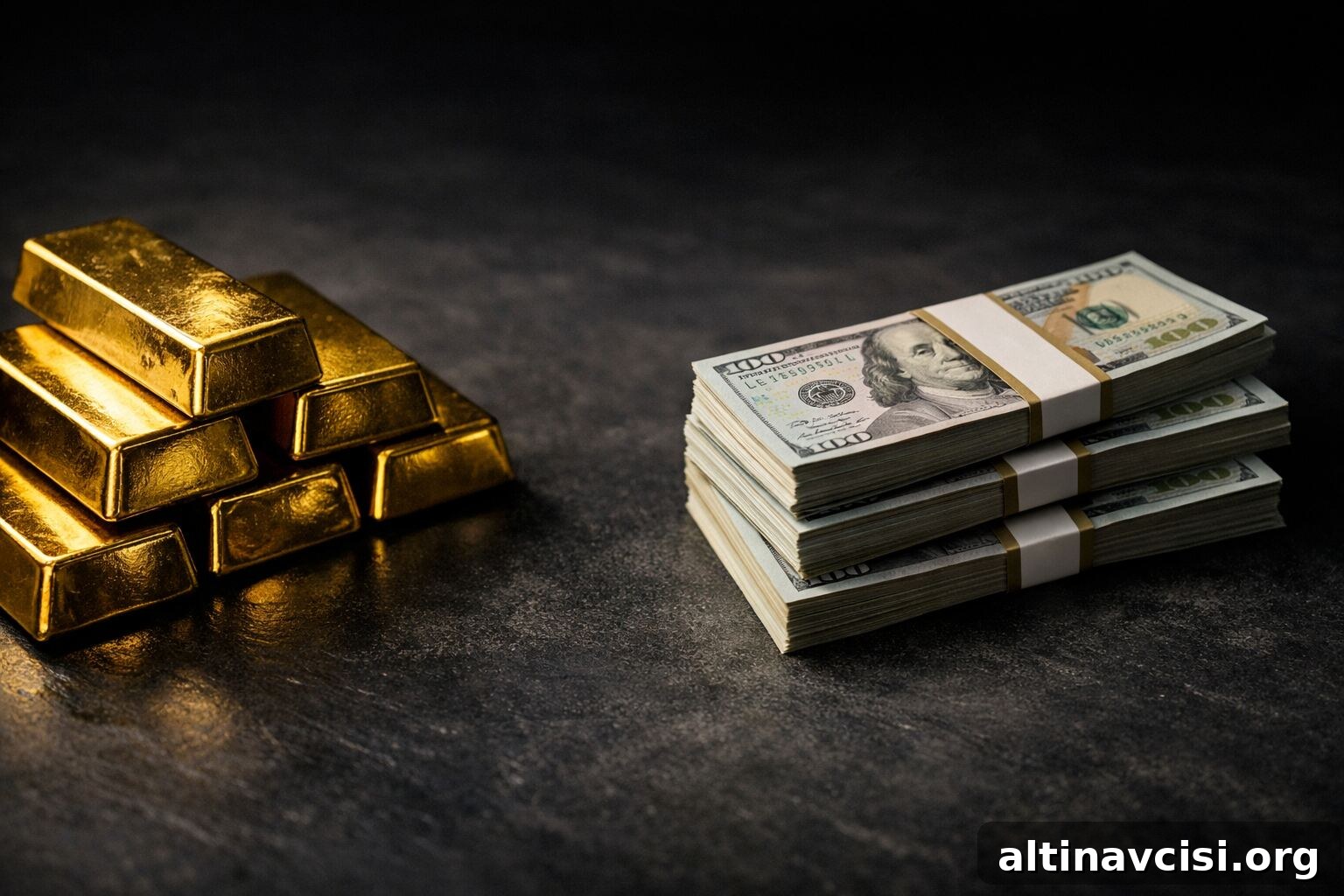
If you follow financial markets, you’ve probably noticed a familiar pattern: gold prices often rise when the U.S. dollar weakens and fall when the dollar strengthens.
That inverse relationship between gold and the dollar is one of the most observed dynamics in global markets. Analysts reference it, investors monitor it, and it provides a helpful framework for interpreting movements in both assets.
While the pattern is well known, the reasons behind it are more nuanced.
- Why does the strength of a currency influence the price of a metal?
- Why does this relationship hold over long periods but sometimes break down?
- What does the connection reveal about broader economic conditions?
To answer these questions, it helps to look beyond price charts and examine the underlying drivers: how gold is priced, how monetary policy affects both assets, and how investor behavior changes across different economic environments.
This guide explains the relationship step by step and highlights the key factors that shape how gold and the U.S. dollar interact over time.
What Is the Dollar–Gold Inverse Relationship?
The inverse relationship refers to a common pattern: when the U.S. Dollar Index (DXY) rises, gold prices tend to fall, and when the dollar weakens, gold prices tend to rise.
Research from reputable sources shows the correlation between gold and the DXY typically ranges from about −0.5 to −0.8 depending on the time frame. That indicates a strong but imperfect inverse link.
Dollar vs. Gold: Why They Often Move in Opposite Directions
U.S. DOLLAR INDEX (DXY) vs. GOLD PRICE | YEAR-END, 2000–2025 + MARCH 2026
Gold Price ($/oz) →
← DXY (Dollar Index)
When the dollar strengthens, gold tends to fall — and vice versa. Strong over long periods, but not perfect.
This pattern is not only a short-term market effect. It reflects a combination of structural, economic, and behavioral forces that shape how gold and currencies interact globally.
To understand why the relationship exists, it helps to recall gold’s historical monetary role.
Before the Dollar, There Was Gold
Gold served as money and a store of value long before the modern U.S. dollar. For much of recent history, many currencies, including the U.S. dollar, were linked to gold under the gold standard. Governments held reserves to support convertibility and monetary stability.
That system began to change through the 20th century and ended in 1971 when the United States suspended dollar convertibility into gold. From that moment, the dollar became fully fiat — its value supported by monetary policy and public confidence rather than a physical asset.
After 1971, gold and the dollar operated as separate but connected stores of value. Movements between them began to reflect interest rates, inflation expectations, and investor confidence rather than formal convertibility.
Why Do Gold Prices and the U.S. Dollar Move in Opposite Directions?
Three core forces explain the typical inverse relationship:
1. Gold Is Priced in U.S. Dollars
Gold is traded worldwide in U.S. dollars, creating a direct mechanical link. When the dollar strengthens, it takes fewer dollars to buy an ounce of gold, which tends to push dollar-denominated gold prices down. Conversely, a weaker dollar raises the dollar price of gold even if its value in other terms hasn’t changed.
Because gold is priced in dollars, a weaker dollar also makes gold cheaper for buyers using other currencies, often boosting international demand. This pricing mechanism is an immediate, consistent driver of the inverse relationship.
2. Gold and the Dollar Compete as Safe-Haven Assets
Both assets are seen as stores of value during economic or geopolitical stress. When confidence in the U.S. economy is strong and markets are stable, investors favor dollar assets such as Treasury securities and cash equivalents, which reduces demand for gold.
When confidence weakens—because of inflation, rising debt, or geopolitical tensions—investors often turn to gold as an alternative store of value that doesn’t depend on a single government’s policies. Central banks have also increased gold reserves to diversify away from dollar-denominated holdings, reinforcing this dynamic.
3. Interest Rates and Real Yields
Real interest rates (nominal rates adjusted for inflation) are a crucial link. When the Federal Reserve raises rates, yields on dollar assets increase, making dollar investments more attractive and gold less so, since gold generates no income.
When rates fall or inflation outpaces nominal rates, real yields decline. That lowers the opportunity cost of holding gold and usually supports higher gold demand and prices. Historically, falling or negative real yields have coincided with strong gold performance.
How Does the U.S. Dollar Index (DXY) Affect Gold Prices?
The DXY measures the dollar’s strength versus a basket of major currencies, including the euro, yen, pound, and others. Because gold is priced in dollars, movements in the DXY affect how expensive gold appears to international buyers.
A rising DXY makes gold costlier in other currencies, often reducing global demand and placing downward pressure on dollar-denominated gold prices. A falling DXY has the opposite effect, increasing foreign purchasing power and typically supporting gold.
However, the DXY captures the dollar’s value relative to other fiat currencies, not its absolute purchasing power. Gold also reacts to inflation expectations, real interest rates, and systemic risk—factors not fully represented by the DXY—so the index is one useful indicator among several.
Is Gold a Reliable Hedge Against a Declining U.S. Dollar?
Over medium to long horizons, gold has generally preserved purchasing power even as the dollar has lost value to inflation. Its effectiveness as a hedge depends on why the dollar is weakening:
Inflation-driven weakness: Gold tends to perform well when purchasing power declines.
Risk-off environments: Gold often benefits when investors seek safe-haven assets.
Falling real yields: Gold typically rises as the opportunity cost of holding it declines.
In the short term, gold and the dollar can diverge, so gold is best viewed as part of a broader macro allocation rather than a simple direct bet against the dollar.
What Other Factors Influence the Relationship Between Gold and the Dollar?
The dollar–gold link is a useful framework but not an immutable rule. Several forces can weaken or reverse the pattern:
Central Bank Gold Buying
Sustained central bank purchases, especially by emerging-market nations, have supported gold prices even when the dollar was strong.
Geopolitical Risk
During major crises, both gold and the dollar can rise together as investors seek safe-haven assets. Such episodes temporarily break the usual inverse correlation.
Real Interest Rates
Gold responds directly to real yields. When real yields fall or turn negative, gold typically rises regardless of currency moves.
De-Dollarization Trends
Some countries are reducing reliance on the dollar in trade and reserves, which has increased sovereign demand for gold and introduced structural shifts in global demand.
Has the Gold–Dollar Relationship Changed in Recent Years?
In recent years the relationship has been less consistent. In 2023 and 2024, both gold and the dollar rose together—an unusual pattern compared with historical norms. Factors behind that include strong central bank buying, persistent geopolitical uncertainty, and inflation concerns even in the face of higher nominal interest rates.
That doesn’t mean the link has disappeared. Instead, it shows more drivers now shape gold’s price beyond the dollar alone.
What This Means for Your Portfolio
The dollar–gold relationship is a helpful signal but should be one of many inputs into investment decisions. While a weaker dollar often supports gold, the most important forces tend to be real interest rates, inflation expectations, and global demand dynamics.
Gold can be a valuable component of a diversified portfolio—particularly as a macro hedge or store of value during periods of currency stress or systemic risk—but it should not be treated as a simple bet against the dollar.
People Also Ask
Gold and the U.S. dollar generally share an inverse relationship: when the dollar strengthens, gold prices often fall; when the dollar weakens, gold tends to rise. Because gold is priced in dollars, changes in dollar strength affect affordability for international buyers and influence investor demand.
A weaker dollar makes gold cheaper in other currencies, boosting international demand. A falling dollar often coincides with lower real yields or higher inflation expectations—conditions that make non-yielding assets like gold more attractive as stores of value.
Studies of gold versus the U.S. Dollar Index typically find a negative correlation in the range of about −0.5 to −0.8, depending on the period analyzed. This indicates a strong inverse relationship that is not absolute.
Yes. During acute geopolitical crises or other risk-off episodes, investors can seek both gold and the dollar as safe havens, causing both assets to rise simultaneously. That pattern appeared in recent years during times of elevated uncertainty.
Fed policy strongly influences both assets. Higher interest rates generally strengthen the dollar and can weigh on gold; lower rates or falling real yields tend to weaken the dollar and boost gold. The key metric is often real interest rates—nominal rates minus inflation—because they determine the opportunity cost of holding a non-yielding asset like gold.
This article is for informational and educational purposes only and does not constitute investment advice. Always consult with a qualified financial advisor before making investment decisions.
You May Also Like:
- What Happens When $20 Trillion Chases Gold and Silver?
- Gold and Silver Mining Stocks: What Most Investors Miss
- Is There a Silver Shortage in 2026? The Data Is Alarming
- The Seven Stages of Empire: Why Every Great Currency Eventually Collapses
- When Should You Sell Gold and Silver? (And What to Buy Next)
- Could the US Revalue Its Gold Reserves to Pay Down Debt?