
Daily News Nuggets | Today’s top stories for gold and silver investors
October 29, 2025
Gold Claws Back Above $4,000 After Trade Talk Selloff
Gold rebounded above $4,000 an ounce on Tuesday after plunging as much as 3.2% on Monday when signs of progress in US-China trade talks reduced demand for safe-haven assets. By Wednesday, gold was trading around $4,016, still well below its record high near $4,400 earlier this month.
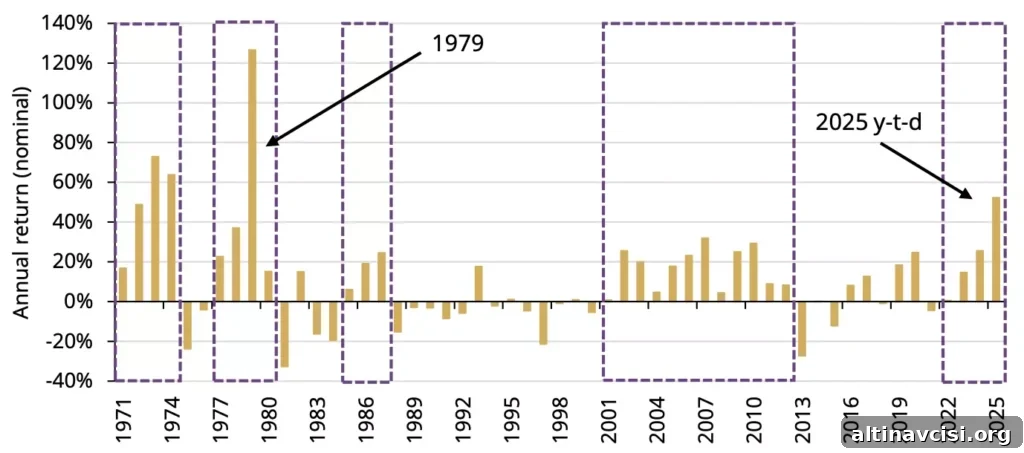
Year-to-date, gold has surged more than 54%, driven by robust investment demand amid geopolitical tensions, a softer dollar, and growing expectations for Federal Reserve rate cuts. If this pace holds, 2025 is shaping up to be gold’s best year since 1979, when the metal rose dramatically amid severe inflation and global uncertainty.
Annual Gold Return in Nominal Terms
Source: Bloomberg, World Gold Council | Data as of 10/9/25. Based on the LBMA Gold Price PM.
As the chart shows, gold rarely moves in a straight line: sharp rallies are often followed by multi-year corrections. Higher Treasury yields after trade announcements also weighed on the non-interest-bearing metal, underscoring that even historic rallies face headwinds when bond returns improve.
Silver Bounces Back 2.5% After Trade Talk Whipsaw
Silver largely followed gold’s volatile path this week, rebounding about 2.5% on Tuesday after a 3.8% slide on Monday. The initial selloff came as optimism over US-China trade talks reduced demand for safe havens. Senior officials from both countries announced a framework agreement on tariffs over the weekend in Malaysia, and some high-profile threats of sweeping tariffs were reportedly eased.
Silver found support ahead of Wednesday’s Fed meeting. With markets pricing in rate cuts, silver benefits from the same dynamics supporting gold: lower interest rates reduce the opportunity cost of holding a non-yielding asset. In addition, silver’s sizable industrial demand makes it sensitive to changes in manufacturing activity—so a true easing of trade tensions could boost both investor and industrial demand.
Ultimately, the Federal Reserve’s path on rates remains the central driver for precious metals.
Fed Set to Cut Rates Again — Despite Flying Blind on Jobs Data
The Federal Reserve is widely expected to cut its benchmark rate by a quarter percentage point Wednesday, marking the second cut in six weeks. Markets are pricing in nearly certain odds, potentially lowering the target range to 3.75%–4.00%. Complicating the decision is an ongoing government shutdown that began October 1, which has delayed official jobs data for September and October.
Policymakers appear focused on preventing a surge in unemployment even as inflation remains above target. Large employers such as Amazon and Target have announced significant corporate layoffs. Lower interest rates generally weaken the dollar and reduce the opportunity cost of holding gold, which is supportive for precious metals. With markets anticipating further easing into December and possibly beyond, the rate-cut cycle may extend into 2026.
America’s White-Collar Workers Face a Silent Recession
Recent labor trends show white-collar workers have been hit disproportionately. In 2024, one in four workers who lost jobs came from professional and business services. Unemployment in that sector has risen from roughly 3.1% to about 4.0%, while many blue-collar sectors such as manufacturing and healthcare have continued hiring.
Large corporate cuts—Amazon’s reduction of thousands of corporate roles and Target’s cuts to hundreds of corporate positions—highlight the pain in office-based jobs. A major factor is the advance of generative AI: analysts estimate a significant share of white-collar tasks could be transformed or automated. LinkedIn and other labor-market reports show hiring for high-salary roles has weakened, hiring timelines for senior professionals have lengthened, and many applicants failed to secure interviews in 2024.
These shifts point to a structural rebalancing of the labor market that may weigh on consumer spending and economic confidence if the trend persists.
Nvidia Races Toward $5 Trillion as AI Bubble Debate Intensifies
Nvidia is on track to become the first company valued near $5 trillion, with shares rising as the company benefits from surging demand for AI hardware and software. Nvidia’s leadership has downplayed bubble concerns, citing significant revenue opportunities from its latest chips and deployments across industries.
Still, observers and some global institutions warn that frothy valuations tied to AI enthusiasm could pose broader market risks. Criticisms include the proliferation of highly valued AI startups, funding structures that emphasize future projections over current profits, and the potential for speculative leverage. If enthusiasm for AI were to reverse, a broad risk-off move could trigger another flight to safety, benefiting traditional havens such as gold and silver.
For precious metals investors, developments in the AI sector—and the extent to which speculative capital chases lofty tech valuations—provide a useful barometer of overall market risk appetite.