
Daily News Nuggets | Today’s top stories for gold and silver investors
October 3rd, 2025
Central Bank Gold Buying Rebounds in August
After a pause in July, central banks returned to the gold market in August, adding a net 15 tonnes to global reserves. Kazakhstan led the purchases, followed by Bulgaria and El Salvador. Poland — already the largest buyer in 2025 — reiterated its long-term strategy by raising its gold reserve target. This renewed buying underscores how central bank demand continues to underpin gold’s strength as investors and institutions re-evaluate reserve strategies.
Year-to-Date Central Bank New Purchases and Sales
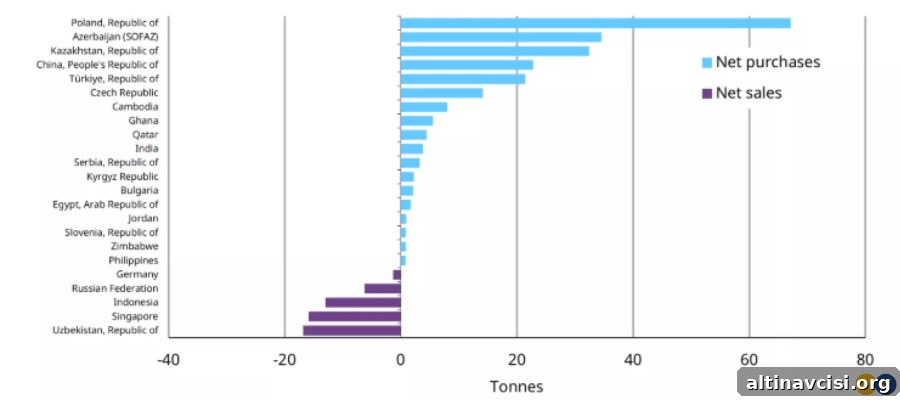
Why this matters: Central bank demand remains a foundational support for gold prices. As many Western investors adapt to this evolving “gold playbook,” official accumulation by sovereigns continues to be a major structural driver in the market.
Gold Extends Seven-Week Rally
Gold has stretched its winning streak to seven consecutive weeks, trading near $3,870 per ounce in late-Friday sessions as investors react to Federal Reserve uncertainty and a U.S. government shutdown that has paused key economic releases. Silver is holding around $47.75 per ounce, levels not seen in more than a decade.
What makes this run notable is gold’s outperformance despite relatively higher real interest rates, an environment that normally pressures bullion. Instead, political friction and perceived risks to the Fed’s independence have prompted a strong flight-to-safety bid. Physical demand across Asia and renewed ETF inflows are contributing to the momentum.
The uplift in bullion prices has also buoyed the miners, which are broadly benefiting from both higher metal prices and improved operational discipline.
Gold Stocks Outshine AI Giants
Gold mining stocks have dramatically outpaced many top tech names this year. MSCI’s global gold miners index is up roughly 135% year-to-date, well ahead of the approximately 40% gain in leading semiconductor stocks. Major producers such as Newmont and Agnico Eagle have more than doubled on U.S. exchanges, while China’s Zijin Mining has surged about 130% in Hong Kong. In London, Fresnillo has nearly quadrupled, becoming one of the FTSE 100’s best-performing stocks this year.
The rally reflects not only rising bullion prices but also tighter cost controls and renewed investor interest in tangible assets over high-growth, speculative stories. The key question for markets is whether this momentum can persist if macroeconomic indicators begin to cool.
U.S. Government Shutdown Silences Jobs Report
The U.S. government shutdown has interrupted the Bureau of Labor Statistics’ flagship jobs report, leaving investors with a gap in official labor-market data. In the absence of the government release, private datasets from ADP and Revelio Labs suggest the labor market is moderating: hiring is slowing, layoffs remain relatively low, and wage growth is easing.
For investors, this combination of cooling labor trends and heightened political dysfunction raises the odds that the Fed could consider easing policy sooner than previously expected—an environment that historically supports precious metals. With official statistics missing, remarks from Fed officials carry greater influence on market expectations.
Fed’s Logan Urges Caution on Rate Cuts
Dallas Fed President Lorie Logan has urged caution regarding additional interest-rate reductions, even as the Fed has recently trimmed rates to help guard against a sharper labor-market slowdown. Speaking at the University of Texas at Austin, she noted that inflation remains above the central bank’s target and could become more persistent if policy is eased too quickly.
Logan emphasized the importance of carefully calibrated policy: easing prematurely risks undermining price stability and could force a more painful policy reversal later. While the labor market appears to be cooling, she argued that the change is gradual and warned against overreacting to short-term signals.
The central issue for markets is how the Fed balances support for employment with the need to keep inflation expectations anchored, especially while headline economic data remains patchy.