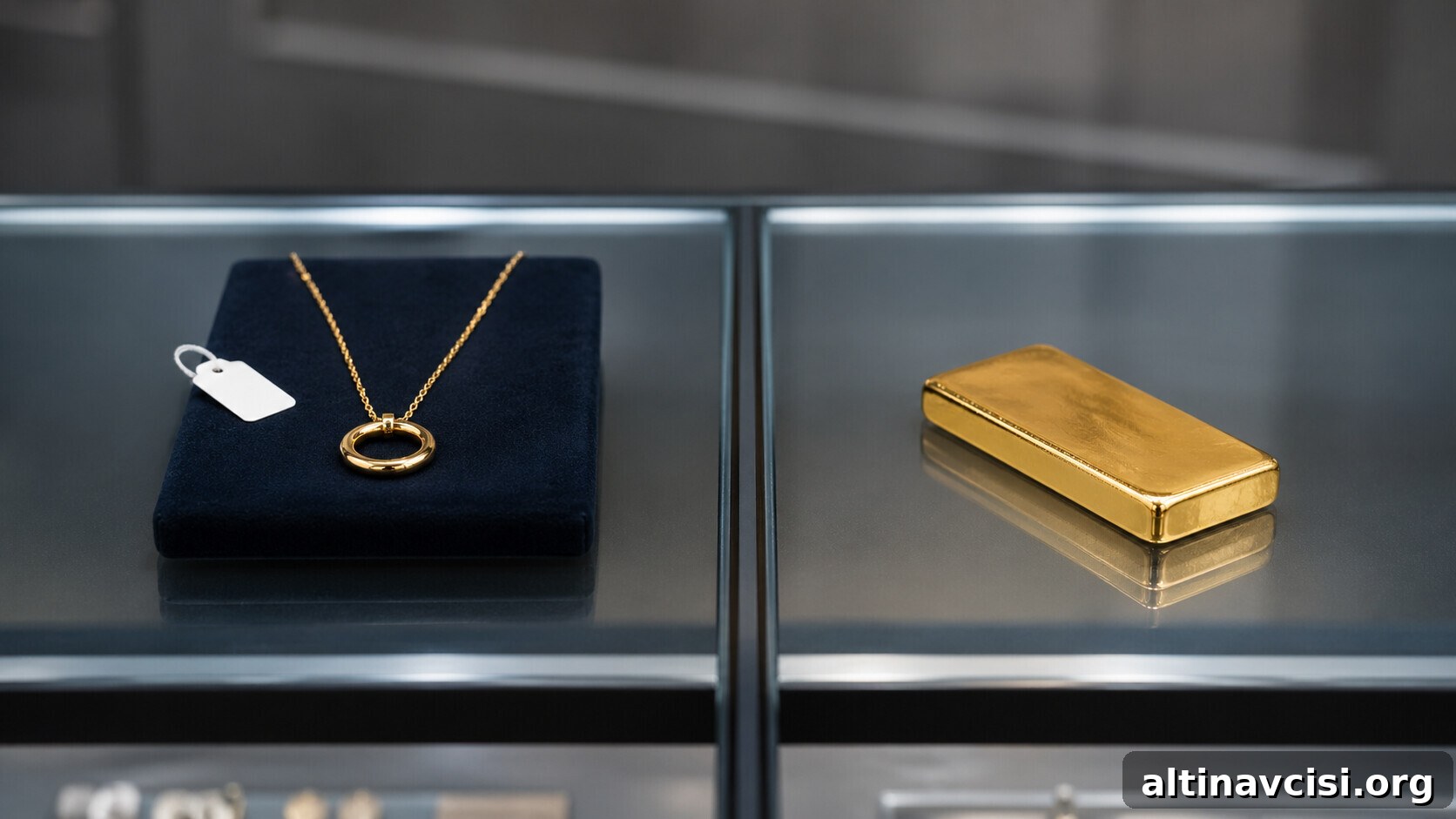
At roughly $4,600 an ounce, the way you buy gold matters as much as the decision to own it. Gold bullion — bars and investment-grade coins — closely tracks the spot price, with typical premiums of 1–5% above market value. Gold jewelry, however, carries retail markups that commonly range from 50–200% at mainstream retailers and 300% or more at luxury brands. Jewelry is a consumer item; bullion is a financial asset.
With gold near $4,600 an ounce in April 2026 — up about 43% year-over-year — investors are increasingly asking whether form matters: bar or bracelet? The metal in a 14-karat ring and a one-ounce bar respond to the same global price signals, but the form of your purchase determines how much of each dollar buys actual gold and how easily you can convert it back into cash. At today’s prices, that difference can determine whether you accumulate lasting wealth or pay for retail margins.
What Is Gold Bullion?
Gold bullion is standardized, investment-grade gold: bars, ingots, and government-minted coins valued primarily for their metal content. Purity is usually .999 or .9999 fine (99.9%–99.99% gold). Price equals spot plus a modest premium to cover refining, minting, distribution, and dealer margin — no design fee, brand markup, or retail overhead.
The spot price is the wholesale baseline. A typical one-ounce bar from a reputable dealer trades about 1–5% above spot. That premium pays to turn raw gold into a standardized, authenticated, deliverable product. On resale you’re paid for the metal content, not minting or retail costs. Jewelry follows entirely different economics.
Your Gold Buying Guide Most investors overpay when they buy gold — and again when they sell. This guide explains exactly what to own and why.
What Are You Actually Paying for With Gold Jewelry?
Retail jewelry markups typically run 50–200% above the metal’s content value at mainstream chains, and 300% or more at luxury brands. Those markups reflect manufacturing labor, store rent, advertising, packaging, brand equity, and sales commissions. Public financials from major jewelers show the top end of the market sustaining substantial design and brand premiums.
When you sell jewelry, none of those retail premiums transfers back. Dealers pay melt value — the metal content at spot price — and often offer below that. The craftsmanship and branding you paid for do not return value in a typical resale transaction.
With a one-ounce gold bar the math is straightforward: a small premium to buy and resale close to spot. Round-trip costs are predictable and transparent.
Is All Gold the Same Purity?
Jewelry is rarely pure gold. Common U.S. grades are 10-karat (41.7% gold), 14-karat (58.3% gold), and 18-karat (75% gold). A 24-karat piece approaches investment-grade purity at 99.9%, but that is uncommon in many Western markets.
A large portion of what you pay for a 14-karat piece is non-gold — copper, zinc, silver, or nickel — alloyed for durability and color. You pay retail prices for something that may be less than 60% gold by weight. On resale a dealer pays for the pure gold content; that markup on the remaining alloyed portion is effectively lost.
A .9999 fine bullion bar carries none of that ambiguity. It is 99.99% gold: nearly every dollar you spend goes directly into metal.
Can You Sell Gold Jewelry at a Fair Price?
Bullion is a globally recognized commodity. Standard products like American Gold Eagles or PAMP Suisse bars have verifiable specifications, authentication standards, and deep secondary markets. Reputable dealers buy them back at published prices close to spot, with a predictable spread.
Jewelry resale is different. Dealers, pawn shops, and gold buyers commonly pay 70–80% of melt value at best, often less. Design and brand premiums disappear at resale unless you sell a collectible, signed piece through an auction house with provenance and original packaging.
If quick conversion to cash is important — which is a primary reason to hold gold — jewelry adds friction, uncertainty, and a built-in loss on every dollar spent beyond metal value.
What Does the Market Data Show?
In 2025 demand for bars and coins jumped to a 12-year high, with bar demand rising substantially and total gold demand surpassing 5,000 tonnes for the first time. Conversely, jewelry consumption experienced several quarters of double-digit volume declines. When investors want direct gold exposure, they buy bullion — not gold-adjacent products.
Major research groups project further upside for gold in 2026, driven by central bank and investor demand. How you hold gold determines how much of any price appreciation you actually capture.
When Does Buying Gold Jewelry Make Sense?
Jewelry can be sensible in some contexts. In parts of South Asia and the Middle East it serves as both adornment and stored wealth. High-karat pieces purchased near melt value with transparent making charges can function as a hybrid. A 22- or 24-karat piece from a reputable jeweler captures much of the metal value.
Jewelry also has non-financial value as a gift, heirloom, or worn piece. The problem is treating retail jewelry as a primary investment: purchase, holding, and resale economics generally work against investors. For wealth protection, bullion is the cleaner choice.
Stay On Top of Gold & Silver Prices
Get important market alerts sent straight to your inbox.
People Also Ask
What is the difference between gold bullion and gold jewelry?
Bullion is investment-grade gold — bars or coins — priced close to spot with small premiums. Jewelry adds labor, design, branding, and retail markup, often far above the metal value. Bullion functions as a financial instrument; jewelry is a consumer product that contains gold.
Is gold jewelry a good investment?
For most investors, no. Retail jewelry is bought with markups well above metal content, and resale is typically limited to melt value. Those markups are not recoverable. Bullion offers transparent pricing and more reliable buy-back terms.
What karat gold is best for investment purposes?
24-karat gold (99.9% pure) is the standard for investment-grade bullion. Common jewelry grades like 10K and 14K contain significant non-gold alloys, reducing how much actual gold you own per dollar spent.
How much over spot do gold bars typically cost?
One-ounce gold bars generally carry premiums of around 1–5% above spot. Larger bars have lower percentage premiums; very small bars or fractional pieces can carry higher relative premiums.
Can you sell gold bullion easily?
Yes. Recognized bullion products have deep secondary markets. Reputable dealers buy them back at published prices close to spot, often with same-day settlement.
Bullion vs. Jewelry: The Math Doesn’t Lie
With gold near $4,600 an ounce, jewelry markups of 50–300%+ versus bullion premiums of 1–5% create a clear arithmetic gap. Every dollar spent on retail markup is a dollar not invested in metal. Serious investors buy bullion because they want pure exposure to gold rather than a retail product with significant overhead.
SOURCES
1. Trading Economics — Gold Price
2. ICN — How Gold Prices Are Calculated
3. Signet Jewelers — Fiscal 2025 Results
4. The Market Capitalist — Luxury Jewelry Analysis
5. World Gold Council — Gold Demand Trends: Full Year 2025
6. J.P. Morgan — Gold Price Forecast 2026 and Beyond
Disclaimer: This article is informational only and not investment advice. Consult a qualified financial adviser before making investment decisions.
You may also like:
- Gold & Silver IRA: Why Starting Early Costs You Less
- Silver Fair Value: What the Data and History Show
- Gold or Silver Price Dip: Temporary Correction or Trend Reversal?
- What Switzerland’s Gold Freeze Means for Investors
- What History Shows About Buying Gold After a Pullback
- Should You Sell Gold During a Bull Market Pullback?
- Silver Bullion Buying Guide 2026: Coins, Bars, and Rounds Compared
- Is Gold Still a Strategic Asset for Your Portfolio?