Data current as of Q1 2026. Historical performance figures sourced from the LBMA Precious Metals Market Report (Full Year 2025), the World Gold Council Gold Demand Trends (Full Year 2025), and Nasdaq annual price reviews.
Long-run avg: 60–70
125 (March 2020 peak)
Below 60 — rotate back to gold
60–75 — hold both on own merits
Above 75 — silver historically undervalued
What Does a Gold-Silver Ratio of 75 Mean for Investors?
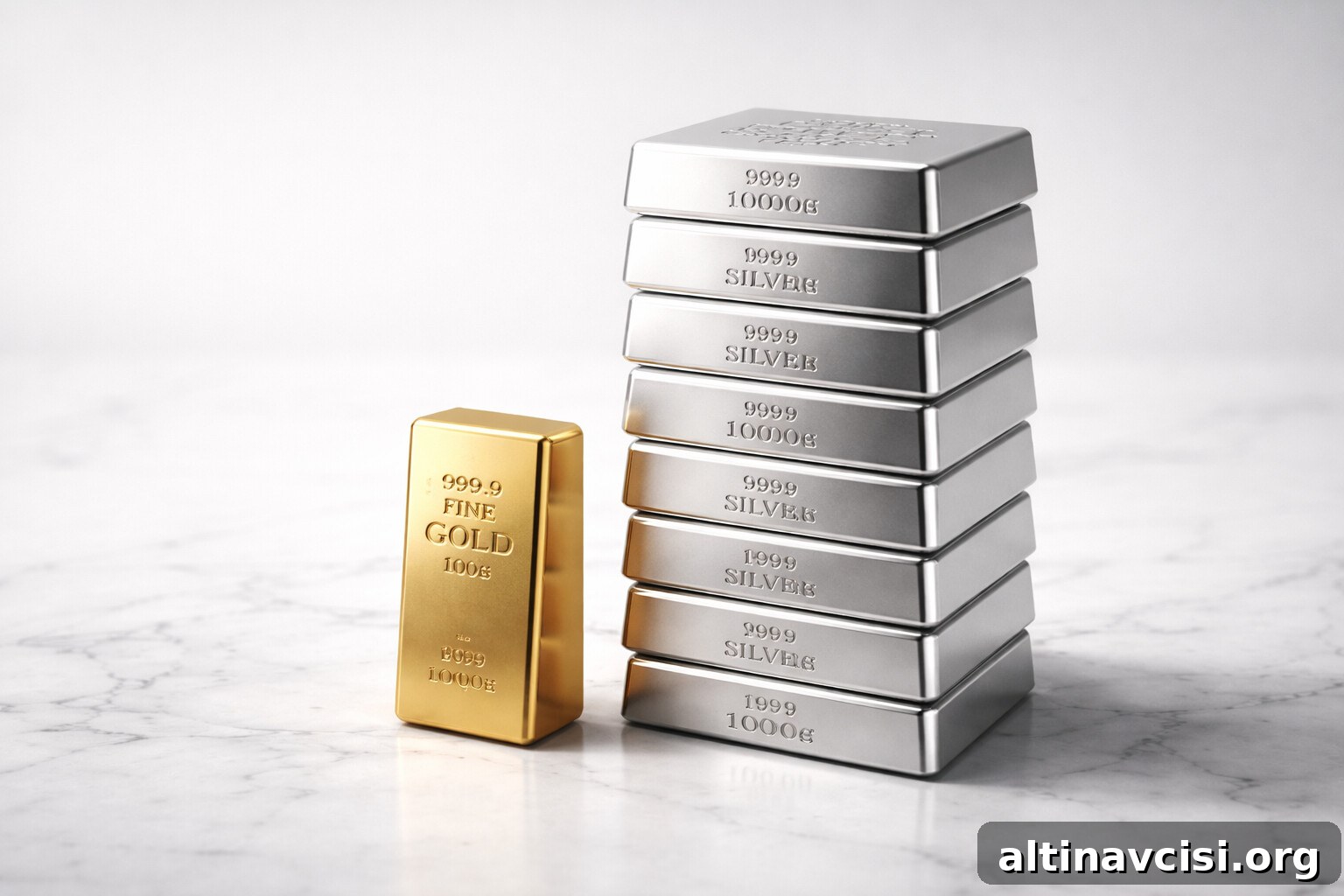
The gold-silver ratio shows how many ounces of silver are required to buy one ounce of gold. At 75:1, one ounce of gold is worth 75 ounces of silver. This ratio is a commonly used relative-value indicator: when it rises, silver looks cheap versus gold; when it falls, silver looks expensive.
How the Ratio Is Read
Historically the ratio has swung widely — from below 20:1 in ancient systems to above 120:1 during extreme market stress. In modern markets the long-run average is roughly 50–65:1. A reading of 75 sits meaningfully above that modern average and is considered elevated.
Why It Matters for Your Portfolio
Elevated readings have often preceded periods where silver outperformed as the ratio reverted closer to its mean. That makes a ratio near 75 a tactical signal for many investors, but not a short-term timing tool: predicting exact turns is difficult, so many use systematic accumulation and clear rebalancing rules.
Gold annual return
Silver annual return
Gold-silver ratio (right axis)
Dual-axis chart omitted. Key points: gold annual returns ranged from -10.4% (2015) to +65.0% (2025). Silver ranged from -19.5% (2014) to +144.4% (2025). The ratio moved from the mid-70s through an 88 peak in 2024, compressing to ~60 by the end of 2025.
What the data shows: Between 2014 and 2023 the ratio often traded in the 70–85 range; 75 sits near the middle of that band. Recent cycles demonstrate the pattern investors watch for: extended ratio elevation followed by meaningful silver outperformance as the ratio compresses.
The key insight: silver typically outperforms during broad precious-metals bull markets but can lag during consolidations. Ratio analysis helps identify when silver’s lag may present a tactical opportunity.
Should I Buy Gold or Add Silver, or Wait?
Three practical scenarios for a ratio of 75.
Scenario 1: Buy Gold — Best for First-Time or Conservative Investors
When this makes sense: You are building an initial precious-metals position or prioritizing capital preservation and low volatility.
Gold at a 75:1 ratio is not necessarily expensive in absolute terms; it is relatively more expensive than silver. Gold remains a reliable portfolio hedge with low equity correlation and long-term purchasing-power preservation.
Allocation guidance: 8–10% of a conservative portfolio; 3–5% for investors who prefer higher risk and want to tilt toward silver.
Verdict: Maintain gold as a core holding at this ratio; it is lower-risk though not the highest-upside trade.
Scenario 2: Add Silver — Best for Existing Gold Holders Seeking Outperformance
When this makes sense: You already own gold and want tactical silver exposure to capture potential mean reversion.
If the ratio compresses from 75 back to near the long-run average (roughly 60), silver would likely outperform gold on a relative basis. Silver also benefits from growing industrial demand in solar, EVs, semiconductors and medical applications, which can support prices beyond pure monetary demand.
Allocation guidance: Moderate investors might target 3–5% silver; aggressive investors 7–10%, using dollar-cost averaging over several months.
Verdict: For those with existing gold positions, 75 is a historically supported entry for adding silver tactically.
Scenario 3: Wait — Best for Investors Seeking Macro Confirmation
When this makes sense: You want to see clearer macro signals before committing — for example, rising inflation expectations, a weakening dollar, or expanding industrial demand.
A ratio of 75 can rise to 80–85 before reversing, as seen in prior cycles. Waiting can avoid adding silver too early but risks missing the initial leg of a rally.
Verdict: Waiting is reasonable if macro indicators are negative; consider a buy trigger above 85 for higher-conviction silver entries.
What Factors Influence the Gold-Silver Ratio — and How to Use Them
Five main forces drive the ratio:
- Macroeconomic environment: Recessions and crises tend to push the ratio higher as gold outperforms while silver’s industrial demand weakens.
- Monetary policy: Easy monetary conditions help both metals, but silver often benefits more in late-cycle recoveries when industrial activity picks up.
- Industrial demand: Silver’s role in solar panels, EVs, semiconductors and medical devices creates structural support that can compress the ratio independent of monetary trends.
- Investor sentiment: Retail and institutional flows can cause rapid, short-lived moves in silver; sentiment-driven spikes are often volatile.
- Central bank activity: Central banks buy gold, not silver, providing a steady underlying bid for gold that can keep the ratio elevated longer than fundamentals alone would imply.
The 75/25 Portfolio Strategy: A Practical Framework
A 75% gold / 25% silver split within a precious-metals sleeve blends gold’s stability with silver’s upside. For example, a 10% total allocation to precious metals becomes 7.5% in gold and 2.5% in silver. This allocation balances volatility and exposure and can be adjusted as the ratio and macro picture evolve. Rebalance when the ratio crosses predefined thresholds — for example, rotate toward silver when the ratio is high and back to gold when it falls below 60–65.
Bottom line: A ratio around 75 is a historically supported signal to begin accumulating silver while maintaining core gold holdings. Systematic accumulation and clear rebalancing rules have historically improved outcomes for ratio-based strategies.
Ready to Act on the Gold-Silver Ratio?
Executing a ratio-based strategy requires choosing how to buy, where to store, and when to rebalance. Use platforms and custodial solutions that match your needs for pricing, storage security, and liquidity.
Stay On Top of Gold & Silver Prices
Get important market alerts sent straight to your inbox.
People Also Ask
What does a gold-silver ratio of 75 mean for investors?
It means one ounce of gold equals 75 ounces of silver. Compared with the modern average of roughly 50–65:1, 75 suggests silver is relatively undervalued and may be an attractive tactical entry while retaining gold as the portfolio foundation.
Should I buy gold or silver when the ratio is at 75?
If you are conservative, maintain gold as the primary holding (8–10% of portfolio) with modest silver exposure (2–3%). If you already hold gold and seek higher upside, consider 3–10% silver depending on risk tolerance, using dollar-cost averaging.
Has the gold-silver ratio been at 75 before, and what happened next?
Yes — the ratio has traded near 75 multiple times. Historically such readings often preceded phases where silver outperformed during subsequent bull runs. Notable cycles include the 2019–2020 period and the 2024–2025 cycle, when elevated ratios preceded substantial silver gains.
What is the best strategy for trading the gold-silver ratio?
Common approaches are the swap strategy (buy silver when the ratio is high, rotate back to gold when it falls below defined thresholds) and dollar-cost averaging to manage timing risk. A 75/25 split within a precious-metals sleeve is a practical framework for many investors.
What factors could push the ratio higher from 75?
The ratio rises when gold outperforms silver, typically during recessions, weak industrial demand, a stronger U.S. dollar, or a sudden drop in investor risk appetite. Historical spikes have sometimes gone higher before reversing, so elevated ratios can persist.
Disclaimer: This article is provided for informational purposes only and should not be construed as investment advice. Past performance is not indicative of future results. Consult a qualified financial advisor before making investment decisions.
SOURCES
1. LBMA — Precious Metals Market Report: Q4 and Full Year 2025
2. World Gold Council — Gold Demand Trends: Full Year 2025
3. Nasdaq — Annual price reviews and market summaries
4. The Silver Institute — World Silver Survey 2025
You May Also Like
- Gold-Silver Ratio: A Hidden Window into Inflation Trends
- The 80/60 Gold-Silver Rule: A Smarter Way to Balance Your Portfolio
- What the Falling Gold-to-Silver Ratio Means for Investors
- Gold/Silver Ratio Price Charts
- Silver Set to Skyrocket: The Gold-Silver Ratio’s Stored Energy