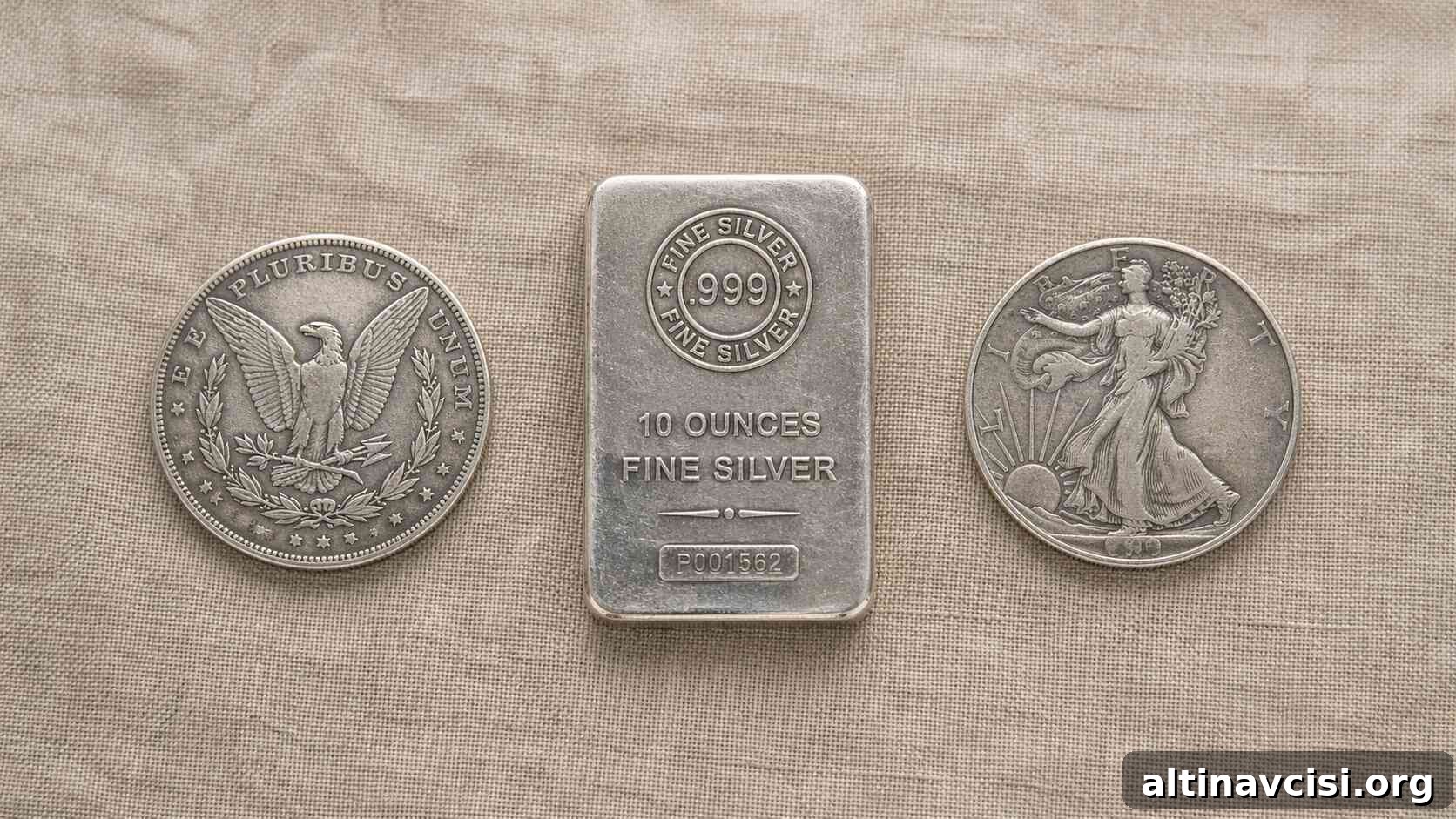
At roughly $79 per ounce in April 2026, silver trades about 34% below its January all-time high of $121.64. For long-term investors the central question is not simply whether to buy silver, but in what form. Coins, bars, and rounds all contain the same .999 fine silver, yet they differ meaningfully in premiums, liquidity, IRA eligibility, and resale behavior. This guide explains each format so you can choose what fits your goals.
Silver reached a nominal high of $121.64 on January 29, 2026, then retreated to roughly $79 by late April. That ~34% pullback looks large until you remember silver rose roughly 144–147% across 2025 — its strongest annual gain since 1979.
The market’s underlying forces remain in place. The silver market is projected to see its sixth consecutive annual supply deficit in 2026, with demand outpacing supply by an estimated 46.3 million ounces — about 15% wider than the prior year. These structural deficits support the case for physical ownership for many investors.
The practical choice today is which form to buy. This article focuses on the trade-offs across coins, bars, and rounds so you can match format to objective.
What Are Silver Coins, Bars, and Rounds?
Physical silver typically comes in three formats: coins, bars, and rounds. They all contain the same metal, but their costs and uses vary.
Silver coins are minted by sovereign government mints such as the U.S. Mint, the Royal Canadian Mint, and the Perth Mint. They carry a nominal face value and legal-tender status — for example, the American Silver Eagle, Canadian Silver Maple Leaf, and Austrian Vienna Philharmonic. That government guarantee is mostly symbolic at bullion prices; you wouldn’t spend a Silver Eagle for its $1 face value when silver spot trades near $79.
Silver bars are rectangular pieces of refined silver, stamped with weight, purity (.999 or .9999), and the refiner’s mark. Produced by accredited refiners, they range from 1 oz to 1,000 oz. Bars have no face value or legal tender status — their value is the metal content.
Silver rounds are privately minted, coin-shaped pieces of silver. They match coins in weight and purity but lack legal-tender status. Private mints often operate with lower overhead, and rounds usually carry the lowest premiums among coin-shaped silver products.
Your Gold Buying Guide Most investors overpay when they buy gold and again when they sell. This guide explains what to own and why.
How Much Over Spot Will You Pay?
Premiums — the markup above spot — are the single most important number when buying silver. They cover minting costs, dealer margins, and demand. The metal content is the same, but prices differ by format. Typical premiums in April 2026 roughly break down as follows:
- American Silver Eagles: 20–25% over spot — at $79 spot, roughly $95–$99 per ounce.
- Canadian Silver Maple Leafs / other sovereign coins: 15–20% over spot, or about $91–$95 per ounce.
- Silver rounds (private mint): 5–10% over spot, or about $83–$87 per ounce.
- 1 oz silver bars: 3–8% over spot, or about $81–$85 per ounce.
- 10 oz silver bars: 3–6% over spot per ounce — bulk discounts apply.
- 100 oz silver bars: 2–4% over spot per ounce — the lowest cost-per-ounce option.
Over time these differences compound. On a $5,000 purchase, choosing 100 oz bars instead of American Silver Eagles can yield several extra ounces for the same outlay — an amount that grows substantially with regular accumulation.
Are Silver Coins Worth the Premium?
If liquidity and ease of resale matter, yes.
Dealers and buyers recognize government-issued coins instantly. That recognition removes delays and verification steps, so you can sell quickly. Historically, government coins tend to retain more of their premium during market dislocations than bars or rounds. For investors who value fast liquidity and broad acceptance, coins justify the higher upfront cost.
Popular sovereign coins in 2026 that are widely IRA-eligible include:
American Silver Eagle (U.S. Mint) — 1 oz .999 fine silver and the most widely traded silver coin globally.
Canadian Silver Maple Leaf (Royal Canadian Mint) — 1 oz .9999 fine silver with advanced security features and typically slightly lower premiums than Eagles.
Austrian Vienna Philharmonic — 1 oz .999 fine silver and a leading bullion coin in Europe.
Australian Silver Kangaroo / Kookaburra (Perth Mint) — 1 oz .999 fine silver; annual designs make them popular with collectors as well as investors.
You pay more now, but coins generally recover a higher share of their premium at resale. If easy conversion to cash is important, that trade-off is often worth it.
Do Silver Bars Give You the Most Metal Per Dollar?
Yes. Bars typically provide the most silver for a given dollar amount.
Large bars, like 100 oz pieces from reputable refiners, carry per-ounce premiums in the low single digits. By contrast, popular sovereign coins can carry premiums of 15–25%. For investors focused on maximizing metal accumulation and holding for the long term, bars often deliver superior cost-efficiency.
Common bar choices and their trade-offs:
1 oz bars — Easier to sell in small quantities; moderate premium (3–8%).
10 oz bars — Popular for stacking; lower per-ounce premium than 1 oz bars.
100 oz bars — Lowest per-ounce premium, best for large positions; less liquid and may require verification.
1,000 oz (Good Delivery) bars — Institutional standard; impractical for most retail investors without professional vaulting.
For IRA eligibility, bars must meet minimum fineness standards and typically come from LBMA- or COMEX-accredited refiners. Bars are a favored choice if the objective is long-term accumulation with minimal premium drag.
What Are Silver Rounds Good For?
Rounds offer a cost-efficient way to hold coin-shaped silver.
Well-known private mint rounds typically trade at 5–10% over spot, giving you coin-style pieces at near-bar premiums. Established brands from reputable private mints sell easily to dealers, while obscure or unbranded rounds may take longer to resell and recover less of their premium. Rounds are usually not IRA-eligible unless produced by an accredited refiner, so they best serve non-IRA accumulation needs.
Rounds are a practical middle layer: once you hold a base of government coins for liquidity, rounds let you add ounces more cheaply without switching to large bars.
Coins, Bars, or Rounds — Which Should You Buy?
Your budget, time horizon, and whether you need IRA eligibility determine the optimal mix.
Silver bars are best if you’re investing $10,000+ with a long-term horizon and don’t need to liquidate in small increments — they maximize ounces per dollar.
Silver coins are preferred when liquidity and recognition matter: smaller stacks, IRA funding, or international sales. Coins are easier and quicker to sell for a fair price.
Silver rounds suit investors who want coin-shaped silver at reduced premiums and aren’t funding an IRA. They work well as a cost-efficient complement to a coin position.
Many experienced investors combine formats: coins for liquidity, bars for efficiency, and rounds when premium spreads make them attractive.
Where Should You Store Physical Silver?
Storage depends on the size of your position and whether the metal sits in an IRA.
Home storage can be appropriate for smaller holdings. Use a quality, floor-bolted, fire-resistant safe and keep it concealed. Verify your homeowner insurance — many policies limit precious metals coverage and require riders for higher values.
Professional vault storage is sensible for larger positions. Reputable custodians offer segregated storage so your metal is separately identified. Fees typically run in the range of 0.5–1% of value annually.
IRA rules are specific
The IRS allows silver in a self-directed precious metals IRA if it meets a minimum fineness of .999 (99.9%) and is produced by an approved government mint or accredited refiner. American Silver Eagles and Canadian Maple Leafs usually qualify automatically; many private mint rounds do not. IRA-held metals must be held by an IRS-approved custodian — home storage disqualifies the account.
Stay On Top of Gold & Silver Prices
Get important market alerts sent straight to your inbox.
People Also Ask
What is the best silver to buy for investment in 2026?
A mix is usually best. Sovereign coins like American Silver Eagles or Canadian Maple Leafs provide a liquid layer. Complement those with 10 oz or 100 oz bars from accredited refiners for cost efficiency. If IRA eligibility matters, stick to government coins and LBMA-accredited bars. Rounds are a useful middle option for non-IRA accumulation.
How much over spot should I pay for silver?
Reasonable premiums in 2026 generally run 3–8% for bars, 5–10% for rounds, and 15–25% for government coins. Premiums above 25% on common bullion warrant careful comparison. Buying during calmer market windows can reduce premium-driven costs.
Is now a good time to buy silver?
Silver traded near $79/oz in April 2026, about 34% below its January high. Supply deficits, industrial demand from solar and EVs, and rising physical investment all support continued interest in silver. Whether to buy depends on your horizon and risk tolerance.
What purity does silver bullion need to be for an IRA?
The IRS requires a minimum fineness of .999 (99.9%) and that the metal come from a government mint or an LBMA/COMEX-approved refiner. Metals must be held by an IRS-approved custodian; home storage is not permitted for IRA metal holdings.
What are the most trusted silver bar refiners?
Widely accepted options include PAMP Suisse, Valcambi, Asahi Refining, Johnson Matthey, and the Royal Canadian Mint. These refiners are commonly recognized and meet the standards for IRA eligibility.
Choose Your Format
Coins for liquidity, bars for efficiency, rounds for the middle ground. Your ideal mix depends on budget, time horizon, and whether you need fast access or IRA eligibility. The metal does not change across formats: the choice is a tactical one about premiums, storage, and resale.
Silver remains .999 fine in a multi-year structural deficit and, as of April 2026, trades well below its January peak. Select formats that minimize unnecessary premiums, store appropriately, and align with your investment plan.
SOURCES
1. BlackRock — Gold & Silver: Prices, Volatility, What’s Next
2. Silver Institute — World Silver Survey 2026
3. CBS News — Silver Bars vs. Coins: Which Should You Buy?
4. GoldSilver — How to Buy Silver Bars: The Investor’s Guide
5. GoldSilver — Silver Price Forecast 2026–2027
Disclaimer: This article is for informational and educational purposes only. It does not constitute investment advice. Consult a qualified financial adviser before making investment decisions.
You may also like:
- Is Gold Still a Strategic Asset for Your Portfolio?
- Best gold investment in 2026: bars, coins, IRA or ETF?
- What Happens to Gold When the Dollar Crashes?
- Gold Fell During a War. So Is It Really a Safe Haven?
- Is Gold at Fair Value? What Three Models Say — and Where They Disagree
- Silver Price Predictions for the Next 5 Years: Data-Backed Scenarios
- Tariff Refunds, Dollar Weakness, the AI Bust: Gold’s Case
- How to Buy Gold for Beginners: Step-by-Step Guide (2026)