
Daily News Nuggets | Today’s top stories for gold and silver investors
February 25th, 2026 | Brandon Sauerwein, Editor
Trump Shrugs Off Affordability Fears in State of the Union
In his State of the Union address, President Trump reiterated his economic agenda while largely downplaying ongoing voter concerns about affordability. He highlighted strong job growth and higher investment, yet offered few concrete measures to address rising housing costs, insurance premiums, and everyday expenses that continue to strain middle-class households.
Markets are watching closely. Consumer sentiment has been fragile for months, and affordability remains a key political and economic risk as the year progresses.
The link between household finances and broader economic momentum is clear: when consumers feel squeezed, spending falls. That reduction affects corporate revenues, growth forecasts and, ultimately, central bank decisions. These slow-moving pressures often go underestimated until they produce visible market reactions.
Nowhere is this tension more evident than in the U.S. housing market.
The Housing Affordability Crisis in One Chart
Despite aggregate economic growth, housing affordability paints a different picture. Federal Reserve and regional data show prospective buyers must now earn substantially more than the typical U.S. household to afford a median home.
Actual Median Household Income and Qualified Income
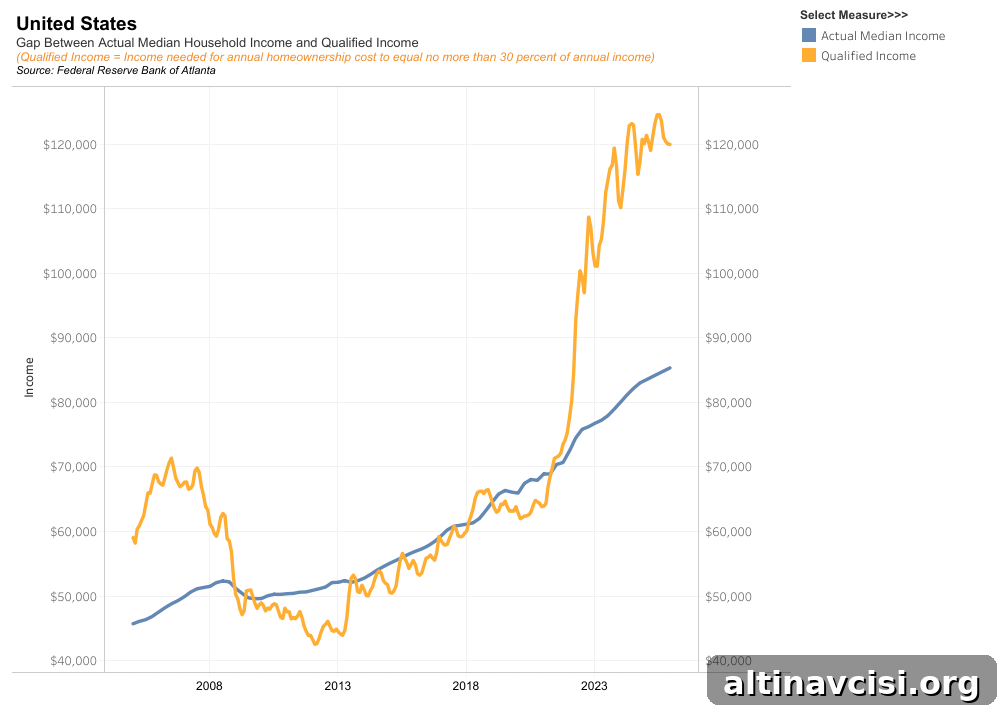
The chart illustrates why affordability is strained. “Qualified income” is the earnings level required to cap housing costs — mortgage, taxes and insurance — at or below 30% of annual income, a conventional affordability benchmark. Since 2020, the income necessary to qualify has surged while median household income has barely kept pace.
Although mortgage rates have softened recently, home prices remain elevated and borrowing costs are still well above pre-pandemic norms. For many families the math simply doesn’t add up.
Housing is the largest expense for most households. When the gap between wages and ownership costs widens this much, no single jobs report or GDP print meaningfully changes how people feel about their finances.
There is, however, a small bright spot in the near term.
The Edge Every Investor NeedsSmarter precious metals investing starts here. The Nuggets Newsletter brings essential market insights, Fed updates, global trends, educational videos, and concise analysis to help you stay informed.
When Lower Rates Raise Bigger Questions
U.S. mortgage rates have fallen to their lowest levels in months, offering modest relief to a housing market that has been largely stagnant. The average 30-year mortgage eased to 6.09% for the week ended Feb. 20, while five-year adjustable rates dipped to 5.23%, the lowest since September 2022.
This decline follows a pullback in Treasury yields as markets increasingly price in potential Federal Reserve cuts later in the year. Cheaper borrowing could revive buyer demand heading into spring, but affordability remains stretched: home prices are still high and inventory limited. Rate relief by itself is unlikely to resolve those structural shortages.
There is a subtle but important distinction: rates can fall because inflation is contained, or because growth is slowing. When the latter drives yields lower, investors may interpret the move as a signal of rising economic risk, prompting capital to seek safer assets.
Households watch every percentage point in mortgage costs, while markets respond to a wider set of macro and geopolitical risks.
Recession Warning Signal Flashes for 13th Straight Month
Consumer sentiment shows a small improvement, but underlying concerns persist. The Conference Board’s consumer confidence index rose to 91.2 in February after a sharp drop in January, yet the expectations subindex — which gauges short-term outlook for income, jobs and business conditions — has remained below 80 for 13 consecutive months. Historically, that persistent weakness has signaled heightened recession risk.
Survey respondents consistently cite prices and the rising cost of goods as their chief worries. Spending plans for 2026 skew toward essentials and modest discretionary items rather than big-ticket purchases, reinforcing a cautious household stance.
A modest headline improvement does little to ease the deeper uncertainty.
While Nobody Was Watching, Silver Climbed 25%
Amid political noise and trade headlines, silver has staged a notable run. After falling to roughly $70/oz on February 5, silver has risen more than 25%, moving back above $90/oz. Gold has also advanced, supporting a broader rally in precious metals.
Markets are already sensitive to slowing global growth and persistent inflation. Any escalation in trade tensions or geopolitical uncertainty can drive renewed safe-haven demand. With equities volatile and bond yields fluctuating, precious metals have found support from a softer dollar and rising risk aversion.
Traders are also revising expectations for the timing and size of Federal Reserve cuts. When policy uncertainty rises, defensive assets tend to attract capital — a dynamic visible in recent metal price moves.
You May Also Like
- Gold Up 21%, Silver 25% YTD as AI and Inflation Risks Build
- Gold Hits $5,000. Is This the Next Leg Higher?
- Gold Support Levels Firm as Washington Backs Minerals
- Gold Slips Below $5K as Jobs Revisions Rattle Markets
- Gold Near $5,000 as Fed Faces Sticky Inflation