Daily News Nuggets | Today’s top stories for gold and silver investors
September 23rd, 2025
Metals Update: Gold Nears $3,800, Silver Nears $45
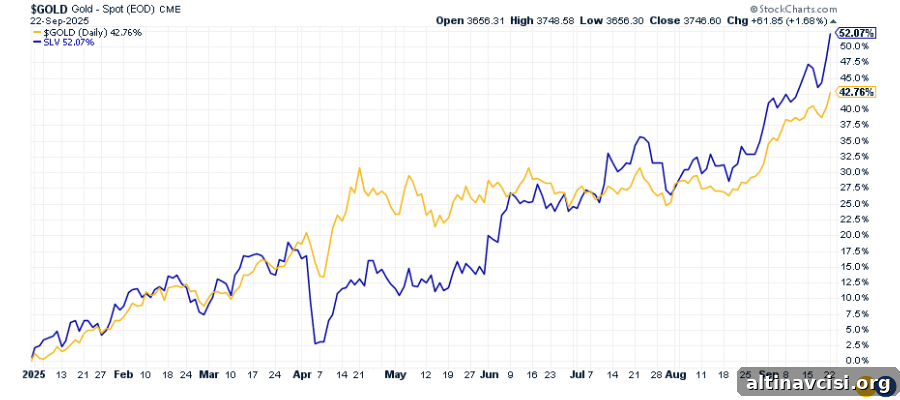
Gold climbed to as high as $3,791.10 an ounce on Tuesday — marking the third consecutive trading day at or near record levels — and is up more than 42% year-to-date in 2025. Silver has outpaced gold this year with gains near 52%, trading around $44.39 an ounce. After last year’s strong rally, few expected another surge of this magnitude, yet 2025 has already surpassed those gains.
Investors are buying gold and silver as the U.S. dollar weakens, inflation remains above target in many regions, and global growth shows signs of slowing. What some labeled an “outlier year” now appears to be the start of a sustained period in which precious metals reclaim their role as a reliable store of value.
US Dollar Down 10% Since Trump Took Office
The U.S. Dollar Index has fallen from above 110 in January to around 97.3 today — an 11–12% decline and the sharpest drop in more than half a century, effectively ending the long-running dollar bull market. Several major banks and strategists expect further weakness, with some forecasting an additional decline into 2026.
This shift in the currency can be easy to overlook while equities continue to hit new nominal highs. Rising stock prices do not negate the fact that the dollar’s purchasing power is eroding. That disconnect can foster complacency among investors. A weaker dollar typically increases demand for gold and silver worldwide, making those metals more attractive as stores of value when fiat currencies lose ground.
OECD Projects Three More Fed Rate Cuts as Growth Slows
The Organization for Economic Co-operation and Development (OECD) expects the Federal Reserve to cut interest rates three more times, potentially bringing the policy rate down to the 3.25%–3.50% range by spring 2026. The projection reflects slower U.S. growth—near 1.8% this year—and inflation that remains slightly above target at around 2.7%.
Lower interest rates reduce the opportunity cost of holding non-yielding assets such as gold and silver. When returns on bonds and savings accounts fall, precious metals become comparatively more appealing. Combined with a softer dollar, this creates a favorable environment that can sustain upward pressure on metal prices.
China Pushes for Gold Hub Status
The People’s Bank of China is using the Shanghai Gold Exchange to encourage central banks from allied nations to buy and hold bullion in China, positioning the country as a regional gold hub. While this strategy will not displace the dollar immediately, it signals growing interest in diversifying reserves away from dollar-denominated assets.
If more central banks choose to store a portion of their reserves in gold within China’s system, demand for physical bullion could increase. That structural shift would support global prices while reflecting a broader effort by some nations to reduce dependence on traditional Western financial infrastructure.
Australian Gold Miners Rally as Bullion Breaks Records
Shares of Australian gold miners rose as bullion prices hit fresh records, helping to lift the ASX-200 and boosting sentiment in the mining sector. Years of high costs and tighter regulations are giving way to expanding margins for some producers as metal prices climb.
Mining stocks can amplify gold’s moves, offering the potential for outsized returns when operations and markets align. However, miners also carry operational and regulatory risks: equipment failures, rising energy costs, environmental obligations, or management missteps can quickly erode profitability. For many investors seeking direct exposure to the metals themselves, holding physical gold and silver remains the most straightforward and reliable approach.