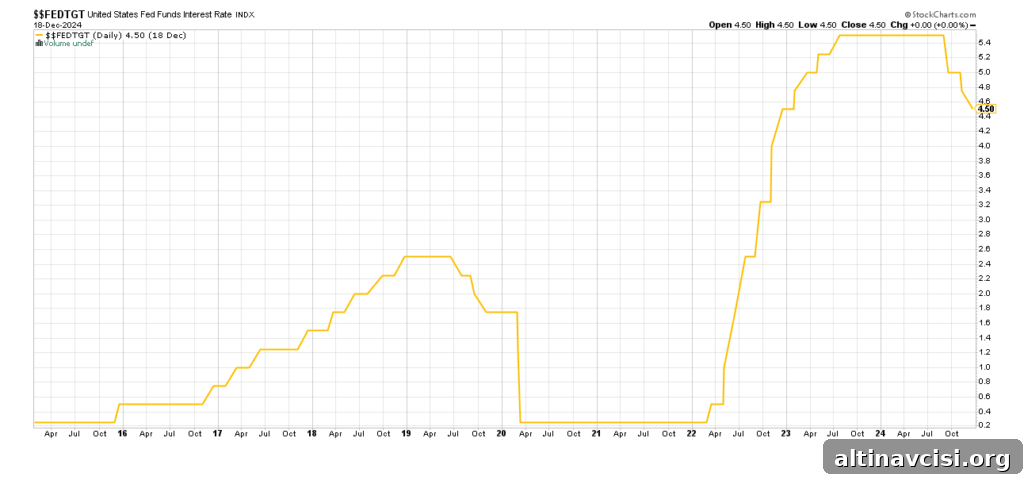
The Federal Reserve’s first policy meeting of 2025 takes place at an important moment for financial markets. The S&P 500 is trading at record levels, and investors are closely watching for any clues about the timing and pace of future rate cuts. After last December’s meeting tempered expectations for easy policy, better-than-expected inflation readings helped spark a rally: the S&P 500 climbed roughly 4% in January as markets reassessed the path of monetary policy.
Most economists and strategists expect the Fed to pause and keep the federal funds rate in the 4.25%–4.5% range at this session. Still, the market’s attention is squarely on the signals that could reopen the door to rate reductions later in the year. Futures markets are currently pricing in about two cuts by year-end, a view that would require sustained signs of cooling inflation and softening labor market pressures. Policymakers’ public commentary, the Fed’s updated economic projections, and the post-meeting statement will all be scrutinized for any shifts in the committee’s reaction function.
This meeting also arrives against a changed political backdrop. The return of Donald Trump to the presidency has added a new variable to the Fed’s decision calculus. His public calls for immediate rate cuts and talk of trade measures such as tariffs could affect inflation pressures and the broader economic outlook. While the Federal Reserve operates independently, any fiscal or trade policy changes proposed or implemented by the administration can influence supply chains, import prices, and demand — all of which factor into the Fed’s assessment of inflation and the appropriate policy stance.
Beyond policy pronouncements and macro data, markets will absorb a heavy corporate news calendar. Several large technology firms — including Apple, Microsoft, Meta, and Tesla — are set to report quarterly results in the coming weeks. These companies, often lumped together as the “Magnificent Seven,” currently trade at premium valuations relative to the broader market. Their earnings and guidance will be pivotal for market sentiment because positive surprises could extend the equity rally, while disappointing results could prompt a re-pricing of growth expectations and valuation multiples.
Investors are parsing multiple cross-currents. On one hand, easing inflation and gradual improvement in certain economic indicators could justify a path toward rate cuts, supporting risk assets. On the other, resilient consumer spending or unexpected inflationary pressures would keep monetary policy restrictive for longer, potentially weighing on equities. The composition of market gains also matters: concentration among a few megacap technology names raises concerns about breadth and the durability of the rally. If the leadership narrows further, the overall market may become more vulnerable to idiosyncratic shocks tied to those companies.
The Fed’s public communications will be central to how markets interpret near-term prospects. Officials’ language around the likelihood, timing, and conditionality of rate cuts will be parsed for subtle shifts. Investors will also watch incoming data releases — employment, consumer prices, and manufacturing indicators — that could confirm or contradict the Fed’s outlook. Any notable divergence between Fed guidance and data trends could spark volatility as market expectations adjust.
In addition to macro and corporate drivers, geopolitical developments and fiscal policy proposals are on the radar. Trade policy changes or fiscal initiatives that affect demand or production costs can alter inflation dynamics and thereby influence Fed decision-making. The interplay between monetary policy, fiscal actions, and corporate earnings will determine whether market optimism is sustained or requires reassessment.
For portfolio managers and individual investors, the immediate implication is to remain attentive to the Fed’s message, upcoming economic reports, and major earnings announcements. Diversification and risk management can help navigate periods when policy uncertainty and earnings season overlap. Market participants should also be prepared for scenarios in which the expected two rate cuts are delayed or accelerated, and for the potential market impact if the “Magnificent Seven” produce mixed or underwhelming results.
As the Fed convenes, markets will test the resilience of recent gains and reevaluate expectations for monetary easing. The combination of policy decisions, macro data, corporate earnings, and political developments will shape the trajectory of markets through the rest of 2025.