Gold has been regarded as a safe haven for thousands of years.
But how effective is it as a true hedge?
A hedge is an asset that tends to gain when other holdings decline. For example, an investor holding common stocks might also keep some gold because historically it has shown strength during severe stock market drops.
But on balance, does it make sense to maintain a permanent allocation to gold in a portfolio?
History provides clear insight. We analyzed several historical scenarios to compare the performance of theoretical portfolios with different gold allocations, including none.
The Portfolios
The base portfolio is a conventional 60% stocks / 40% bonds mix. Stocks are represented by the S&P 500 and bonds by the 10-year Treasury. As gold was added to the allocation, the prevailing spot price was used.
The analysis covers January 1999 through September 2019—almost 21 years—capturing multiple bull and bear markets across asset classes to evaluate gold’s behavior in varied market environments.
We modeled four portfolios, each beginning with $100,000. As gold was introduced, allocations to stocks and bonds were reduced by equal proportional amounts.
- Zero Gold Portfolio (60% stocks / 40% bonds)
- 3% Gold Portfolio (3% gold / 58.5% stocks / 38.5% bonds)
- 5% Gold Portfolio (5% gold / 57.5% stocks / 37.5% bonds)
- 10% Gold Portfolio (10% gold / 55% stocks / 35% bonds)
No adjustments were made for inflation, and the results exclude commissions, dividends, and tax implications.
The Results
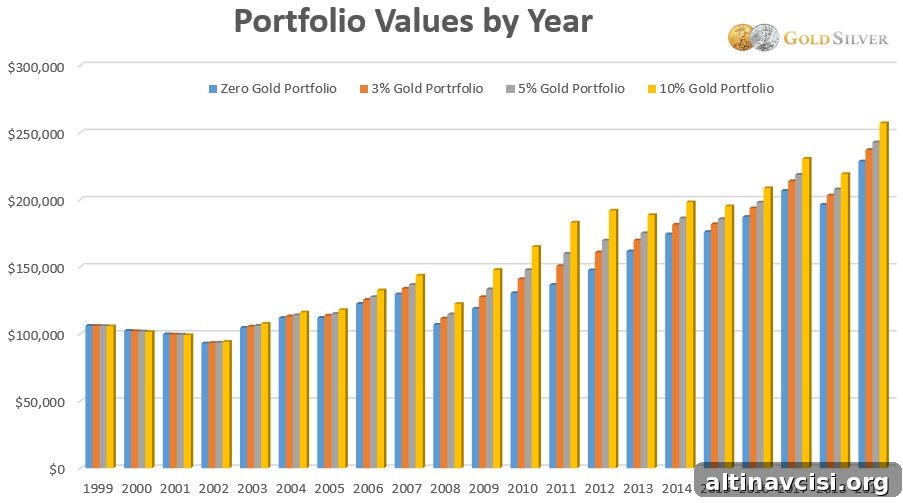
The first chart (not shown here) tracked each portfolio’s year-end value. The blue bar represented the zero-gold portfolio, while the gold-colored bar represented the portfolio with the 10% gold allocation.
Overall, portfolio values increased as the gold allocation rose. Over the two-decade span, the portfolio with a 10% gold allocation outperformed those with smaller gold weights.
After roughly 20 years, only the 10% gold portfolio surpassed $250,000. This outcome is consistent with gold’s historical role as a hedge during stock market drawdowns and recessions, while also participating in price advances during certain bull cycles.
Annual performance showed that while all portfolios typically moved together, portfolios containing gold tended to suffer smaller losses during bear markets and deliver stronger gains during many bull markets.
Exceptions occurred from 2013 through 2015, when portfolios with gold underperformed the no-gold portfolio (differences in 1999 and 2000 were minimal, under 1%). Outside of that window, adding gold improved returns in most years.
On a cumulative basis, portfolios that included gold outperformed those with little or no gold.
Early in the analysis period the statistical differences were small, but over time the advantage of holding gold became more apparent: allocations that included gold achieved higher long-term returns relative to comparable portfolios with little or no gold.
The Verdict
The analysis indicates that adding a measured allocation to gold within a typical stock/bond portfolio has historically delivered better returns than portfolios without gold, while also reducing downside risk.
Portfolios that include gold tended to decline less in market downturns and recover more strongly in many up markets. Over the long term, including gold enhanced portfolio value.
It is important to note that this research examines gold specifically—not broad “commodities.” Most commodity funds have limited exposure to gold, so one should not expect identical results from mixed-commodity allocations.
The Gold Advantage is Your Advantage
Historical evidence shows that adding gold to a diversified portfolio can improve overall performance.
Gold can:
- Hedge against systemic risk, stock market pullbacks, and recessions.
- Lower portfolio risk by reducing drawdowns.
- Provide liquidity to meet obligations during periods of market stress.
- Serve as a tangible asset that hedges many forms of paper-based financial exposure.
History’s message is straightforward: a sensible exposure to gold can enhance portfolio outcomes without introducing unproven or speculative claims.