
Gold and silver market update — May 5, 2026
Key Takeaways
- May 8 Nonfarm Payrolls consensus is 49,000 — a steep drop from March’s 178,000. The size of that gap matters.
- Weak jobs alongside sticky inflation would confirm stagflation and is the most powerful near-term bullish catalyst for gold.
- Structural drivers — roughly $1 trillion in annual debt interest, 3.5% PCE inflation, and a divided Fed — remain unchanged by one data release.
On Thursday at 8:30 a.m. ET the US labor market will deliver a high-profile update. Economists’ consensus is for roughly 49,000 new jobs, less than one-third of the prior month’s 178,000. That gap is the story. Paired with manufacturing inflation near four-year highs, this jobs report could be one of the most consequential for gold in years. Not because a single number rewrites the long-term case, but because it will show whether the stagflation signal seen in manufacturing has spread across the broader economy.
Gold is trading near $4,560. The Personal Consumption Expenditures (PCE) price index sits around 3.5%. The Federal Open Market Committee (FOMC) recently recorded its most divided vote since 1992. The Fed faces limited and uncomfortable choices. Below, three plausible outcomes are laid out so you can anticipate the likely market reaction before volatility arrives.
Why Does the May 8 Jobs Report Matter So Much for Gold?
Last week’s Institute for Supply Management (ISM) manufacturing report showed the Prices Paid index at 84.6 — the highest reading since April 2022 and the largest three-month jump in the index’s history. At the same time the ISM employment sub-index fell to 46.4, a 2026 low. Higher prices and falling employment is the textbook definition of stagflation.
Gold initially fell about 0.63% when that ISM data hit, suggesting markets have not fully priced in a broad stagflation outcome because the signal was still confined to manufacturing, which represents roughly 11% of the US economy. Thursday’s payrolls release will indicate whether the same dynamics are present across the remaining 89% of the economy.
The Edge Every Investor Needs
Smarter precious metals investing starts here. The Nuggets Newsletter brings essential market insights, Fed updates, global trends, educational videos, and timely analysis.
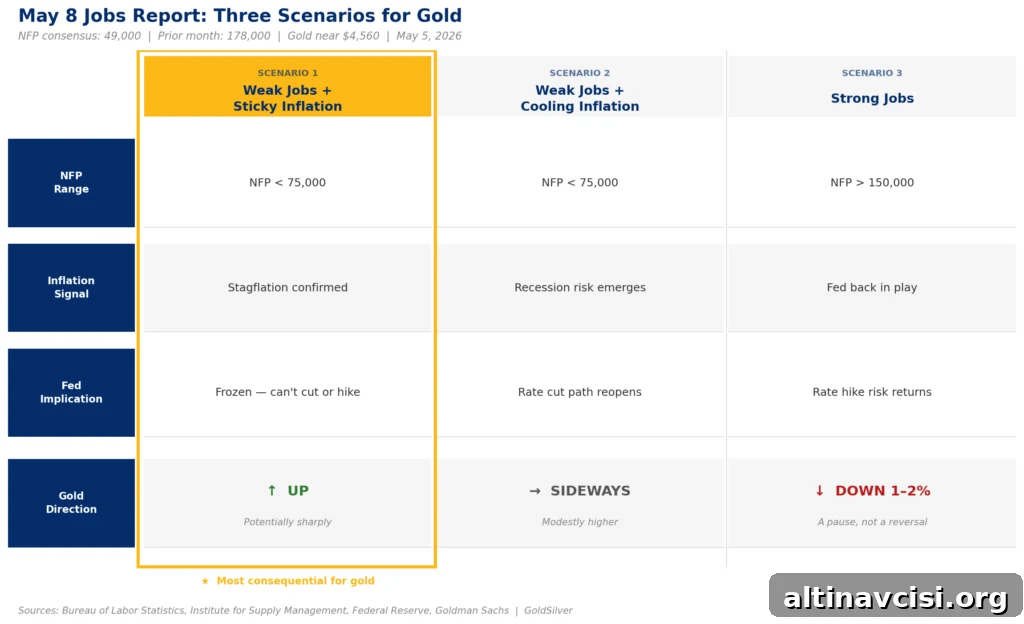
What Happens to Gold If Jobs Are Weak and Inflation Stays Sticky?
The Scenario: Nonfarm payrolls print below 75,000, the unemployment rate rises, and average hourly earnings remain elevated.
What it means for gold: The Federal Reserve is boxed in. With PCE near 3.5% it cannot credibly cut rates, but with employment weakening it cannot continue to tighten. That stalemate keeps real yields suppressed and erodes the purchasing power of cash and savings. Investment banks, including Goldman Sachs, have outlined a scenario where gold reaches $5,400 by year-end under these conditions, arguing fiscal constraints limit Fed flexibility. A broad stagflation print would make that projection more believable to the wider market.
History offers perspective. The last time ISM Prices Paid topped 80 while the employment index fell below 48 was in mid-2022. Back then gold initially dipped amid Fed tightening, but rose more than 20% over the next year as real yields peaked and then fell. Today the Fed’s room to maneuver is smaller — annual interest on federal debt already approaches $1 trillion.
Gold’s direction: Up — potentially sharply if payrolls come in well below consensus.
What Happens to Gold If Jobs Are Weak but Inflation Starts Cooling?
The Scenario: NFP below 75,000, but wage growth slows and inflation expectations ease.
What it means for gold: Conflicting forces would likely produce a muted market response. A weaker economy increases safe-haven demand for gold, while cooler inflation reduces pressure from monetary debasement narratives. The two factors can largely offset each other. Silver, which depends more on industrial demand, would likely face greater downside risk in this environment.
Gold’s direction: Sideways to modestly higher. A softer US Dollar Index (DXY) driven by recession fears would be an additional tailwind.
What Happens to Gold If the Jobs Report Comes In Strong?
The Scenario: NFP above 150,000, with unemployment steady or falling.
What it means for gold: A strong payrolls print would hand momentum back to FOMC hawks and revive rate-hike expectations. Real yields would likely rise, creating headwinds for gold.
This is the clearest short-term bearish case: a robust jobs number could push gold down roughly 1–2% on the initial reaction. That said, a single report won’t undo structural pressures like high federal debt service, elevated PCE inflation, or a deeply divided Fed. It would be a pause rather than a long-term reversal.
Gold’s direction: Down 1–2% on the initial reaction; the long-term thesis would remain intact.
What Else Should You Watch on Thursday Morning?
The headline payrolls number moves markets immediately, but the details often matter more. Watch three items closely:
Average hourly earnings. Elevated wages alongside weak hiring are the clearest stagflation signal. If wages hold up while payrolls disappoint, the Fed’s dilemma intensifies.
The unemployment rate. March 2026’s unemployment rate was 4.4%. A higher reading would indicate faster deterioration in the labor market than the headline can show.
Prior-month revisions. March’s 178,000 could be revised lower. A sharp downward revision would suggest the slowdown began earlier and that policymakers are further behind the curve.
Also note the ISM Services PMI releasing today, May 5. If Services Prices Paid climbs toward manufacturing’s reading, stagflation would no longer be confined to factory sectors — it would be economy-wide — raising the stakes for Thursday’s labor-market release.
Does Any of This Change the Long-Term Case for Gold?
No. The structural factors that have driven gold’s roughly 34% year-over-year gain do not vanish with one data point. Annual interest on US federal debt has crossed the trillion-dollar mark, limiting the Fed’s freedom to fight inflation with rate hikes alone. The FOMC’s internal division — four dissents at the April 29 meeting — is another persistent constraint. These are multi-year pressures that shape the macro backdrop for precious metals. Thursday’s report can shift price and sentiment in the short term, but it does not dismantle the long-term thesis.
Stay On Top of Gold & Silver Prices
Get important market alerts sent straight to your inbox.
SOURCES
1. Bureau of Labor Statistics — The Employment Situation, March 2026
2. TradingEconomics — Gold Spot Price, May 5, 2026
3. CNBC — PCE Inflation Rate, March 2026
4. Federal Reserve — FOMC Press Conference Statement, April 29, 2026
5. Institute for Supply Management — Manufacturing PMI Report, April 2026
6. Bloomberg via Yahoo Finance — Goldman Sachs Raises Year-End Gold Forecast to $5,400 an Ounce
7. Federal Reserve Bank of St. Louis (FRED) — Gold Fixing Price, Historical Data
8. Congressional Budget Office — Budget and Economic Outlook, FY2026
Disclaimer: This article is for informational purposes only and does not constitute financial or investment advice. Always consult a qualified financial adviser before making investment decisions.
You May Also Like:
- The Gold-Silver Ratio Is Expanding — and Being Misread
- Gold, Silver, and Stagflation: 5 Signals That Matter Now
- Why Gold Fell on the Hormuz Tanker Strike
- WGC Q1 2026: What Asia Knows That Wall Street Doesn’t
- BEA Stripped Silver From GDP. Here’s What It Means
- PCE at 3.5%, GDP Miss: Why This Is Bullish for Gold
- How Warsh’s Inflation Measure Could Move the Gold Price
- Gold Is Down 19%. This $3.8B Bet Says It Doesn’t Matter