Gold and silver market update — May 7, 2026
Key Takeaways
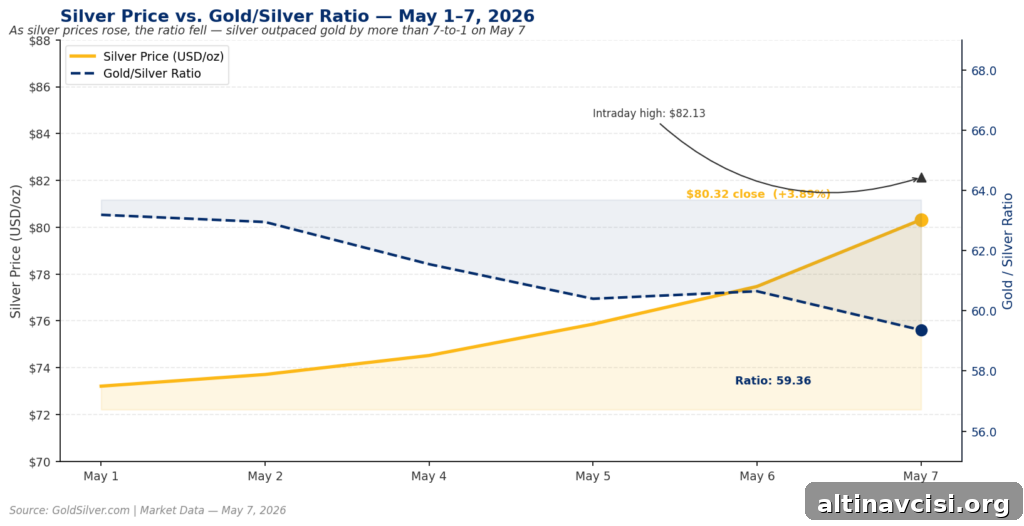
- On May 7, 2026, silver reached an intraday high of $82.13 and closed at $80.32 (+3.89%), after reports of a U.S.-Iran memorandum of understanding that sent oil prices lower, eased inflation expectations and improved the outlook for Federal Reserve rate cuts (nFusion Solutions / Trading Economics).
- The gold/silver ratio compressed to 59.36 from 60.65 as silver outperformed gold by more than 7-to-1. J.P. Morgan Global Research notes that roughly 60% of silver demand is industrial, which makes silver especially sensitive to any reopening of the Strait of Hormuz (FXStreet, May 7, 2026).
- The bear case remains relevant: Iran has not confirmed any deal; Federal Reserve Bank of Chicago President Austan Goolsbee warned inflation has accelerated since the war began; and silver is already up more than 150% year-over-year, meaning much optimism may already be priced in (Bloomberg / Fortune, May 7, 2026).
Why Did Silver Spike to $82 on May 7, 2026?
Silver’s sharp move on May 7 was driven by macro news — reports that the U.S. and Iran were close to a one-page memorandum of understanding — rather than any silver-specific development. Axios reported that the White House believes negotiators are near agreement on a 14-point MOU intended to declare an end to the war and to open a 30-day window for reopening the Strait of Hormuz and restarting nuclear talks.
Trump envoys Steve Witkoff and Jared Kushner are said to be involved in negotiations directly and through intermediaries. No formal agreement has been announced, and Iran has not publicly confirmed the report. Still, the market reacted to those peace signals: oil prices fell, which in turn sparked the silver rally as traders repriced inflation expectations and the Fed rate-cut timeline.
The Edge Every Investor Needs
Smarter precious metals investing starts here. The Nuggets Newsletter brings you essential market insights, Fed updates, global trends, educational videos, and much more.
How Does Falling Oil Push Silver and Gold Higher?
Falling oil prices affect precious metals mainly through the inflation channel. When energy costs decline on peace signals, headline inflation pressure eases. That gives the Federal Reserve more room to consider cutting interest rates, which reduces real yields — the inflation-adjusted return on safe assets. Lower real yields make non-yielding assets such as gold and silver more attractive as stores of value.
That mechanism helps explain the persistent selling pressure metals faced after the Iran war began in February 2026: high oil kept inflation elevated and extinguished expectations of near-term rate cuts. The May 7 peace signal partially reversed those conditions, but one session of lower oil does not erase months of elevated inflation.
Federal Reserve Bank of Chicago President Austan Goolsbee warned on May 6 that inflation has not moved toward the Fed’s 2% goal and has, in fact, accelerated since the conflict began. That warning underscores why sustained disinflation, not just a single drop in oil, will be needed to cement a rate-cut path and a durable move higher for precious metals.
What Is the Gold/Silver Ratio Telling Investors Right Now?
The gold/silver ratio shows how many ounces of silver are needed to buy one ounce of gold. On May 7, 2026, the ratio fell to 59.36 from 60.65 the prior session, according to FXStreet. That compression signals the market is pricing in both a path toward Fed rate cuts and an improvement in industrial demand for silver.
Silver combines monetary and industrial demand in a way gold does not. J.P. Morgan’s 2026 outlook estimated roughly 60% of silver demand stems from industrial uses — solar panels, electronics and electric vehicle components — with the remainder driven by investment. When peace prospects improve both inflation and industrial activity expectations, silver tends to amplify gold’s move in both speed and magnitude. J.P. Morgan’s full-year silver target of $81 per ounce for 2026 sits near the levels seen on May 7, so confirmation of a deal could push prices further.
Does the Bear Case for Silver Still Hold After Today’s Rally?
Yes. Both short-term and structural bear arguments remain meaningful, though they operate on different timelines. Near term, the reported MOU has not been confirmed by Iran, and the Fed’s recent commentary on persistent or rising inflation undercuts a clear rate-cut narrative. Silver already sits well above year-ago levels, meaning a lot of optimism is priced in; if the deal falls apart, the inflation-relief trade would likely reverse quickly.
On a longer horizon, structural forces persist regardless of a peace agreement. The U.S. faces large borrowing needs in 2026, putting pressure on yields and fiscal policy. The Fed is managing a challenging environment where both inflation and growth concerns complicate policy. Leadership transitions at the Fed — with Jerome Powell in place through May 15 and Fed Chair nominee Kevin Warsh awaiting a full Senate vote the week of May 11 — add further uncertainty.
A confirmed deal would strengthen silver’s industrial demand outlook. No deal would reinforce silver’s role as a monetary hedge. Because silver sits at the intersection of both industrial and store-of-value demand, it can justify a long-term allocation as protection against either outcome rather than a purely speculative trade.
Stay On Top of Gold & Silver Prices
Get important market alerts sent straight to your inbox.
SOURCES
1. Trading Economics — Silver Price, Chart, Historical Data & News
2. nFusion Solutions — Precious Metals Spot Price API
3. FXStreet — Silver Price Today: Silver Rises on May 7, 2026
4. Axios — U.S. and Iran Closing in on One-Page Memo to End War, Officials Say
5. Bloomberg — Fed’s Goolsbee Sounds Warning on Inflation, Consumer Behavior
6. FXStreet — Fed’s Goolsbee: US‑Iran Conflict Is an Inflationary Shock
7. J.P. Morgan Global Research — How Will Silver Prices Fare in 2026?
8. Macrotrends — Gold to Silver Ratio: 100 Year Historical Chart
9. Fortune — Current Price of Silver, May 7, 2026
10. Fortune — Treasury Expected to Borrow $2 Trillion This Year to Continue Functioning
11. CNBC — Trump Fed Pick Kevin Warsh Clears Key Senate Hurdle, Teeing Up Final Vote
Disclaimer: This article is for informational purposes only and does not constitute financial or investment advice. Always consult a qualified financial adviser before making investment decisions.
You May Also Like:
- Gold Hits $4,746 as Oil Crashes. Here’s Why That’s Bullish
- Gold Price and Nonfarm Payrolls: Why the Fed Is Trapped
- Gold Is Decoupling From Geopolitics. Here’s the Proof
- The Fed Is Frozen. The Debt Is Growing. Gold Is Watching.
- Gold Jumps on Iran Deal Hopes. The Real Driver Is the Fed
- What the IMF’s Inflation Forecast Shift Means for Gold
- What’s Really Driving Gold Prices Today — 5 Key Signals
- Gold Price and the Jobs Report: A Pre-Market Guide