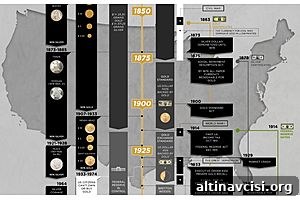
Have you ever wondered how the United States ended up with the fiat monetary system it uses today? Throughout much of American history, the nation relied on money backed by gold or silver far more often than not.
Inspired in part by a reader’s suggestion, we created a visual timeline that traces the evolution of money in the U.S. The pattern is clear: each major monetary shift progressively weakened the link between currency and precious metals. The nation began with currency fully backed by gold, but over time political decisions and economic policies eroded that backing until it reached zero. The result is a currency that can be created without limit and therefore susceptible to loss of purchasing power.
Many analysts argue that the global monetary system is overdue for a significant reset, one that could produce broad economic upheaval. As you follow the historical timeline, a central question emerges: which form of money would you prefer to hold — fiat paper currency, or physical gold and silver?
The timeline highlights key moments when government action altered the monetary standard, from early coinage and bimetallism to the gradual abandonment of specie redemption and the eventual transition to an entirely fiat-based currency. At each step, the practical effect was the same: the money supply became easier to expand, while direct links to tangible stores of value were reduced or removed.
Holding physical precious metals differs fundamentally from holding fiat. Gold and silver have historically preserved purchasing power over long periods, whereas paper currencies can lose value through inflation when supply increases faster than demand. This distinction is central to debates about savings, investment, and monetary policy.
Understanding the history of money in the United States helps clarify why some investors and savers prefer tangible assets. It also sheds light on recurring policy choices: during times of crisis or political pressure, there’s often an incentive to increase currency supply to finance spending, which weakens metal backing or severs it entirely. Conversely, systems tied to gold or silver limit how rapidly a country can expand its money supply, which constrains some policy options but can anchor long-term price stability.
As you consider monetary history, it’s useful to weigh the trade-offs. Fiat money offers flexibility for fiscal and monetary policy, which can be valuable in responding to recessions or financial stress. Physical gold and silver offer a hedge against currency debasement and can act as a store of value when confidence in paper money wanes.
Ultimately, the choice between fiat currency and precious metals depends on your priorities: whether you value the policy flexibility of a fiat system or the long-term purchasing-power preservation associated with tangible assets. The historical record shows that shifts in monetary policy have lasting consequences, so informed decisions about money and savings benefit from a clear view of that history.