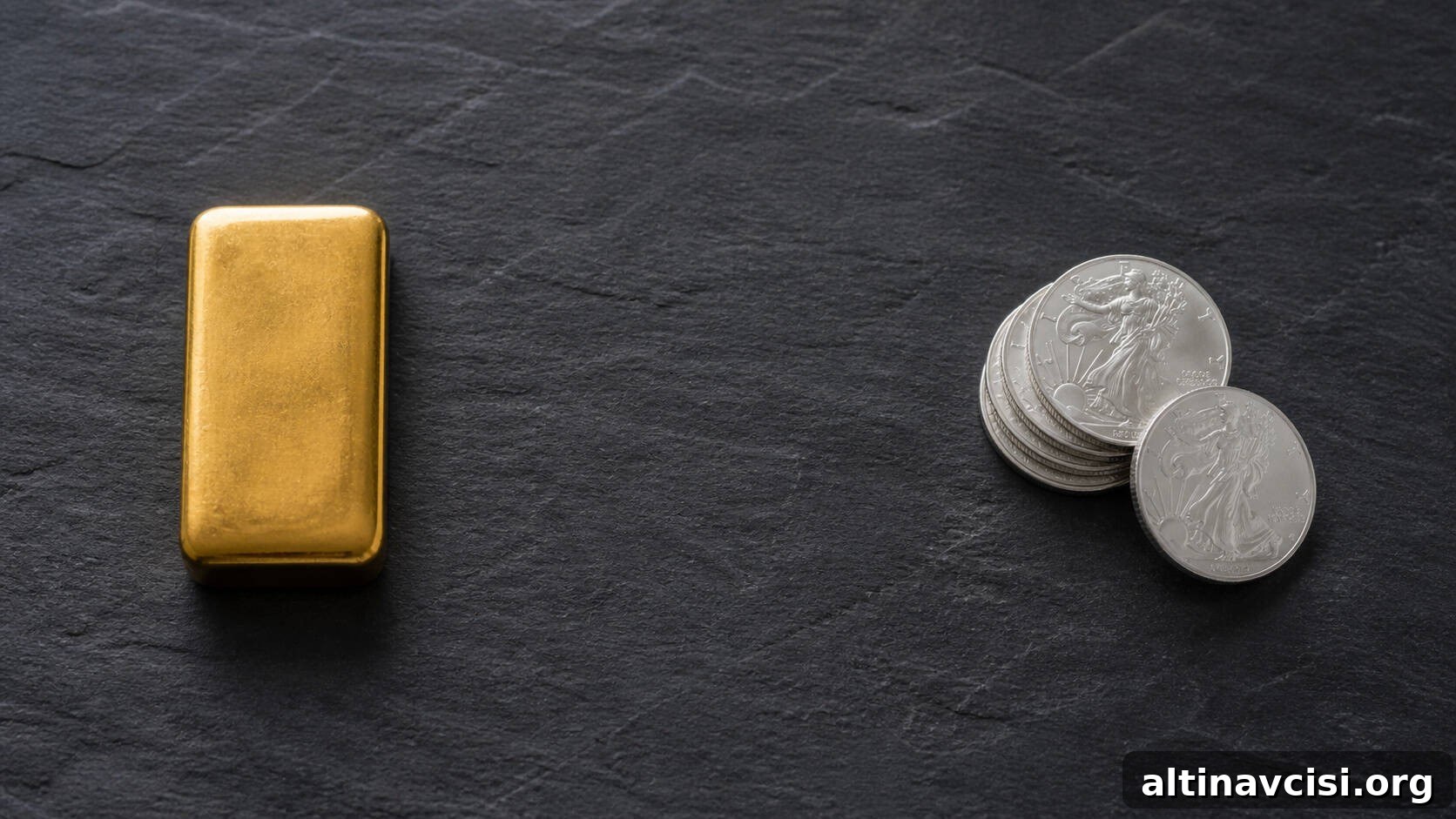
Gold and silver are distinct investments with different roles. Gold stabilizes a portfolio—historically showing low or negative correlation to equities and holding value during market stress. Silver behaves like a high-beta asset—more than half of its demand is industrial, which makes it more volatile and sensitive to economic cycles. When used together with clearly defined roles, they complement each other: gold as the anchor, silver as the growth-oriented complement.
Both metals appear on the same dealer shelf and on brokerage statements under “precious metals,” but they do not act the same in a portfolio. Treating them as interchangeable is a common mistake.
Gold stabilizes. Silver amplifies. Recognizing this distinction can change how you build and protect wealth.
Are You Asking the Right Question?
Many investors ask, “Should I buy gold or silver?” That framing misses the point. A better question is: “What role do I need this metal to perform right now?”
Gold and silver differ in demand composition, market depth, and behavior during economic stress. Once you grasp those differences, allocation becomes strategic rather than arbitrary.
Your Gold Buying Guide Most investors overpay when buying gold—and again when selling. This guide explains what to own and why.
Why Does Gold Stabilize a Portfolio?
Gold’s stabilizing effect comes from the diversity of its demand.
It serves as jewelry, an industrial input in technology, an investment asset (ETFs, bars, coins), and a reserve held by central banks. That mix prevents any single force from dominating price action. When investment demand weakens, central bank purchases and consumer demand often offset the decline.
Because of that broad demand, gold behaves more like a financial asset than a pure commodity. It reacts to interest rates, currency strength, and credit conditions—the same macro factors that influence bonds and currencies. Historically, gold often moves differently from equities, and during sharp market drawdowns its negative correlation to stocks makes it an effective hedge.
The practical results are lower volatility, deeper liquidity, and more consistent behavior across cycles. Gold is the metal to hold when you want stability as other assets fluctuate.
Why Does Silver Amplify Market Moves?
Silver has a very different profile. Industrial uses—electronics, solar panels, medical devices, and other green-energy applications—represent a large portion of demand. That makes silver strongly pro-cyclical.
When economic activity expands, industrial output rises and silver demand and prices typically follow. In contractions, silver often falls more sharply than gold. This pro-cyclical nature, combined with a smaller market and shallower liquidity, gives silver higher volatility—sometimes roughly twice that of gold—and wider intraday bid-ask spreads.
Silver can offer significant upside in bull markets, but that upside comes with steeper drawdowns, higher transaction costs, and greater sensitivity to commodity fund flows. In short: silver amplifies moves in both directions.
Does the Supply Picture Change the Calculation?
Yes—and it reinforces the behavioral differences.
Gold: Stable Supply with a Built-In Buffer
Gold is largely mined as a primary product across multiple regions, and recycling contributes a meaningful portion of annual supply. Recycling tends to increase when prices rise, providing a natural buffer when primary production slows.
Silver: Concentrated, Dependent, and Harder to Forecast
A large share of silver supply is produced as a by-product of copper, lead, and zinc mining. A handful of countries account for a significant portion of mine output, so disruptions in base-metal sectors can tighten silver supply irrespective of silver’s own price signals. Recycling rates for silver are lower because much of it is embedded in electronics and industrial components, where recovery is often uneconomical.
These dynamics make silver’s physical market tighter and its supply harder to predict.
How Should Gold and Silver Fit in a Portfolio?
They play different, complementary roles, and both have value when used with purpose.
Gold is a strategic, long-term holding aimed at stability, crisis protection, and wealth preservation. Its low correlation to equities offers diversification that tends to show up when markets fall, not just on models.
Silver is a tactical, growth-oriented addition for investors seeking exposure to industrial demand and willing to accept higher volatility. Because silver is substantially more volatile, positions should generally be smaller than gold positions to maintain balanced portfolio risk.
Used together, gold anchors the portfolio while silver provides upside potential. Each should be assigned a clear job rather than treated as substitutes.
Stay On Top of Gold & Silver Prices
Get important market alerts sent straight to your inbox.
People Also Ask
Why does gold stabilize a portfolio during market downturns?
Gold’s negative correlation to equities during sharp drawdowns, and its broad demand across investment, jewelry, and central bank reserves, mean no single economic factor dominates its price. That breadth makes it a reliable hedge when stocks fall.
Is silver a good substitute for gold in a portfolio?
No. Silver’s heavy industrial demand makes it behave more like a cyclical commodity than a safe-haven asset. It tends to amplify market moves rather than offset them, the opposite of what a crisis hedge should do.
Why is silver more volatile than gold?
Silver has a smaller market, a demand base tied to economic cycles, and a by-product supply structure that doesn’t respond directly to silver prices. Its intraday spreads and historical price swings are wider than gold’s, contributing to higher volatility.
Should I hold both gold and silver in my portfolio?
Yes—if you assign distinct roles. Gold should serve as the stable foundation; silver can be a higher-beta complement. Because silver is roughly more volatile, its allocation is typically smaller to avoid outsized portfolio risk.
What drives the gold-to-silver ratio?
The ratio reflects differences in industrial demand, liquidity, and investor sentiment. It can swing widely depending on market conditions, illustrating how differently the two metals can respond to the same environment.
Knowing the Difference Is Half the Battle
Many investors lose money not because they chose the wrong metal, but because they expected the wrong outcome—buying silver hoping it would behave like a crisis hedge, or buying gold expecting it to deliver large gains in a short bull run.
Think of gold as your anchor and silver as your accelerator. Neither is superior in every situation—both are most effective when they have clearly defined roles.
Disclaimer: This article is for informational and educational purposes only and does not constitute investment advice. Consult a qualified financial adviser before making investment decisions.
SOURCES
1. World Gold Council — research on gold and its role as a stable asset.
2. Silver Institute — World Silver Survey and data on silver demand and supply.
3. World Gold Council — gold demand trends and recycling data.
You may also like:
- COMEX Silver Coverage Ratio: Is Your Paper Silver Real?
- What the Gold Price Per Ounce Really Tells You
- The Gold Inflation Paradox Most Investors Miss
- Insurance vs. Upside: Balancing Your Portfolio with Gold and Silver
- Gold Bullion vs. Jewelry: Why Serious Investors Choose the Bar
- Gold & Silver IRA: Why Starting Early Costs You Less
- Silver Fair Value: What the Data and History Show
- Gold or Silver Price Dip: Temporary Correction or Trend Reversal?