
ADP reported 122,000 private‑sector jobs added in May this morning — the strongest reading since January 2025, according to ADP Research. Gold is trading near $4,450 at the open. Friday’s official US nonfarm payrolls (NFP) report arrives at 8:30 a.m. Eastern. On June 16–17, Kevin Warsh will chair his first Federal Reserve meeting.
Before markets react, and before commentary heats up, here’s a concise framework to think about the week ahead.
Key Takeaways
- Friday’s NFP sets the tone for Warsh’s first FOMC meeting on June 16–17. Three plausible outcomes: a hot print pressures gold $30–$50 short‑term; a consensus print produces only noise; a weak print reopens the path to $4,600 as rate‑cut odds return.
- The Fed is structurally constrained. Inflation is running around 3.8%, too high to justify cuts, while growth is too fragile to support hikes. That paralysis has defined gold’s trading range in recent weeks.
- Watch gold’s $4,400 floor on any hot‑print selloff. If it holds, structural demand is absorbing rate‑sensitive selling — a more important signal than the jobs number itself.
Why Does This Week’s Jobs Number Matter More Than Usual?
Typically, a single payroll report nudges gold by $15–$30, clearing out leveraged positions and fading within a couple of days. This Friday is different because three forces converge at once.
First, the Fed is in transition. Kevin Warsh is new as Fed chair, and the April 29 FOMC showed an unusually divided committee — an 8–4 vote with multiple dissents. Warsh inherits a less unified policy committee.
Second, inflation remains elevated. The US annual inflation rate reached about 3.8% in April 2026, driven largely by energy costs after disruptions to oil flows, which complicates the Fed’s decision calculus.
Third, upstream price pressures are persistent. The ISM Manufacturing prices paid index was 82.1 in May, near multi‑year highs and signaling continued raw materials cost inflation. That tells the Fed that inflationary pressures have not clearly broken.
Given these conditions, markets currently price a very high probability that the Fed will hold in June. What Friday’s NFP will change is the Fed’s forward language and which aspect of the “trap” markets focus on.
In short: Friday’s NFP won’t resolve the structural policy dilemma, but it will determine which version of that dilemma markets react to.
What Happens to Gold in Each NFP Scenario?
There are three realistic scenarios, each with a distinct short‑term gold trajectory: a hot print that pressures gold, a consensus print that produces noise, and a weak print that pushes gold higher.
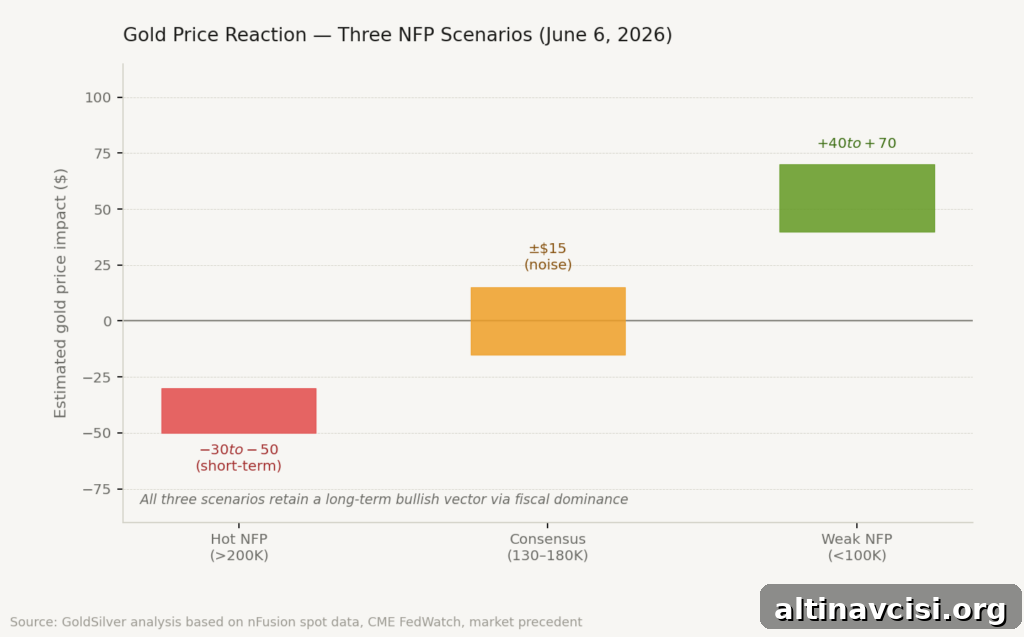
Scenario one: Hot NFP above 200,000 jobs
A print above 200,000 would confirm a surprisingly tight labor market. Markets would price a higher chance of additional rate hikes, pushing the 10‑year Treasury yield through 4.6% and lifting real yields further. The dollar would strengthen and gold could sell off $30–$50 intraday as rate‑sensitive holders reduce exposure.
However, structural buyers — including central banks and long‑term sound‑money investors — are likely to absorb much of the dip. The long‑term case for gold does not disappear because of one hotter report.
Scenario two: Consensus NFP, 100,000–115,000 jobs
A consensus print would reflect the “low‑hire, low‑fire” dynamic the Fed has described. It would neither confirm recession fears nor signal overheating. The Fed would likely hold in June and gold would move modestly — $10–$15 either way — more noise than signal.
Attention would then pivot to June 16–17 and Warsh’s press conference. A consensus result keeps the debate unresolved and maintains the status quo: real yields stay elevated but steady, and gold remains within the $4,400–$4,500 trading band it has held through recent strong data and geopolitical energy uncertainty.
Scenario three: Weak NFP below 100,000 jobs
A weak print would reopen the path toward $4,600 and higher. It would signal the labor market is softening under restrictive policy, prompting markets to price in rate cuts. Real yields would fall, the dollar would soften, and gold could rally $40–$70.
Mechanically, lower real yields reduce the opportunity cost of holding gold. When Treasury yields fall below inflation, cash and bonds lose purchasing power in real terms, making gold a more attractive store of value over time.
The Edge Every Investor Needs
Smarter precious metals investing starts here. The Nuggets Newsletter brings essential market insights, Fed updates, global trends, educational videos, and more.
What Do All Three Scenarios Have in Common?
All outcomes reflect the same structural reality: the Fed is operating within constraints created by fiscal dynamics, and no single jobs print changes that reality.
The US is running large deficits and interest payments on debt are a major budget item. That limits the Fed’s freedom: aggressive rate hikes raise government borrowing costs, while cuts risk signaling tolerance for higher inflation. This tension compresses or makes real rates volatile regardless of the immediate payroll result.
That structural backdrop is the main rationale for including physical gold in a long‑term allocation — not any single NFP release or one FOMC meeting. The multi‑year monetary dynamic persists beyond short‑term headlines.
What Should You Watch This Week?
Two dates and one price level matter most:
Friday, 8:30 a.m. ET: US May Nonfarm Payrolls. Consensus is roughly 100,000–115,000 jobs, with unemployment near 4.3%.
June 16–17: FOMC decision and Warsh’s press conference. Listen for changes in forward guidance about the pace of future rate adjustments. A shift in the committee’s language would be the market mover — not the rate vote itself.
The $4,400 floor: Watch whether gold holds $4,400 on a hot print. That level has held through weeks of strong data, geopolitical energy risk, and dollar firmness. If $4,400 holds on a hotter print, it indicates structural buyers are absorbing rate‑sensitive selling — a signal about demand that matters more than the jobs number alone.
Stay On Top of Gold & Silver Prices
Get important market alerts sent straight to your inbox.
SOURCES
1. ADP Research — ADP National Employment Report: Private Sector Employment Increased by 122,000 Jobs in May
2. Bureau of Labor Statistics — Consumer Price Index Summary, April 2026
3. Institute for Supply Management — May 2026 ISM Manufacturing PMI Report
4. Federal Reserve — FOMC Statement, April 29, 2026
5. CME Group — FedWatch Tool, June 2026 FOMC Meeting Probabilities
Disclaimer: This article is for informational purposes only and does not constitute financial or investment advice. Consult a qualified financial adviser before making investment decisions.
You May Also Like:
- Central Banks Picked Gold Over Treasuries. Should You?
- Central Banks Just Crossed a Line Not Seen Since 1996
- Factory Costs Hit 82.1. That Number Is Now Working for Your Gold.
- Gold at $4,500: What Fort Knox, China, and Silver Are Telling You
- Silver Has Two Engines. Stagflation Is the One Condition That Fires Both at Once.
- The Buyer List for Gold Just Got Longer. These Countries Have Never Bought Before.
- PCE Hit 3.8%. GDP: 1.6%. Gold Went Up. Here’s the Mechanism.
- Gold Targets Are Falling. The $8,000 Forecast Isn’t.
- Gold Radar: 5 Stories the Price Chart Isn’t Telling You
- Silver Lost 3.3% While Gold Lost 1.6%. That Gap Is Not Random.