Where We Are in the Cycle
If you’re wondering whether gold’s recent all-time highs mean you’ve missed the rally, history provides a reassuring perspective: gold bull markets frequently last much longer than many investors expect. By historical measures, this cycle still appears to be in its early innings.
A useful way to gauge today’s position is to compare the current rally with earlier gold bull markets — not only by price but by duration. Patterns don’t repeat exactly, but they often rhyme. Those historical comparisons suggest this move could have more room to run.
How Today’s Rally Compares to Past Bull Markets
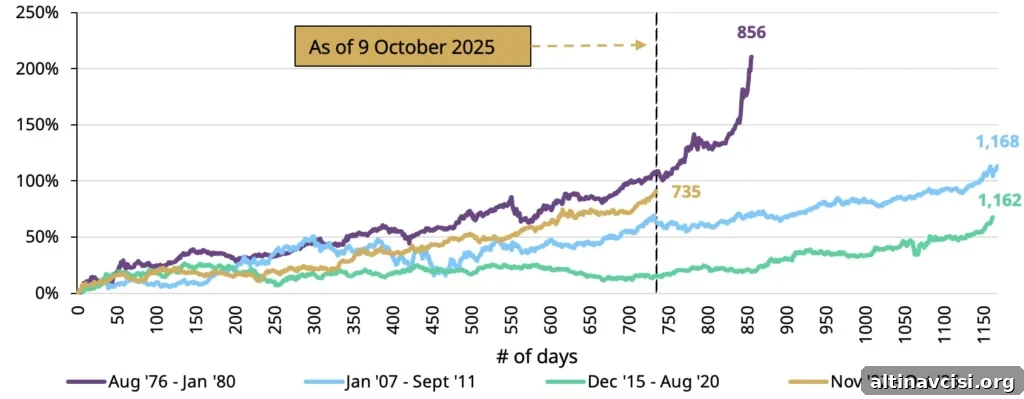
Source: Bloomberg, World Gold Council | *Data as of 10/09/2025. Based on the LBMA Gold Price PM.
As of October 9, 2025, the current rally is roughly 735 days old. That may sound substantial, but major gold bull markets have averaged about 1,062 days in duration — nearly three years. In several past cycles, gold reached record highs relatively early, then continued climbing for years.
The chart above displays three major gold bull markets alongside today’s rally, indexed to their starting points. The clear takeaway is that duration matters as much as magnitude — and by that measure, this cycle still has runway.
The 1970s: When Gold Rose 2,300% Over Four Years
The 1970s gold bull market stands as the most dramatic example of gold’s potential during periods of monetary instability.
Gold entered the decade at $35 per ounce, a fixed price since 1934. When the dollar’s tie to gold ended in 1971, prices began to climb. By January 1980, gold had topped $850 — a gain of roughly 2,300% from the decade’s start.
Importantly, gold surpassed its prior all-time high relatively early in that cycle and then spent years consolidating and moving higher before its final parabolic spike. The forces behind that run were clear: double-digit inflation, expanding deficits, geopolitical shocks, and a broad loss of confidence in fiat currencies. Today’s macro environment echoes several of those themes.
The 2001-2011 Rally: A Decade-Long Climb
The bull market that began in 2001 unfolded differently — steadier and longer — driven by a new set of catalysts.
Gold found a bottom near $250 in 1999 and climbed as the dot-com bubble burst. By 2006 it reached new nominal highs around $725, leading some investors to conclude the rally was over. Yet over the following five years gold would triple from those highs, peaking near $1,900 in September 2011.
That extended climb was propelled by the 2008 financial crisis, massive monetary easing through quantitative easing, sovereign debt concerns, and worries about currency debasement. In this case, the rally ended not because prices were high but when those fundamental pressures began to ease after 2011.
What Actually Ends a Gold Bull Market
Gold rallies typically end when their underlying drivers reverse — not merely because prices feel elevated. At present, many of those drivers are accelerating rather than easing.
Key fundamentals supporting gold today include:
- Mounting sovereign debt across developed economies
- Persistent inflation eroding purchasing power
- Currency debasement from expansionary monetary policy
- Rising geopolitical instability that fuels safe-haven demand
Until those trends shift meaningfully, the macro backdrop remains supportive for gold. None of them currently show clear signs of reversing.
Why This Cycle May Still Be Early-Stage
By duration alone, today’s rally appears younger than previous major bull markets. If historical patterns hold, the risk of being under-allocated to gold may be larger than the risk of maintaining a core position.
The practical takeaway is not to chase price or attempt perfect market timing. Gold bull markets have historically rewarded patience over short-term trading. For many investors, staying invested through volatility has proved more effective than reacting to headlines.
History suggests we may be watching middle chapters of this story rather than its final act.
Investing in Physical Metals Made Easy
People Also Ask
How long do gold bull markets typically last?
Major gold bull markets have averaged around 1,062 days — nearly three years. The 1970s rally extended over four years, while the 2001–2011 cycle lasted a decade. By comparison, the current cycle (as of October 2025) is roughly 735 days old, which suggests it may still have room to run.
Can gold continue rising after hitting all-time highs?
Yes. In previous bull markets, reaching record highs frequently marked an early stage rather than a peak. Both the 1970s and the 2001–2011 rally saw substantial gains after initial record highs. Duration and fundamental drivers often matter more than the absolute price level.
What causes a gold bull market to end?
Gold bull markets usually end when the underlying drivers reverse — for example, when fiscal pressures ease, inflation subsides, currency confidence is restored, or geopolitical tensions diminish. Absent those reversals, rallies can continue even if prices feel elevated.
Is it too late to buy gold in 2025?
History suggests it may not be too late. If the current cycle follows earlier patterns, the rally could still be in its middle stages rather than near a peak. For many investors, building a strategic core position—rather than attempting to time short-term moves—remains a prudent approach.
How does the current gold rally compare to the 1970s bull market?
The 1970s rally lasted over four years and produced gains of more than 2,000% from start to finish, with significant gains occurring after initial record highs. Today’s rally shares similar underlying drivers — fiscal deficits, currency concerns, and geopolitical risk — but is shorter in duration so far, indicating potential for further upside if those drivers persist.
Get Gold & Silver Insights Direct to Your Inbox
Join thousands of investors who receive expert analysis, market updates, and exclusive offers each week.