
Daily News Nuggets | Today’s top stories for gold and silver investors
October 22nd, 2025
Government Shutdown Hits Workers — Presidential Wishlist Marches On
Day 22 of the federal government shutdown has begun to show serious consequences. Nutrition programs for women and children are running low on funding, many federal employees have filed for unemployment, and key services are slowing. At the same time, demolition crews have started work this week on a $250 million ballroom addition to the White House — a 90,000‑square‑foot glass-walled space said to seat 999 people. Meanwhile, the former president is requesting that the Justice Department pay him $230 million related to prior investigations.
The White House maintains the project is privately funded, but the contrast is stark: essential government functions are struggling to stay open while high-profile projects continue. That mismatch not only undermines public confidence but also raises questions about the reliability of official information coming from Washington — an important consideration for investors who rely on trustworthy economic data.
Friday’s Inflation Report Comes With an Asterisk
September’s Consumer Price Index report is scheduled for release Friday, but many on Wall Street are treating the numbers with unusual skepticism. The Bureau of Labor Statistics recently faced scrutiny after large downward revisions to employment figures led to leadership changes, and the ongoing shutdown has constrained staffing for data collection. Investors worry that those disruptions could affect the quality of the inflation reading.
“Skeptics like me are going to be focused on how clean is this data,” says Vishal Khanduja of Morgan Stanley Investment Management. If confidence in official inflation metrics weakens — or if the report produces unexpected results — markets could become more volatile. For gold in particular, which often benefits from rising inflation expectations and policy uncertainty, doubts about the accuracy of government data can increase the appeal of physical precious metals as an objective store of value.
With trust in official statistics under pressure, some investors are re-evaluating assets that don’t depend on government reports for valuation.
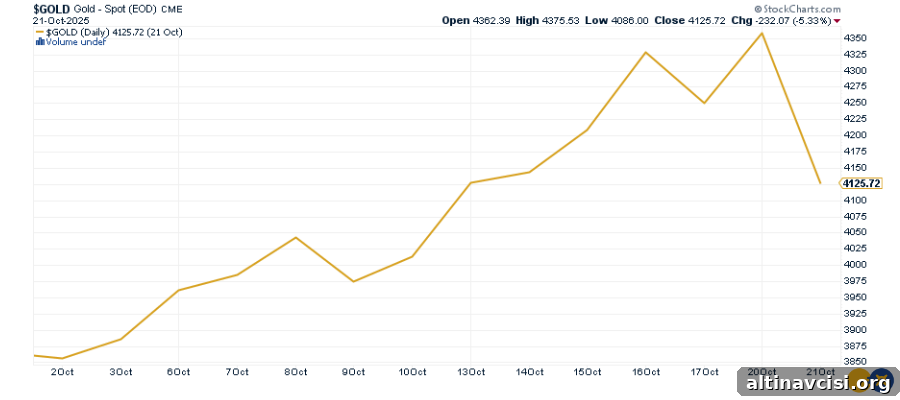
Gold Slides as Investors Book Profits
Spot gold slipped below $4,080 an ounce this week, ending a remarkable rally that saw prices climb roughly 55% year-to-date. The pullback looks like classic profit-taking after one of gold’s strongest stretches since mid‑August.
The fundamental drivers behind gold’s advance remain intact. Concerns about growing government debt are nudging investors toward tangible assets and away from traditional bonds and fiat currencies. At the same time, expectations for aggressive Federal Reserve rate cuts are suppressing real yields, which typically supports precious metals.
Those dynamics suggest the pullback may be temporary. For investors waiting for an entry point or seeking to add to positions, a short-term dip following a historic run could present an opportunity. Real-world demand remains strong, as shown by activity in other global markets.
Queues Around the Block for Bullion in Sydney
Sydney’s financial district is experiencing what looks like a modern gold rush. Up to 1,000 people a day have been lining up — sometimes for hours — outside ABC Bullion to buy physical gold and silver. Reported storage demand surged in September, nearly tripling year‑over‑year. With gold near record levels around A$6,700 per ounce and silver hitting multi‑decade highs, buyers cite protection against U.S. political instability, geopolitical tensions, and expectations of further Fed easing.
The takeaway: when uncertainty rises, many investors want an asset they can hold in their hands. Long queues at bullion dealers are a vivid reminder that demand for physical metal remains a powerful force supporting bullion prices, even as futures traders might take profits.
India Tightens Gold Loan Rules — Signals Deeper Trust in Physical Metal
India’s central bank issued a unified set of rules in June for lending against gold and silver collateral, consolidating decades of fragmented guidance into a single framework due to take effect by April 2026. The rules introduce tiered loan‑to‑value limits — higher for smaller loans and lower for larger ones — and prohibit loans against certain paper or pooled products such as bullion held in specific forms and some ETFs. Lenders must return collateral within seven days or face daily penalties.
India accounts for about a quarter of global gold demand, and gold loans in the country exceed tens of billions of dollars each year. Regulators are tightening oversight rather than restricting access, which underscores the central role of physical gold in India’s financial system. For international investors, India’s emphasis on physical metal over paper proxies reinforces the long-term value proposition of tangible bullion.