
Gold and silver market update — April 22, 2026
In this update: Five forces are moving gold right now — a live naval standoff in the Strait of Hormuz, an unsettled Federal Reserve leadership before a key rate meeting, a weakening dollar, 16 months of continuous central bank buying, and a policy dilemma with no easy path forward. Together, they are reshaping investor views on gold in 2026. Below we explain how each factor matters for portfolios.
Is the Iran Ceasefire Actually Over — or Just Paused?
President Trump extended the US–Iran ceasefire on April 22, 2026, but the US naval blockade of Iranian port traffic remains in effect. That same day, Iran’s IRGC seized two commercial vessels in the Strait of Hormuz, a sign the situation is still unstable.
The Strait of Hormuz channels around 20% of global oil consumption, so any disruption keeps energy markets on edge and can feed inflation. Yet gold’s price action gives an important additional signal. After peaking near $5,250 per ounce in early March 2026 amid heavy tensions, gold has retreated by about 10% to roughly $4,752. Notably, that level has held through repeated diplomatic setbacks. A metal that finds support during ongoing conflict looks less like a short-term fear trade and more like an asset with long-term institutional buyers underpinning demand.
What Happens to Gold If the Fed Has No Chair?
Real yields — nominal interest rates minus expected inflation — are the most immediate driver of gold. When real yields fall, gold usually benefits. Right now, pricing real yields is unusually difficult because the Fed’s leadership is uncertain.
Jerome Powell’s term as Fed Chair ends May 15, 2026, and Kevin Warsh’s confirmation remains blocked. The delay stems from a senator conditioning his vote on the outcome of a Justice Department inquiry linked to Powell. The Senate calendar leaves little time to resolve the issue before Powell’s term expires, and the Fed faces an April 28–29 FOMC meeting while its leadership situation is unsettled.
For investors, that uncertainty is a structural positive for gold. When the institution that sets interest rates is in limbo, real yields become harder to forecast and the dollar’s purchasing power looks less certain. That makes gold more attractive as a hedge, independent of immediate geopolitical headlines.
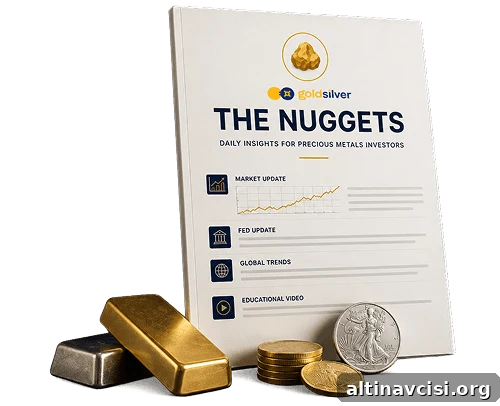
The Edge Every Investor Needs
Smarter precious metals investing starts here. The Nuggets Newsletter delivers market insights, Fed updates, global trends, and educational content to help investors make informed choices.
Why Is Gold Holding Firm Even as the Dollar Falls?
Historically, gold and the US dollar move inversely: a weaker dollar makes gold cheaper for overseas buyers, increasing demand. That correlation remains important, but current behavior shows a more complex dynamic.
The US dollar index traded near 98.13 on April 21, 2026, below pre-conflict levels. Instead of tracking dollar moves on a daily basis, gold has formed a resilient floor around $4,700–$4,750 and doesn’t give back gains on days when the dollar briefly strengthens. That pattern suggests steady, structural buying rather than speculative flows reacting to short-term currency swings.
Central banks and sovereign wealth funds have been large, consistent buyers. Their purchases are strategic, not tactical: they do not unwind holdings because of a small daily swing in the dollar. Institutional accumulation helps explain why gold’s price action looks anchored even as FX markets fluctuate.
Are Regulators Finally Starting to Treat Gold Like Money?
Gold has been treated like zero-risk-weight cash under Basel rules since 1988. Today, discussions are underway to take that recognition further. The World Gold Council and the London Bullion Market Association are pressing regulators to classify gold as a High Quality Liquid Asset under Basel III, which would let banks include physical gold in short-term liquidity buffers alongside government bonds and cash.
That reclassification has not been finalized, but the conversation is gaining momentum as central bank buying reaches new highs. China, for example, added gold to its reserves for 16 consecutive months through February 2026, raising holdings to about 2,308 tonnes. Given large projected US fiscal deficits, adding gold to reserves is increasingly framed as balance-sheet management rather than geopolitical signaling.
Is the Fed Trapped — and What Does That Mean for Gold?
Perhaps the most important long-term driver for gold is the Federal Reserve’s limited room for decisive policy. Inflation remains above target while growth is cooling amid tariff pressures and higher energy costs tied to the Hormuz disruption.
Both policy choices carry risks. Cutting rates risks rekindling inflation; raising rates risks pushing the economy into recession. That deadlock has left the Fed largely on hold: market-implied odds point to a high probability of no change at the April 28–29 meeting. More meaningful than a single rate call is the broader signal: a central bank constrained politically and institutionally reduces confidence in the dollar’s steady purchasing power.
Gold benefits from that structural erosion of confidence. It does not require a sudden crisis to rise; it only needs persistent doubts about the effectiveness of dollar-focused policy. As long as those doubts remain, institutional demand for gold is likely to persist.
Stay On Top of Gold & Silver Prices
Get important market alerts sent straight to your inbox.
SOURCES
1. US Energy Information Administration — Strait of Hormuz
2. Trading Economics — Gold Price Historical Data
3. CNBC — Kevin Warsh Fed Confirmation Hearing: Live Updates
4. Federal Reserve Bank of St. Louis (FRED) — Trade Weighted US Dollar Index
5. World Gold Council — Central Bank Gold Statistics: February 2026
6. LBMA — Gold and HQLA: Correcting Misleading Information
7. World Gold Council — Does Gold Qualify as an HQLA Under Basel III?
8. Congressional Budget Office — The Budget and Economic Outlook: 2026 to 2036
9. CME Group — FedWatch Tool
10. CNN — Iran War Live: Ceasefire Extended, Ships Seized in Hormuz
Disclaimer: This article is for informational purposes only and does not constitute financial or investment advice. Consult a qualified financial adviser before making investment decisions.
You May Also Like:
- The Gold-Silver Ratio Signal: What Silver’s Lead Means
- Gold Drops to $4,681 — Iran Ceasefire Expires Today
- The Real Reason Gold Is Down During an Oil War
- What the Warsh Hearing Means for Gold Prices
- IMF Says Treasuries Aren’t Safe Anymore. Gold Noticed First
- Gold Price After Ceasefire Violation: The Floor Has Moved
- Oil Crashed 11%. Gold Went Up. That Tells You Everything
- $1 Trillion in Debt Interest Is Why Gold Keeps Climbing