Daily News Nuggets | Today’s top stories for gold and silver investors
February 2nd, 2026
Gold and Silver’s Historic Crash
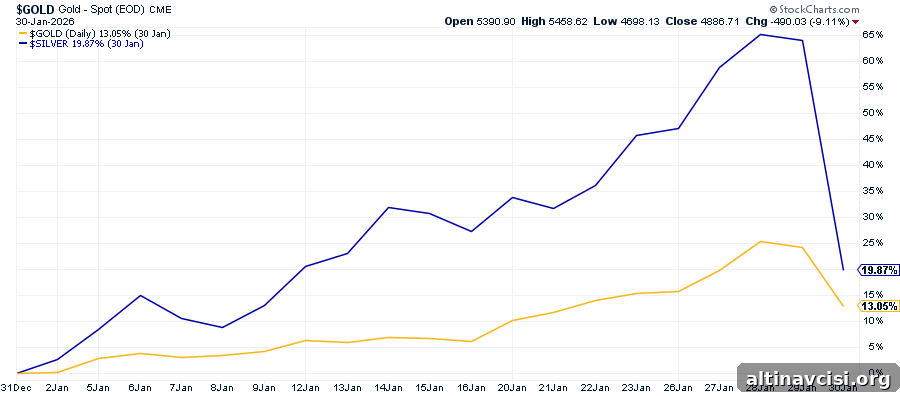
Gold and silver suffered their steepest drops in decades last week. Gold tumbled below $5,000 on Friday — nearly $1,000 down from Thursday’s record near $5,600. Silver plunged about 31% in a single day, its sharpest one-day decline since 1980.
The immediate catalyst was President Trump’s nomination of Kevin Warsh as Federal Reserve chair. Warsh’s reputation for a hawkish approach reduced concerns about central bank independence, pushing the dollar higher and triggering broad profit-taking after both metals had experienced parabolic gains. Gold surged roughly 66% during 2025, while silver rallied about 135%.
But the rout reflected more than one political event. Many analysts had warned that the rally was overheated: technical indicators flagged risk, liquidity thinned as volatility spiked, and banks reduced market exposure. Margin calls forced some leveraged positions to liquidate, accelerating a rapid unwind of crowded trades.
Even after the crash, precious metals remain higher year-to-date — gold is up roughly 8% and silver around 16%. The underlying drivers—geopolitical uncertainty, currency pressures and record sovereign debt—are unchanged. Still, the speed and scale of the selloff exposed how quickly sentiment can reverse in stressed markets.
The Edge Every Investor Needs
Smarter precious metals investing starts here. The Nuggets Newsletter brings essential market insights, Fed updates, global trends, educational videos, and timely analysis to help investors make informed decisions.
China’s Speculative Frenzy Fueled the Metals Crash
Chinese retail speculators, equity funds and momentum-driven trading algorithms played a major role in the run-up and the rapid reversal. For weeks a wave of hot money flowed into precious metals, pushing prices to unprecedented highs as retail demand and algorithmic buying intensified the move.
Silver’s relatively small market size amplified volatility. Annual supply values for silver are much smaller than gold’s, and concentrated trading pushed intraday volumes to extreme levels — the iShares Silver Trust recorded unusually high turnover, comparable in scale to large tech ETFs. Options and retail-driven trades added to the pressure; some individual traders reported outsized gains before the reversal.
When the dollar strengthened after the Fed nomination, many Chinese investors chose to take profits instead of adding exposure. That shift in sentiment produced a sharp drop in silver — a record intraday decline — and turned what had been a speculative rally into a fast-moving selloff. Market strategists described January as an extraordinarily volatile month for precious metals.
January 2026 Returns — Gold and Silver
Despite the rout, some investors viewed the decline as a buying opportunity rather than a sign of lasting weakness.
Singaporeans Queue to Buy Gold Despite the Crash
Retail demand in parts of Asia showed notable resilience. In Singapore, customers reportedly lined up at bank branches to buy physical bullion as prices fell, illustrating a segment of investors who treat dips as opportunistic entry points.
Data from regional banks pointed to increased interest in gold saving accounts and higher purchases of physical gold through 2025. That behavior reflects a broader shift across some Asian markets toward tangible assets amid currency concerns and equity market volatility.
While traders in Western markets rushed to unwind positions, Asian retail buyers and some institutional participants stepped in, and major banks took note of the persistent physical demand.

JP Morgan Sees Gold at $6,300 Despite the Crash
In the aftermath of the sharp decline, leading banks reiterated bullish medium-term views. JP Morgan raised its year-end gold price forecast to $6,300, signaling confidence that the long-term drivers for gold remain intact despite short-term volatility.
The bank highlighted central bank buying as a key underpinning — forecasting substantial official-sector purchases in 2026 as countries diversify reserves away from a single dominant currency. JP Morgan framed the selloff as a liquidation event that cleared speculative excesses rather than a collapse in fundamental demand for a real asset.
Deutsche Bank and other institutions similarly maintained multi-thousand-dollar targets, describing the recent plunge as a shakeout that could create entry points for long-term investors who focus on reserve diversification and sustained demand for physical holdings.
Morgan Stanley Breaks With 60/40, Recommends 20% Gold
Morgan Stanley’s CIO proposed a notable shift to portfolio construction: a 60/20/20 allocation of stocks, bonds and gold, respectively, replacing the long-standing 60/40 model. The rationale is that bonds may no longer serve as a dependable hedge in all market stress scenarios, while gold has demonstrated resilience when real rates decline and fiscal pressures rise.
The recommendation positions gold as core portfolio infrastructure — a strategic allocation rather than a speculative holding. It aligns with signs that central banks are increasing gold reserves and reassessing their exposure to sovereign debt, reinforcing the argument for diversifying with physical assets.
You May Also Like
- Gold’s Week: $9T Swing, Trump’s Fed Pick, and Record Premiums
- Gold Breaks $5,500 as Metals Rally Accelerates
- Gold Passes $5,300 as Fed Meets, Dollar Craters
- Why Gold Just Hit $5,100 and Where It’s Headed Next
- Gold Breaks $5,000 as Bond Markets Crack
- Gold Price Eyes $5,000, Silver Nears $100