
Few voices in global finance carry as much influence as Ray Dalio’s. As the founder of Bridgewater Associates, the world’s largest hedge fund, Dalio has spent decades studying economic cycles, monetary systems, and how money behaves under stress.
His stance on gold is deliberate and long-standing. Dalio treats gold not as a speculative bet but as a structural hedge against inflation and monetary instability.
Today his perspective is especially pointed.
What Does Ray Dalio Actually Think About Gold?
Dalio’s view is clear: gold is a structural holding, not a trade.
He argues that investors should hold gold as a permanent part of their portfolio because it preserves value when paper currencies do not. At the World Governments Summit in Dubai in early 2026, Dalio called gold “the safest money” and warned that the world is moving toward a period he described as a “capital war,” when capital flows and currencies become geopolitical tools. In that environment, he says, traditional financial assets may become less reliable as stores of value.
His bottom line: “There is only one gold.”
Gold vs. Bitcoin: Where Does Dalio Stand?
Many investors compare gold and bitcoin, often dubbing bitcoin “digital gold.” Dalio does not view them as substitutes.
On the All-In Podcast he explained that gold’s strength comes from widespread institutional acceptance as a reserve asset. Central banks hold thousands of tonnes of gold as part of monetary reserves — a role gold has played for centuries. That institutional backing gives gold credibility during financial stress that bitcoin does not yet have.
Bitcoin, by contrast, still behaves largely like a speculative risk asset. When sentiment sours, bitcoin has historically moved down alongside equities rather than acting as a stabilizer.
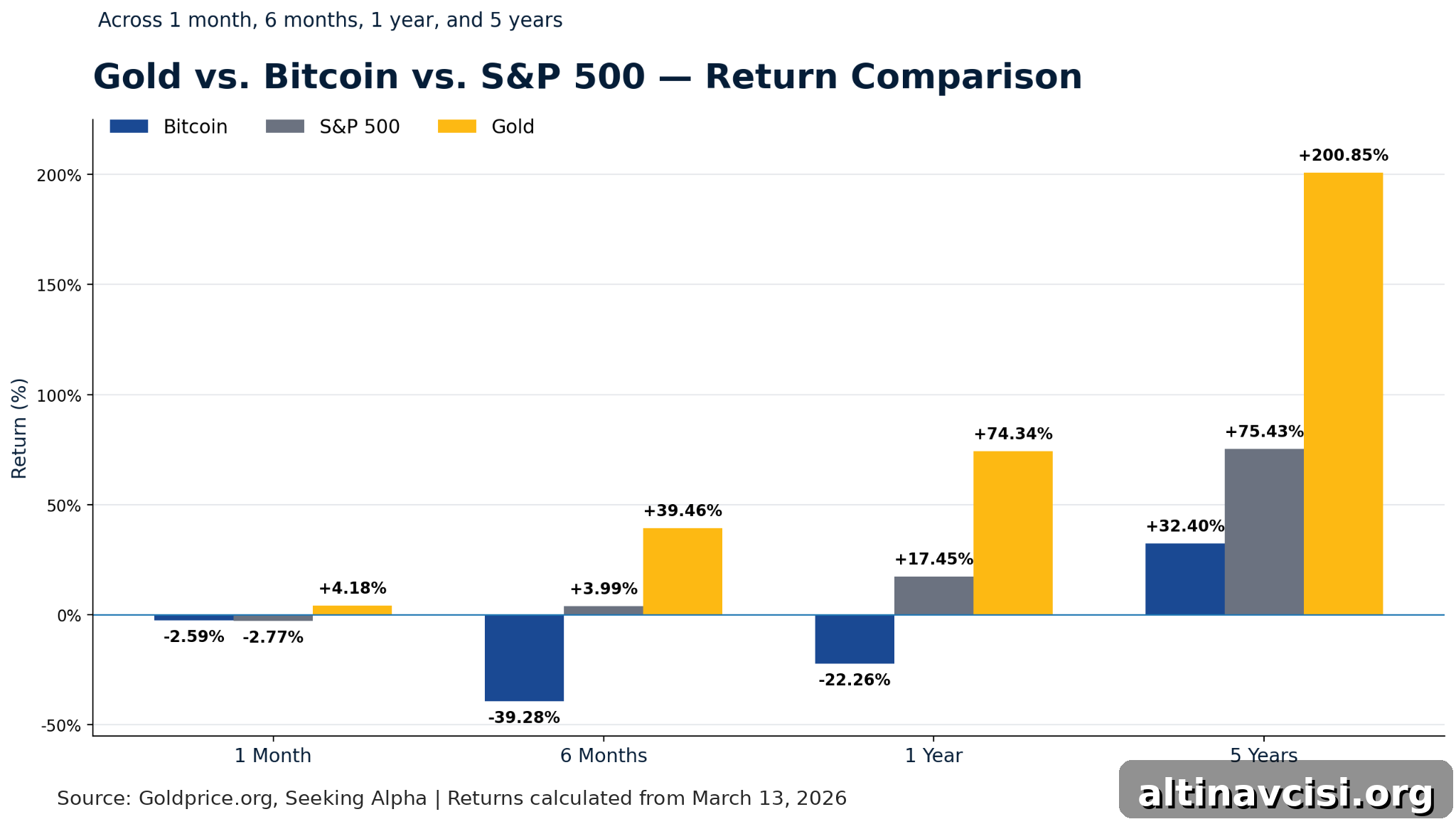
Dalio’s point is not that bitcoin has no place in a portfolio; it’s that the two assets serve different purposes. Gold functions as a monetary hedge and reserve asset, while bitcoin remains a high-volatility technology asset whose long-term role is still evolving.
What Percentage of Gold Does Ray Dalio Recommend?
A central element of Dalio’s gold strategy is consistent allocation rather than market timing. He typically recommends allocating between 5% and 15% of a portfolio to gold.
That range reflects his broader investment philosophy of diversification across assets that perform differently under varying economic conditions. Gold doesn’t need to dominate a portfolio to provide value; its role is to act as a structural counterweight to assets vulnerable to inflation, rising debt levels, and currency depreciation.
A modest allocation can significantly improve portfolio resilience, especially when stocks or bonds come under pressure. For investors considering a broader precious metals allocation, gold often serves as the stability anchor while silver can offer greater upside during commodity cycles.
The Financial System Isn’t Safer — And You Know It
As risks mount, see why gold and silver are projected to keep shining in 2026 and beyond.
Why Does Ray Dalio Consider Gold a Sound Fundamental Investment?
Dalio’s case for gold is grounded in his study of monetary history. He observes a recurring pattern: when governments accumulate large debts, central banks tend to expand the money supply to support economies or stabilize markets. Over time, that expansion erodes the purchasing power of fiat currencies.
Gold behaves differently because its supply cannot be arbitrarily increased by policy. That scarcity has helped gold preserve value during periods when fiat currencies weaken.
Several factors reinforce Dalio’s conviction:
- Central banks continue to accumulate gold. Recent central bank buying has been well above long-term averages, reflecting strategic reserve management rather than speculation.
- Gold carries no counterparty risk. Unlike bonds, equities, or bank deposits, physical gold does not rely on the solvency of an institution. It exists outside the financial system, which becomes particularly valuable during crises.
- Gold tends to perform during market stress. For example, gold rose in the pandemic market turmoil of 2020 and has at times outperformed major equity benchmarks over trailing periods, demonstrating its role as a defensive asset.
For Dalio, these traits make gold a useful component in a diversified portfolio: one of the few assets that can help preserve purchasing power when the broader financial system is under pressure.
How Does Ray Dalio View Gold as a Hedge Against Inflation?
Inflation risk is central to Dalio’s argument for owning gold. He believes the modern fiat, debt-driven monetary system is structurally prone to inflation over long periods. When deficits grow, central banks may expand the money supply, which gradually reduces currency purchasing power.
Gold’s supply cannot be expanded by policy, and its value is recognized globally across cultures and financial systems. Historically, gold has preserved purchasing power better than cash during extended periods of monetary expansion.
Dalio contrasts gold with cash, noting that while cash feels safe short term, it is vulnerable to long-term erosion from inflation. In his framework, gold serves as a reliable store of value when monetary policy weakens currency purchasing power.
How Does Dalio’s Gold View Align With His Broader Investment Principles?
Dalio is known for the “All Weather” portfolio—a design intended to perform reasonably well across growth, recession, inflation, and deflation. Gold is a key element of that design because it behaves differently from stocks and bonds.
While equities benefit from growth and bonds from falling interest rates, gold tends to perform best during monetary instability, rising inflation, or geopolitical stress. Dalio emphasizes radical diversification—building portfolios that can withstand multiple scenarios and avoiding single points of failure.
Gold aligns with that approach: globally liquid, historically durable, and largely independent of the financial system. Dalio treats gold as a permanent allocation, not a short-term trade, making it a structural component of portfolio design.
The Bottom Line: What Does This Mean for Your Portfolio?
Dalio’s guidance on gold is straightforward:
- Treat gold as a structural allocation, not a short-term trade. He recommends holding 5% to 15% of a portfolio in gold as a long-term hedge against inflation, currency devaluation, and financial instability.
- Understand gold’s role: it is not intended to outperform equities every year but to protect purchasing power when traditional assets struggle.
The current macro backdrop—high government debt, continued monetary expansion, and geopolitical tensions—matches the conditions where gold has historically been valuable. Various Wall Street forecasts are bullish on gold, reflecting similar convictions from major institutions.
Ultimately, Ray Dalio’s gold strategy follows a simple principle: build portfolios to withstand a range of economic outcomes. If gold is not yet part of your allocation, his viewpoint is worth considering; if it is, his framework reinforces why maintaining that exposure matters when markets turn volatile.
People Also Ask
What percentage of gold does Ray Dalio recommend holding in a portfolio?
Dalio recommends allocating 5% to 15% of a portfolio to gold as a structural allocation to protect purchasing power during inflation, currency devaluation, and market stress. He treats gold as a permanent diversification asset rather than a short-term trade.
Why does Ray Dalio prefer gold over cash?
Dalio argues that cash loses value over time as inflation erodes purchasing power. Gold cannot be created by policy, carries no counterparty risk, and has historically preserved value across many economic cycles. For that reason, he views gold as a more reliable long-term store of wealth than holding excess cash.
Does Ray Dalio consider bitcoin a substitute for gold?
No. Dalio does not view bitcoin as a substitute for gold. He emphasizes gold’s deep institutional backing from central banks, while bitcoin remains primarily a speculative asset that often moves with equities during market stress.
How does Ray Dalio’s gold strategy fit into his All Weather portfolio?
Gold is an important part of the All Weather portfolio because it diversifies against inflation, currency instability, and market stress. Its behavior often offsets periods when stocks or bonds perform poorly, helping stabilize overall returns across economic scenarios.
Is now a good time to buy gold according to Ray Dalio’s principles?
Dalio advises maintaining a consistent gold allocation rather than trying to time purchases. His framework suggests that periods of high debt, monetary expansion, and geopolitical risk are precisely when gold’s role as a hedge becomes most valuable.
This article is for informational purposes only and does not constitute financial or investment advice. Past performance is not indicative of future results. Please consult a qualified financial advisor before making investment decisions.
You May Also Like:
- Gold vs Inflation: What 100 Years of Data Shows
- Why Silver Is More Volatile Than Gold (And Why It Matters for Investors)
- Silver Bars vs. Silver Coins: Which Is the Better Investment?
- Gold vs. Silver: Roles, Risks, and Portfolio Strategy
- Gold Silver Prices: Short-Term Noise, Long-Term Signal