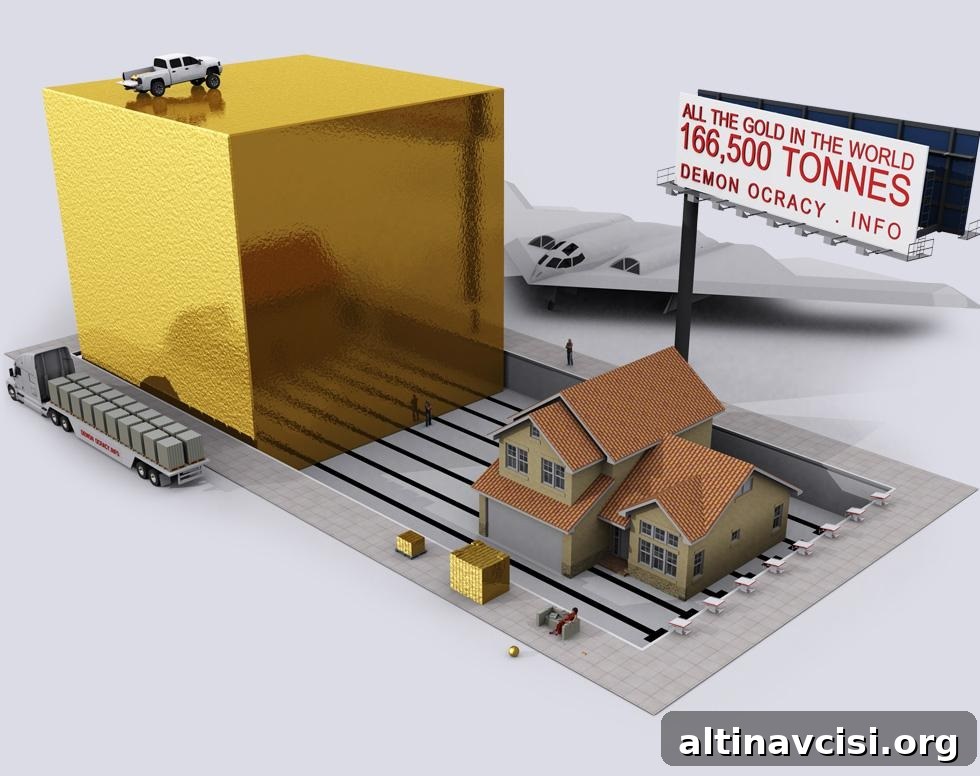
The question of how much gold exists in the world is frequently asked and has practical importance beyond simple curiosity. Understanding the total amount of gold helps frame future supply and demand dynamics and offers insight into potential long-term price trends.
The short answer is that there is both a great quantity of gold in the Earth and, at the same time, a scarcity of accessible gold.
That may sound contradictory, but it reflects the difference between gold locked deep inside the planet and the much smaller amount available for mining and use. To explain, it helps to look back at gold’s origin.
Where did gold originally come from?
For most of human history the source of gold was unknown. Modern science gradually formed a theory: heavy elements such as gold are created by nucleosynthesis during catastrophic stellar events. For a long time this was an educated hypothesis; only recently has direct evidence confirmed it.
Confirming the hypothesis
On August 17, 2017, sensitive detectors at the Laser Interferometer Gravitational-Wave Observatory (LIGO) registered a gravitational wave produced by the collision of two neutron stars roughly 130 million light-years away. Neutron stars cram more mass than the Sun into a ball only about 10 miles across. Their collision created a kilonova whose emitted light could be analyzed by telescopes worldwide.
Astronomers captured spectra from that kilonova before it faded. The spectral lines revealed the presence of very heavy elements being formed in the explosion—providing direct evidence that events like neutron-star mergers produce gold and other precious metals.
The birth of gold
Material ejected from such cosmic collisions spreads through space and eventually becomes part of the dust and gas that form new stars and planets. During Earth’s molten early history, heavy elements such as iron sank to form the core, taking most of the primordial gold with them. That means a vast amount of gold exists in the planet’s core, out of reach for human extraction.
Gold on Earth
Saying “there is a lot of gold in the world” is accurate if you include the gold locked in the core. Some estimates suggest enough precious metals exist to coat the planet in a multi-meter layer. Yet calling gold rare is also correct when referring to the amount accessible in the crust and near-surface deposits.
Geologists note that the Earth’s crust and mantle contain more precious metals than expected if all heavy elements had simply sunk to the core. The accepted explanation is that many of those metals arrived later, delivered by meteorite impacts during the late stages of planetary formation.
Gold imported from space
Researchers have supported the meteorite-delivery theory by analyzing ancient rocks. Studies indicate that a significant portion of the precious metals now available on the surface were added by asteroid and meteoritic bombardment billions of years ago. Those extraterrestrial materials were mixed into the mantle and crust, creating the concentrations of gold miners can access today.
All gold ever mined, minted into coins, made into jewelry, or used in industry is conserved: gold does not corrode or break down. That means current stocks reflect a cumulative history stretching back to those early cosmic events. However, a growing share of newly mined gold is locked into electronic devices, many of which are discarded. Some estimates suggest a notable portion of annual production becomes effectively unrecoverable due to being embedded in consumer electronics and landfilled.
How much gold is there? Can we add it up?
Estimates of aboveground gold vary. A commonly cited figure is roughly 165,000–175,000 tonnes of aboveground gold, which would fit into a cube roughly 20 meters on a side. That estimate aligns with major industry tallies that track mined gold and known reserves. Other estimates are much higher but are generally considered speculative.
Several factors complicate accurate measurement: imprecise records of early historic production, unreported artisanal mining, and uncertainty about actual output from nations that do not fully disclose production. China’s production, for example, is widely believed to be underreported, which adds uncertainty to global tallies.
Annual mined gold is currently around 3,000 tonnes, while global demand has sometimes exceeded that level—creating movement of existing aboveground stocks between sectors such as jewelry, investment, central bank holdings, and industrial use. Where gold flows and how much is withdrawn from tradable stocks can be difficult to trace precisely.
Because large, high-grade deposits have largely been discovered and exploited, marginal new finds tend to be lower grade. Many of today’s projects yield only fractional grams of gold per tonne of ore, making profitable extraction more challenging and more sensitive to gold prices and operating costs. Environmental and social opposition to new mines further constrains expansion.
Will more gold likely be discovered?
New discoveries will continue, but the key question is economic recoverability. Potential new sources include seawater, the deep-sea floor, and extraterrestrial bodies. Seawater holds an estimated 20 million tonnes of dissolved gold, but concentrations are vanishingly low, making recovery currently impractical. The seabed contains higher concentrations in some deposits, but technical and environmental challenges remain for deep-ocean mining.
Beyond Earth, interest in lunar and asteroid mining is growing. Lunar surface materials at certain locations may have elevated concentrations compared with typical terrestrial ores, and several private ventures have planned or test missions aimed at prospecting near-Earth asteroids. These prospects are long-term and face major technical, legal, and economic hurdles, but they broaden the conversation about future supply.
The amount of minable gold on Earth
Conservative assessments of known, economically minable gold are substantially lower than total aboveground totals. The U.S. Geological Survey estimates roughly 52,000 tonnes remain in identified, economically extractable deposits. At current production rates, that represents only about a decade or so of supply, assuming demand and economics do not change dramatically.
If demand continues to grow—driven by technology, investment demand, or central-bank purchases—price pressure is likely. Producers can respond by reworking lower-grade deposits, developing more costly mines, or increasing recycling, but those options have limits. Over time, constrained accessible supply supports the likelihood of higher long-term prices.
Conclusion
Exact totals for gold in the world vary by methodology and assumptions. Reasonable estimates of aboveground gold commonly cited by industry sources fall in the mid-hundreds of thousands of tonnes, while speculative estimates can be much larger. Much of Earth’s gold remains inaccessible in the core or in sources that are not yet economically recoverable.
Accessible, minable gold is limited relative to current demand. As high-grade, easy-to-reach deposits become scarcer, economics and technology will determine how much additional gold can be brought to market. In the near to medium term, constrained accessible supply and steady or rising demand make higher gold prices a plausible outcome.
For now, gold’s scarcity, durability, and long history as a store of value continue to underpin its appeal as a form of wealth preservation—whether held as coins, bars, jewelry, or strategic reserves.