How much of your portfolio should be allocated to gold or silver? What percentage is appropriate, and should you favor one metal over the other?
These are important decisions. Allocate too little and the metals may not influence your overall returns when markets turn. Allocate too much and your portfolio may suffer if precious metal prices stagnate or decline.
To reach a sensible conclusion, follow a few practical guidelines and tailor them to your goals and risk tolerance. This article walks through key questions to help you build a bullion strategy aligned with your situation.
Answer these three essential questions — plus a bonus question — and you’ll be closer to a practical allocation for gold and silver.
Question #1: What Are Your Goals as an Investor?
Start by clarifying why you want gold and silver. Your objectives will determine how much you should hold. Consider whether you are buying metals for:
- Short-term gains, long-term preservation, or both
- Speculative buying because they appear undervalued
- A hedge against stock market declines or broader economic risks
- Collectible value that could outpace standard bullion
- Owning tangible assets rather than paper-based instruments
When setting your allocation, factor in your risk tolerance. Generally, the less risk you want, the more weight precious metals should have in your portfolio. Gold has served as money for millennia and has never gone to zero; in extreme systemic crises it often becomes a last-resort store of value.
Gold does not produce dividends or corporate earnings, which some criticize. But that lack of cashflow dependence is one reason investors value it:
- Precious metals do not rely on quarterly corporate results.
- Physical gold and silver carry no counterparty risk.
- They can preserve value during market crashes and crises.
- They have limited supply compared with fiat currency.
Consider how much you trust financial institutions or governments to uphold promises during systemic stress. Physical gold and silver eliminate that counterparty exposure: if you hold them, you directly control their value.
- Physical gold and silver have no counterparty risk; by owning them you directly possess their value.
Question #2: How Much Do I Need to Make a Difference?
I once shorted the market in October 2008 and captured a strong short-term profit. Even so, that trade barely affected my overall net worth because the position was small relative to my total assets. The correct call and timing meant little without meaningful allocation.
Owning a single Gold Eagle or a tube of Silver Maple Leafs won’t materially protect or transform a diversified portfolio.
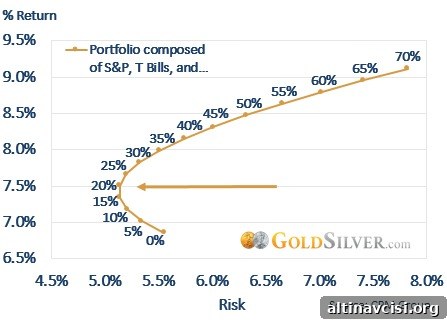
So how much will make a difference? Long-term research offers guidance. CPM Group studied a 53-year period including stocks and bonds and found an optimal long-term allocation.
The study identified roughly 20% exposure to gold as the historical “sweet spot,” balancing risk and return over decades. Given today’s macro environment — heavy stimulus, large deficits, asset bubbles, and geopolitical risks — many investors consider being overweight relative to that benchmark.
Whatever you decide, allocations under about 5% are unlikely to provide meaningful protection. For instance, if 5% of your portfolio is gold and 50% is equities, a 50% drop in stocks would require a 400% increase in gold just to break even, assuming perfect inverse correlation. Bear markets can last longer than expected, so make sure allocations match your objectives.
- Own enough physical gold and silver to make a material difference to your overall portfolio.
Question #3: How Much Do I Need To Support My Expenses?
Another practical method is to align bullion holdings with potential income needs. If you might need to liquidate metals to cover living expenses — for example during unemployment or high inflation — plan how many ounces would meet those needs for a given timeframe.
Estimate monthly supplemental income and the number of months you may need support. As metal prices rise, you would need fewer ounces to generate the same cash flow, but remember that selling bullion for a gain can have tax implications similar to other investments.
Perform this exercise separately for gold and silver, and then consider how a combined holding reduces the required ounces of each. Matching your holdings to your expense needs gives a practical floor for minimum ownership.
Bonus Question: Should I Buy More Gold or More Silver?
Gold and silver share many attributes: they are tangible, portable, liquid, and widely recognized. Yet each metal has characteristics that may influence how much you buy of each.
Two key differences to consider:
- Silver tends to be more volatile than gold, offering higher upside in bull markets but larger downside in bear markets.
- Silver is bulkier. Large silver holdings require more storage space and are often better suited to professional vaulting rather than home storage.
If using secure storage, consider buying bars to reduce premiums; bars generally carry lower premiums than coins. Gold bars likewise usually cost less per ounce than gold coins.
- Best practice is to hold both metals for diversified exposure rather than focusing exclusively on one.
How to Buy Small Amounts of Gold & Silver
If your budget is limited or you prefer dollar-cost averaging, you can buy fractional-ounce products: half-ounce, quarter-ounce, and smaller increments are commonly available. Premiums on these smaller pieces are higher as a percentage of price because fabrication costs are similar regardless of size.
An alternative is using allocated storage or vault programs that let you accumulate fractional ownership of physical ounces without paying high premiums on small minted pieces. These programs allow you to consolidate into larger, lower-premium products later or take delivery when convenient.
How to Buy Large Amounts of Gold & Silver
For significant purchases, allocated vault programs and large bars are the most cost-effective choices, offering the lowest premiums per ounce. For silver coin enthusiasts, bulk options such as Mint Cases (often called monster boxes) of Silver Eagles or Maple Leafs are available.
Private vault storage is worth considering for large positions: it provides secure storage, insurance, and quick liquidity while allowing for home delivery if needed.
Last, what about other precious metals?
Platinum and palladium are rare and classified as precious metals, but their demand is heavily industrial. That makes them more sensitive to economic cycles and less reliable as safe-haven assets during crises. For investors seeking crisis protection and long-term store of value, gold and silver remain the primary choices.