
Written by: The MacroButler
Savvy investors familiar with the business cycle, monetary illusion, and asset allocation within a permanent portfolio already know that inflation favors tangible assets like property and penalizes long-term contracts. In inflationary regimes, holding real assets and avoiding long-duration contractual exposures typically preserves purchasing power better than fixed claims.
Equities remain relatively straightforward to value with established methods such as Discounted Cash Flow (DCF), Price-to-Earnings (P/E), Price-to-Book (P/B), and Dividend Discount Models (DDM). Complementary metrics like EV/EBITDA, Price-to-Sales (P/S), Free Cash Flow (FCF) yield, and the PEG ratio add nuance. Comparing peers, examining industry trends, and accounting for macroeconomic conditions refine these valuations and help investors determine whether a stock is under- or overvalued.
Gold, by contrast, is harder to value. Its price is driven largely by scarcity and monetary demand rather than by cash flows or productive use. Gold wears many hats—it acts as money, a commodity, a financial asset, and a consumption good—so assigning a single “fair value” is inherently difficult. Because its price is set by immediate supply and demand, gold is less straightforward for many institutional investors accustomed to income-based valuation.
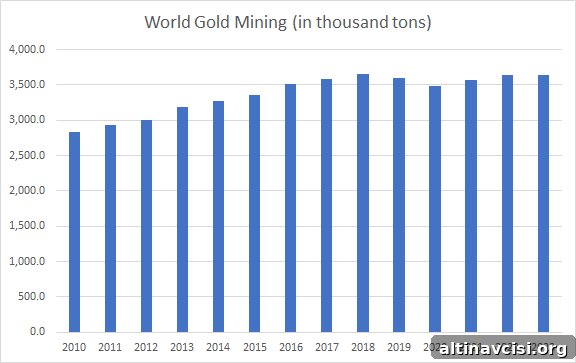
On the supply side, global mined gold production has been roughly stable at about 3,500 tons per year since 2016 despite heavy exploration and capital investment by miners. At current prices, that annual production adds roughly $260 billion in new supply—an amount smaller than two months of the U.S. budget deficit. Meanwhile, global population, GDP, and money supplies continue to expand, exerting upward pressure on monetary assets like gold.
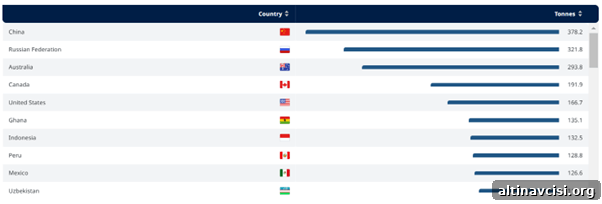
Geopolitically, China and Russia—major players within the Global South and BRICS—are among the largest gold producers, together contributing roughly 18% of annual mined supply. Their positions and policies influence global flows of gold as nations seek alternatives to relying solely on USD-denominated assets.
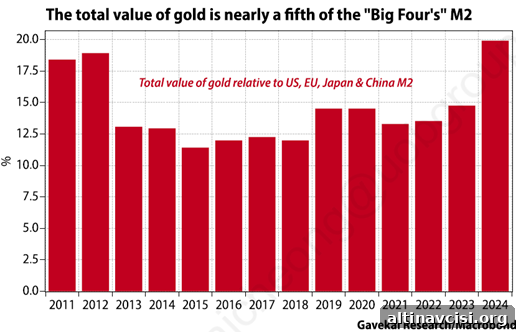
If gold is treated as money, one useful valuation benchmark is the ratio of total gold stock to broad money supply across the major economies—the U.S., EU, Japan, and China. Over the past 15 years that ratio typically ranged from about 12% to 18%. With the recent gold bull market and some contraction in U.S. M2, the ratio has approached 20%, historically high. Still, with central banks and governments likely to expand money supply in response to crises, this elevated ratio may prove transitory. That said, many investors hold gold for its antifragile properties and as protection against fiscal excesses and potential sovereign stress. Historically, gold often appreciates as the U.S. debt-to-GDP ratio rises, so in times of escalating deficits and geopolitical tensions, gold is not necessarily expensive by that metric.
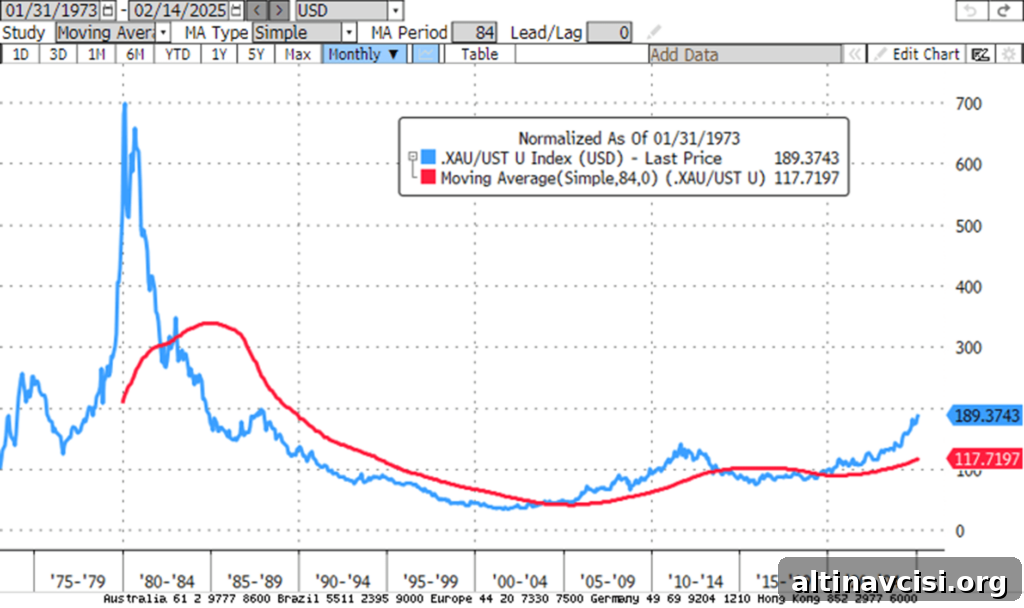
Market practitioners who track the business cycle often prefer market-based indicators over headline CPI figures. The Gold-to-Treasury ratio and its relationship to a long-term moving average (commonly seven years or 84 months) offer a practical gauge: when gold outperforms Treasuries and the ratio sits above its long-term average, the market favors gold as a store of value, signaling inflationary pressure. Conversely, when Treasuries outpace gold and the ratio falls below that average, deflationary forces are more likely at work.
Given the rapid expansion of money supplies, the weaponization of USD assets, and large U.S. fiscal deficits, the Gold-to-Treasury ratio has climbed markedly since the start of this decade, though it remains below the extremes seen in the late 1970s and early 1980s. If geopolitical or trade-policy risks push investors away from U.S. Treasuries, those historical extremes are reachable again, underscoring why some investors turn to physical gold as a hedge against potential confiscation or financial coercion.
Gold to US Treasury Ratio (blue line); 84-month Moving Average of the Gold to US Treasury ratio (red line).
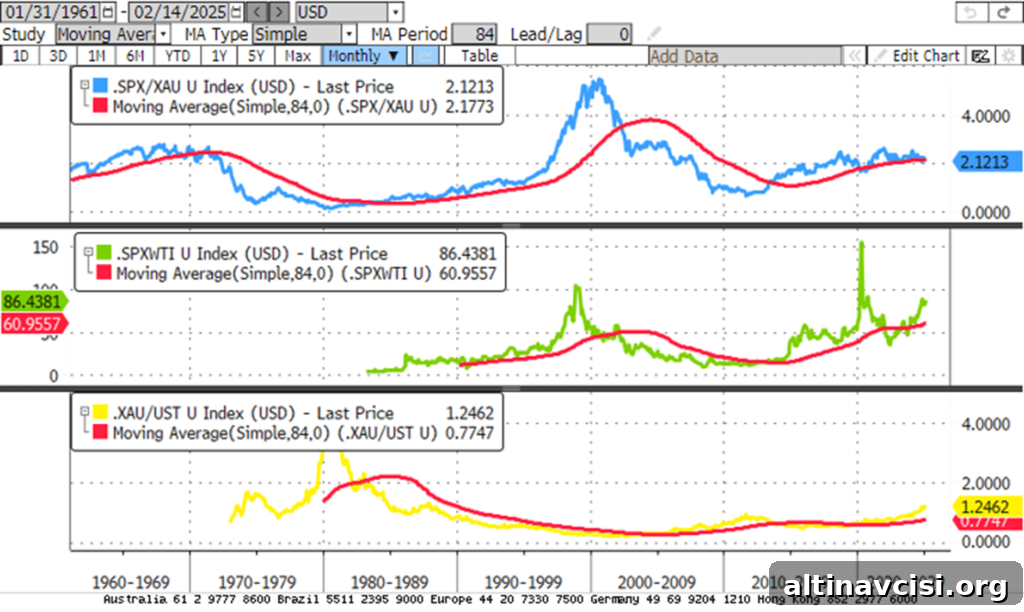
Another important gauge is the S&P 500-to-Gold ratio, a useful indicator of monetary illusion—how investors perceive wealth in nominal terms rather than in real or gold-adjusted terms. When the S&P 500-to-Gold ratio falls below its long-term moving average, history shows it often precedes weaker economic conditions. Breaks of this moving average historically lead declines in the S&P 500-to-Oil ratio and have signalled economic busts within roughly six to nine months.
Upper Panel: S&P 500 to Gold Ratio (blue line); 84-month Moving Average of the S&P 500 to Gold Ratio (red line); Lower Panel: S&P 500 to WTI Ratio (green line); 84-month Moving Average of the S&P 500 to WTI Ratio (red line)
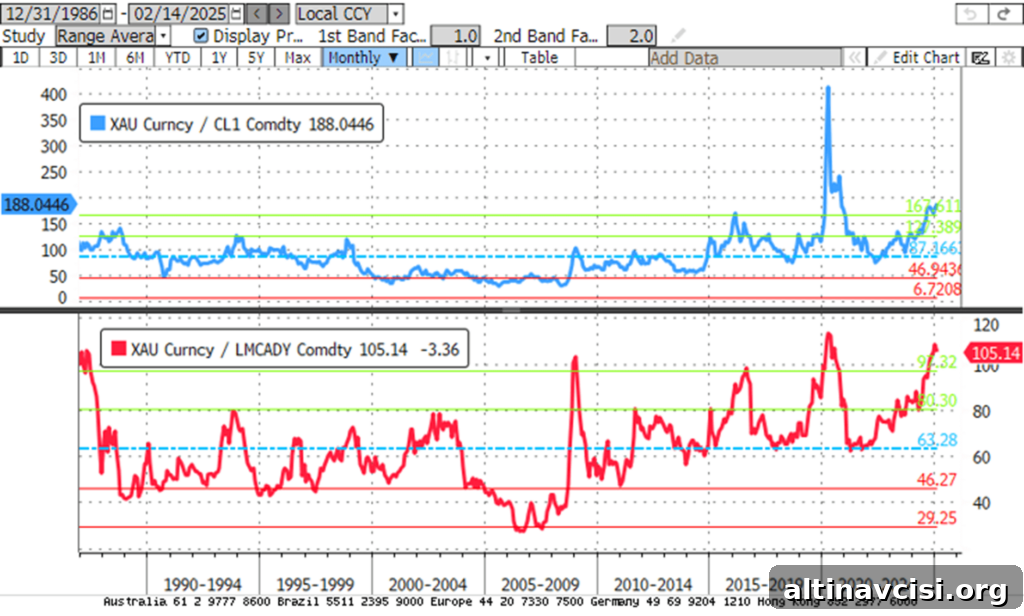
Viewed as a commodity, gold should also be compared against essential inputs like oil and copper that underpin economic activity. On those measures, gold looks relatively expensive, although this can reflect undervaluation of oil and copper in fiat currency terms rather than overstated gold prices.
Gold to Oil ratio (blue line); Gold to Copper ratio (red line) rebased at 100 as of December 31st, 1986.
Gold’s role as a consumption good remains vital across much of Asia, where cultural demand is deep-rooted. In India, gold is central to weddings and festivals and doubles as a form of savings. In China, demand spikes during Lunar New Year and other celebrations. In Southeast Asia, gold is used for ornaments, religious art, and as a store of value. Because of this enduring cultural and financial demand, assessing the world’s total gold stock on a per-capita basis is useful: the current stock equates to roughly $2,150 per person alive today—a notable and slightly elevated figure. This matters because most incremental physical demand comes from emerging markets where gold can be relatively expensive compared with local incomes.
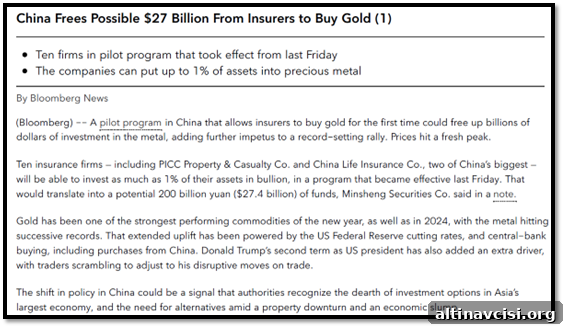
Regulatory approaches also differ. While many Western regulators push banks and insurers toward sovereign bonds, China’s insurance regulator began a pilot program allowing the country’s 10 largest insurers to allocate up to 1% of assets to gold. That change could channel over $27 billion in additional institutional demand into gold and reflects a broader recognition of gold as a legitimate institutional asset in that market.
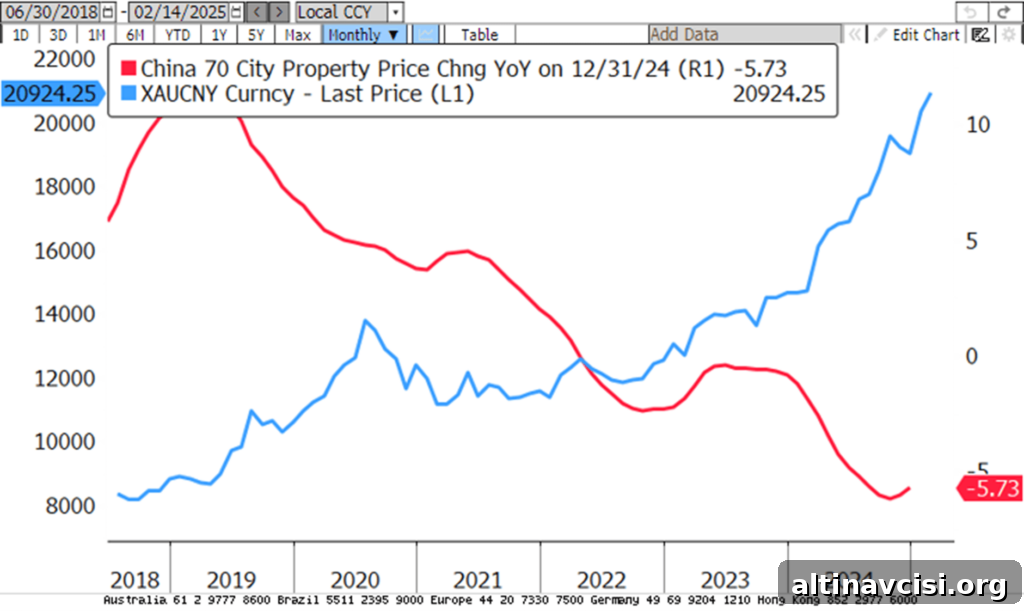
In China, rising gold prices have reduced affordability for some consumers, but falling property prices and a deep real estate downturn have pushed domestic investors toward gold as wealth preservation. With high housing inventories and uncertain stimulus effectiveness, gold stands out as one of the few accessible stores of value for many Chinese households and investors.
Gold Price in CNY (blue line); China 70 Cities Newly Built Commercial & Residential Buildings Price YoY change (red line).
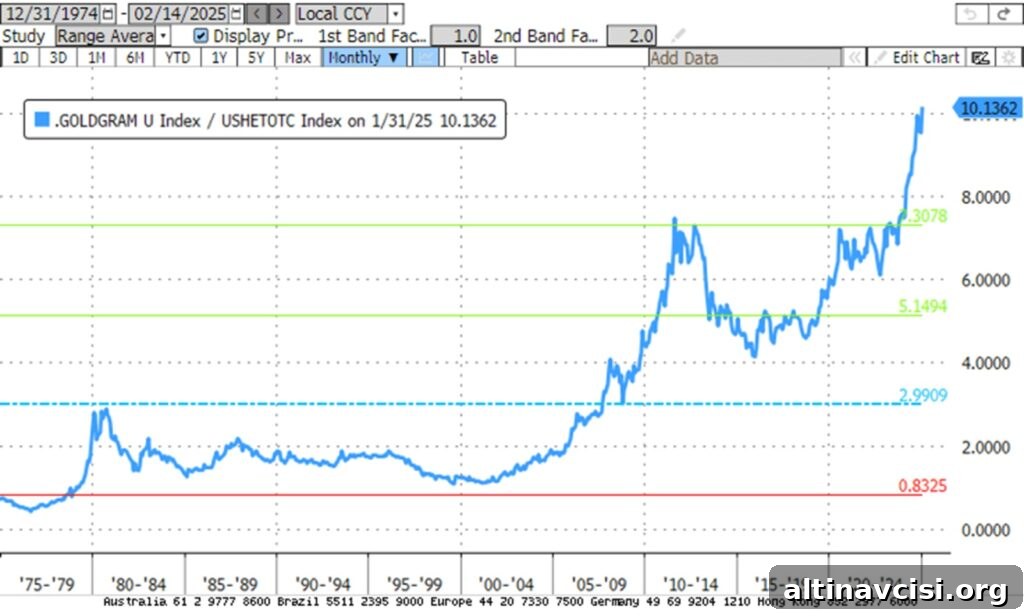
In the United States, the affordability metric—hours of work required to buy a gram of gold—now stands at roughly nine and a half hours for the average worker, a historically high reading that suggests gold is expensive on a wage-adjusted basis.
The price of a Gram of Gold in USD divided by the US average hourly earnings of Private Non-farm employees.
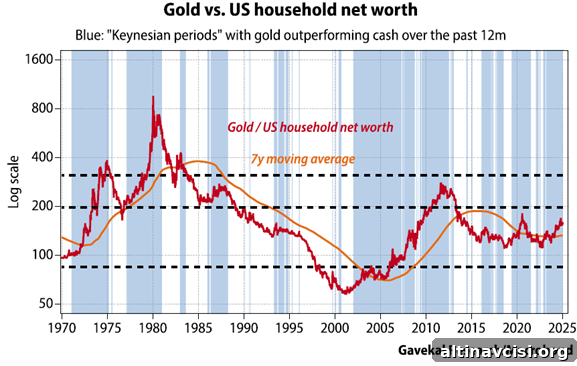
From a household wealth perspective, gold’s current value relative to aggregate U.S. net worth is not extreme. Gold remains underrepresented in many Western portfolios due to narratives that digital assets or fiat-denominated investments have supplanted it. If that perception shifts, gold’s relative weight could expand significantly in coming years. Many investors view gold as the only truly antifragile asset without counterparty risk, while other alternatives like Bitcoin are criticized for being speculative and politically entangled.
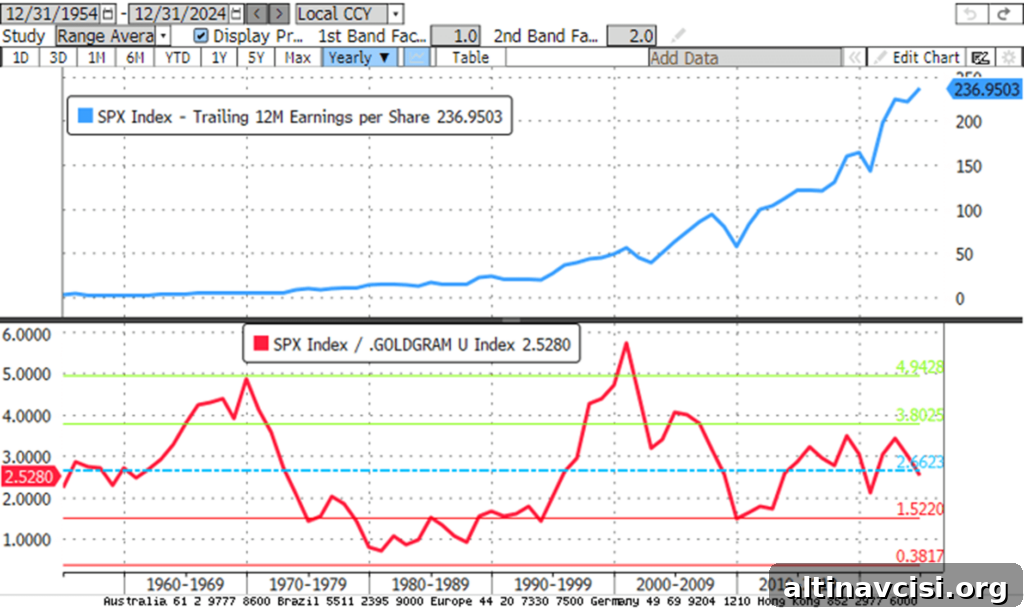
Examining S&P 500 corporate earnings measured in grams of gold shows the ratio sitting near its historical mean—around 2.66 grams. Should an economic bust occur in the next few years, this ratio could decline toward 1.5 grams or lower, as it did during severe crises in the 1970s–1980s and in 2009. Those periods coincided with deep economic stress.
Trailing 12-months Earnings per share of S&P 500 index in USD (blue line); Trailing 12-months Earnings per share of the S&P 500 index expressed in grams of gold (red line).
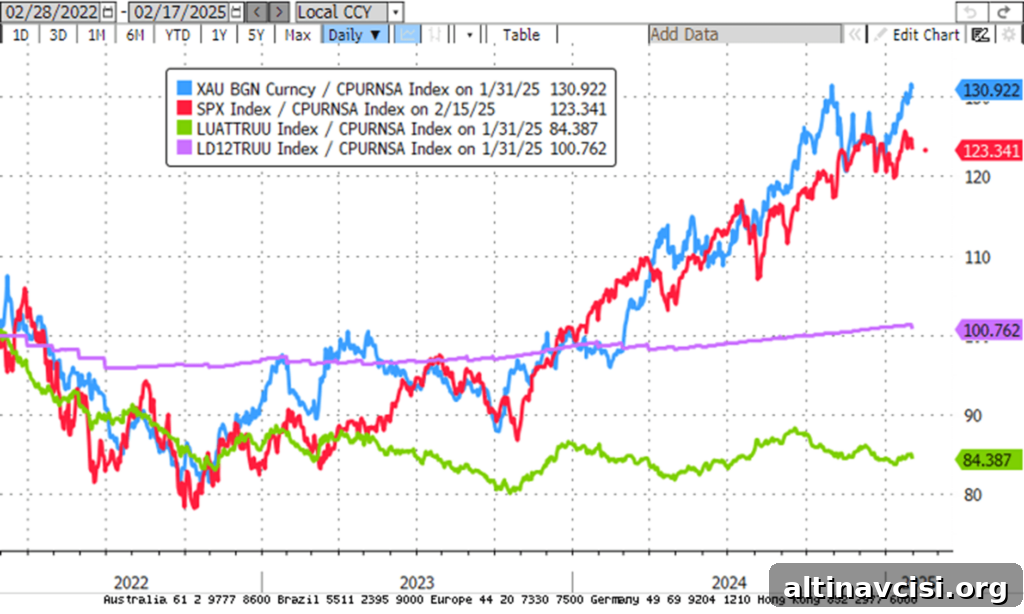
Historically, gold has performed well during wartime and geopolitical shocks, preserving wealth as shortages hit energy, metals, and food. From Vietnam to the Gulf War and the recent conflict in Ukraine, gold has often outperformed oil, equities, and bonds. Given rising geopolitical tensions and the growing use of economic coercion, many investors view physical gold as a defensive asset in turbulent times.
Evolution of $100 invested: Gold (blue line); S&P 500 (red line); Bloomberg US Agg Total Return Index (green line); Bloomberg T-bills 1-3 months Index (purple line), adjusted to inflation since 24th February 2022.
In summary, when viewed through the lens of money in a structurally inflationary environment, gold is far from obviously overvalued relative to historical extremes. As a commodity it may look expensive compared with some inputs, but that often reflects the weakness or undervaluation of other commodities. As a financial asset, gold can continue to appreciate relative to equities and Treasuries, and as a consumption good it remains embedded in cultural demand across many regions.
The bottom line: gold is not at extreme valuations overall. Some indicators warrant caution, but they are unlikely to end the broader bull market while geopolitical polarization and the weaponization of USD assets persist. In such an environment, prioritizing preservation of capital—holding physical gold alongside short-dated investment-grade USD bonds and short-term T-bills—can offer stability.

This approach emphasizes RETURN OF CAPITAL over RETURN ON CAPITAL, helping investors preserve wealth and reduce exposure to systemic risk.
KEY TAKEAWAYS.
Key points to remember:
- Gold is more complex to value than equities because it functions as money, a commodity, a financial asset, and a consumption good.
- Gold’s elevated value relative to money supply may be transitory, but it remains a hedge against reckless government spending and rising sovereign risk.
- As a commodity, gold can appear expensive because other commodities may be undervalued.
- As a financial asset, gold can continue to rise versus U.S. equities and Treasuries.
- As a consumption good, gold may look pricey relative to average incomes, yet remains a meaningful store of value given strong consumer and corporate balance sheets in some economies.
- Gold is not at the extreme valuations of past bull markets; despite warning signs, the current bull market may have further to run amid geopolitical tensions and financial weaponization.
- Investors should favor antifragile assets like physical gold, which offer low correlation with equities and protection against currency debasement.
- In volatile environments, prioritize return of capital over return on capital as stagflation risks rise.
- Physical gold is a reliable hedge against unpredictable government policy and institutional failures.
- Declining trust in public institutions will likely boost demand for non-counterparty, non-confiscable assets such as physical gold and silver.
- Long-dated U.S. Treasuries and bonds may no longer be suitable core holdings for many portfolios; consider short-duration investment-grade corporate bonds and short-term T-bills for capital preservation.
- Expect higher volatility and modest inflation-adjusted returns in the foreseeable future.
HOW TO TRADE IT?
As of February 14th, 2025, the U.S. remained in an inflationary phase, but with the S&P 500-to-Gold ratio dipping below its seven-year moving average, signs point to a transition toward an inflationary bust sooner than some expect. Investors should stay disciplined, use market-based indicators to anticipate cycle shifts, and avoid being swayed by short-term narratives.
As the economy shifts from an inflationary boom to bust, return of capital should take precedence. Physical gold and silver stored outside the banking system offer crisis resilience and remain apolitical stores of value, unlike politically-driven cryptocurrencies. These precious metals can provide access to essentials during severe disruptions and protect against the broader risks of geopolitics and fiscal excess.
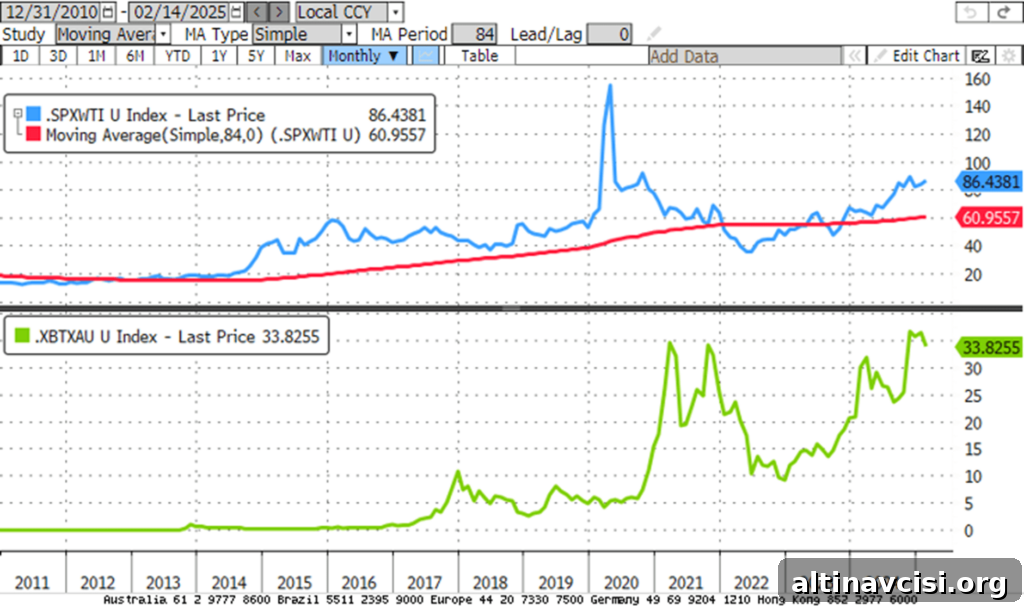
Market relationships such as the S&P 500-to-Oil ratio and the Bitcoin-to-Gold ratio tend to shift alongside broader cycle changes, reinforcing gold’s role as a defensive asset. In an inflationary bust, gold is likely to outperform equities, bonds, cash, and many speculative assets. Wealth preservation going forward will depend on holding physical gold where appropriate, coupled with disciplined selection of equities and short-duration, high-quality cash management instruments.
Upper Panel: S&P 500 to Oil ratio (blue line); 84-months Moving Average of the S&P 500 to Oil ratio (red line); Lower Panel: Bitcoin to Gold ratio (green line).
Ultimately, a combination of physical gold for capital preservation and short-dated, high-quality USD instruments for liquidity management should help investors navigate the turbulent cycle ahead and protect purchasing power through geopolitical and economic uncertainty.