Silver mines are producing significantly less metal than they once did, which means less silver is reaching the market.
Why is silver output falling? Several factors are involved, but one key issue has gone largely unnoticed by many investors—and the situation is more serious than most expect. Below I explain that issue and what it could mean for investors.
Longtime readers know I’ve highlighted a structural decline in supply from silver mining.
By “structural” I mean there are embedded barriers and constraints within the silver mining industry that can’t be quickly or easily fixed. These are not problems that can be reversed by a simple decision or short-term action.
Those constraints matter for investors—especially those who hold physical metal. Here’s what the data show.
Silver Grades Are Plummeting
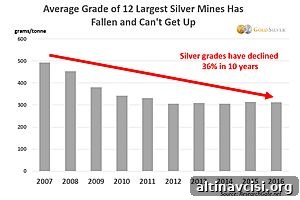
ResearchGate examined the mill feed grades—the grade of ore entering the mill—at the world’s 12 largest primary silver mines. Although the study’s data run only through 2016, the trend is clear: the average grade of these deposits has declined sharply over the past decade.
The average grade across those 12 largest silver projects fell roughly 36% in ten years.
That steep decline in ore grades is a major reason new silver supply has rolled over and begun to drop globally. Less metal in the ground means less metal available to reach the market.
What caused grades to fall?
One important cause is “high grading.” When silver prices crashed in 2013, many producers targeted the richest portions of their deposits to preserve production and earnings. That strategy boosted short-term output but left lower-grade material behind—material that often only becomes economic when blended with higher-grade ore.
As a result, much of the remaining ore now requires substantially higher silver prices to be mined economically, and in some cases it may never be viable at realistic price levels.
This trend has affected company reserves as well. Reserves are the highest-confidence estimate of how many ounces a company has in the ground, and they too have shown a troubling decline.
Reserve grades among the same 12 large mines have dropped nearly 40%. A fall of that magnitude in any mining sector has serious consequences.
New projects could partially offset this trend, and some may offer investment opportunities, but offsetting a decade-long downtrend will require many large, high-grade discoveries. Given the current trajectory, the industry faces an unrelenting downward spiral unless conditions change materially.
Some readers may ask about “resources.” Resources are estimates of ounces in the ground with a lower confidence than reserves; they indicate reasonable prospects for economic extraction, and companies aim to convert resources into reserves to boost investor confidence.
Unfortunately, resource grades are not higher: they have declined even more than reserve grades. That means future reserves are unlikely to feature substantially better grades without major new discoveries.
- The data clearly show that grades at the largest silver mines will not increase in the coming years. That implies less mined silver will reach the market.
This matters because most bullion comes from newly mined silver. Secondary sources—previously bought and sold products—will remain part of the market and could play an increasing role in a supply crunch, but if mine production is not healthy and rising, there will be pressure on physical supply when demand surges. At present, mine production is neither robust nor growing.
The Only Way Out
The only realistic way to reverse the decline in new mine supply is higher silver prices—sustainably higher.
Producers and their financiers must be convinced that elevated prices will persist before committing millions or billions to new projects. Cost reductions have limits, so only a long-term price increase will justify the capital expenditures needed to develop new mines or expand existing ones.
I know many mining executives, and they work constantly to replace produced ounces. Still, they will not commit significant funds unless they—and the investors and banks backing them—believe the silver price will remain at profitable levels for years. That requirement slows the pace of new supply development dramatically.
- At current price levels, the silver price is too low to reverse the decline in mine supply.
The other option is discovery of new, high-grade deposits that can be exploited at lower cost. However, such deposits are increasingly rare, harder to find, sometimes located in politically risky jurisdictions, face environmental constraints, or are costly to prove up. Even when discovered, advancing a project to production often takes many years—it’s a slow, capital-intensive process, not a quick fix.
Even if silver prices rise, the mining industry behaves like a large tanker making a slow turn: it cannot respond to price moves instantly. That mismatch between a volatile market and a slow-moving supply side means tightening is likely.
It is becoming clear that silver supply will tighten further.
What does this mean for investors?
- If demand spikes again and it becomes widely understood that the mining industry cannot immediately ramp up production—or that investors and buyers cannot obtain physical metal quickly—what happens to the silver price when headlines highlight a supply/demand crunch?
Draw your own conclusion. I agree with those who expect higher prices ahead, and I am increasing my physical silver holdings accordingly.