Can’t decide whether to buy gold now or wait?
We reviewed historical data to determine whether there’s a best time of year to buy gold. Is there one? Let’s start at the beginning.
Why Buy Gold?
Gold is rarely bought in isolation. Most investors include gold as part of a diversified portfolio and set their allocation based on broader economic risk. When people feel financially secure they take more economic risks: they start businesses, spend more, and invest in public companies. That environment is typically “risk-on.”
Conversely, when people feel uncertain or anxious about their finances they cut spending, save more, and move capital into safer assets. That shift tends to depress stock prices and increase demand for safe havens like gold.
So when is the best time to buy gold? A useful answer begins by assessing both personal circumstances and the market’s risk sentiment.
The Dow/Gold Ratio
One way to gauge collective investor risk appetite is the Dow/gold ratio, which compares the Dow Jones Industrial Average to the price of gold. When the ratio rises, stocks are outperforming gold and the market is generally risk-on. When it falls, gold is outperforming stocks and sentiment has shifted toward risk-off.
The ratio cycles over long periods—often a decade or more for major moves. Faster corrections tend to correspond with periods when gold outperforms. In 2024 the Dow/gold ratio sits roughly around 19, well above its historical mean of about 9.7 and median near 5.5.
A ratio this high suggests that, over time, reversion toward historical averages is possible. If the ratio falls toward its median or lower, gold would likely outperform stocks for an extended period. That potential reversion is a key consideration when deciding whether to add gold to a portfolio now.
That said, high ratios can persist and may continue rising before any reversion occurs. The ratio could extend to new highs. Predicting the timing is impossible, but if you believe a reversion is likely, buying gold sooner rather than later may be prudent.
The Gold Bull Market
Understanding the broader gold cycle helps refine timing decisions. Gold typically moves in long, distinct cycles. A major bull market in the 1970s was followed by a lengthy bear market lasting about 20 years. In past bull markets the final phase has often featured dramatic, rapid price increases—a “blow-off” top—where prices accelerate as enthusiasm and speculation peak.
Paul Tudor Jones captured this dynamic well: “It’s just the nature of a rip-roaring bull market. Fundamentals might be good for the first third or first 50 or 60 percent of a move, but the last third of a great bull market is typically a blow-off, where the mania runs wild and prices go parabolic.”
For example, in 1979 gold rose from $226 to $512 in a year, then spiked to $873 in three weeks—a remarkable blow-off move. If history is a guide and today’s cycle is entering a late stage, investors may face significant upside in gold—though blow-offs can be volatile and rapid.
The Best Time of Year to Buy Gold
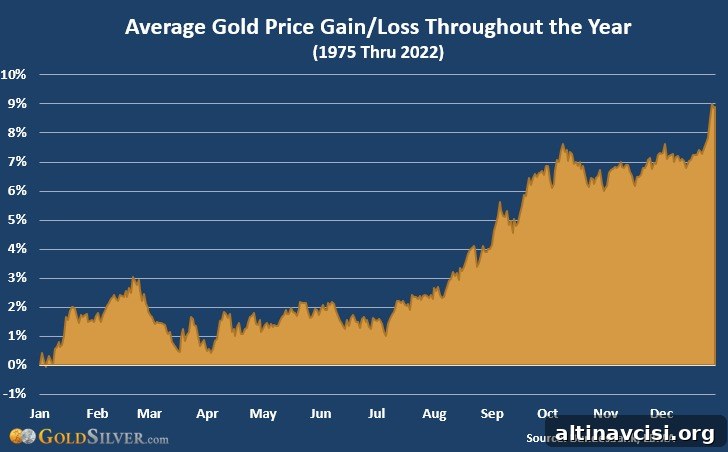
Examining seasonal data shows that exact month-to-month timing matters very little for long-term investors. Over years and decades the difference between buying in one quarter or another is typically negligible. What matters more is purchasing this year instead of waiting another year if you expect gold to outperform in the medium to long term.
Rather than trying to catch the absolute bottom, focus on accumulating ounces. Dollar cost averaging (DCA) is an effective strategy: invest a fixed amount at regular intervals regardless of price. DCA reduces timing risk, enforces consistency, makes investing accessible at any budget level, and aligns well with long-term objectives.
Benefits of dollar cost averaging into gold include:
- Mitigates timing risk: Spreads purchases over time so you’re less exposed to short-term volatility.
- Promotes discipline: Regular investments encourage consistent saving and reduce emotional decision-making.
- Accessible: Enables investors to start small and build positions gradually.
- Well-suited for long-term goals: Helps accumulate ounces over time without trying to time market peaks and troughs.
What Is InstaVault?
InstaVault is a service that allows near-instant buying, selling, and vaulting of fractional interests in large bullion bars. It offers a cost-effective way to gain exposure to physical gold and silver with features designed for flexibility and liquidity.
Key attributes of InstaVault include:
- No minimums: Buy in the increments that fit your budget, whether building gradually or investing in bulk.
- Immediate liquidity: Sell at market after settlement, add to positions on dips, or hold and monitor online.
- Delivery on demand: Convert fractional holdings to whole coins or bars and request insured shipping at any time.
- Efficient pricing: Access the lower premiums typical of large bulk bars while owning fractional shares allocated in your name.
- Physical ownership: Investments represent allocated physical metal held in secure third-party vaults, not futures or paper claims.
- Competitive spreads and security: Prices are designed to track market spot closely, with vaulting in insured facilities under independent audit.
InstaVault enables investors to start with small increments—such as 1 troy ounce of silver or 1/100th troy ounce of gold—and to scale as desired while retaining the option for physical delivery.
Take Delivery Any Time With Conversion
When you invest through InstaVault you own fractional, allocated interest in real bars stored at independent vaults. You can request conversion of your fractional ounces into whole-ounce bullion products and arrange delivery for a modest exchange fee plus insured shipping. Note that certain large-bar sizes cannot be delivered as single bars; conversions are limited to a predefined list of whole-ounce products.
Storage & Insurance Fees
Storage and insurance fees cover the cost of safeguarding physical holdings. For InstaVault silver investors the monthly fee is low—for example, roughly 0.06% of the silver’s value per month, billed by card and not taken from your metal. These fees are typically smaller and more flexible than minimums associated with whole-coin and full-bar allocated storage.
If you’ve been asking, “Is now the best time of year to buy gold?” the practical answer is that, for long-term investors who expect gold to outperform, buying sooner rather than later makes sense. Consider dollar cost averaging to build ounces over time and choose a secure, liquid custody option that fits your needs.