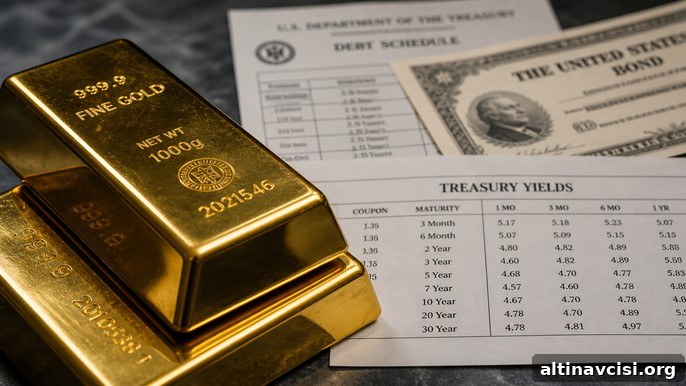
Gold and silver market update — May 1, 2026
Key Takeaways
- The April 29 FOMC produced four dissents — the most divided vote since 1992 — while Q1 PCE inflation ran at a 4.5% annualized rate, well above the Fed’s 2% goal. Recent data have strengthened the hawkish view.
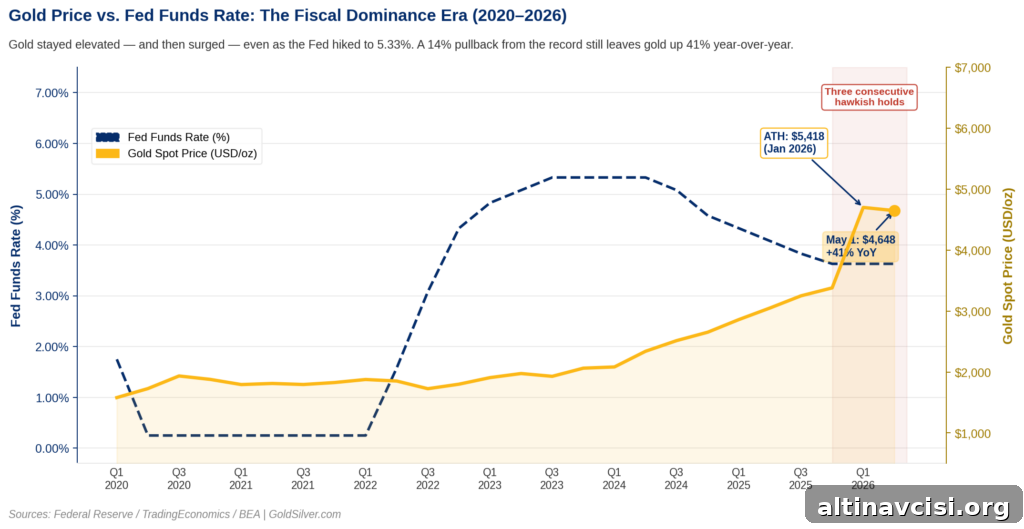
- Gold, trading near $4,648/oz, is up about 41% year-over-year despite a roughly 14% pullback from January’s record high. Those gains have persisted through geopolitical stress, repeated hawkish holds, and a leadership transition — a notable structural story.
- Fiscal constraints matter. With annual US interest payments on the debt topping $1 trillion at current yields, there is a hard arithmetic limit on how far policy can be tightened without forcing monetary accommodation.
As of 1:24 PM ET on May 1, 2026, the gold price is roughly $4,600/oz — down about 1% on the day and up roughly 41% from a year ago. It remains approximately 14% below the January record of $5,418/oz. Both facts are accurate, but the year-over-year gain captures the broader market narrative: a durable rally that has weathered multiple shocks.
A 14% retreat from an all-time high under these conditions looks less like a breakdown and more like consolidation above a new, higher baseline.
What does a four-way FOMC dissent mean for gold?
On April 29, the Federal Open Market Committee voted 8–4 to hold the policy rate at 3.50%–3.75%. That four-member dissent was the first of its kind since October 1992. Three regional presidents — Beth Hammack (Cleveland), Neel Kashkari (Minneapolis), and Lorie Logan (Dallas) — pushed to drop the easing bias from the statement, signaling they want rates higher for longer than the majority conveyed. Governor Stephen Miran dissented in the opposite direction, favoring an immediate cut.
The next day’s BEA data gave those hawks material backing. Q1 2026 GDP rose at a 2.0% annualized pace, a rebound from Q4. More importantly, the PCE price index, the Fed’s preferred inflation gauge, ran at a 4.5% annualized quarterly rate; core PCE was 4.3% on the same basis. On a year-over-year basis, headline PCE hit 3.5% in March and core PCE 3.2% — the highest annual readings in about two years.
This is not stagflation. The economy is expanding while inflation is re-accelerating — an inflationary expansion. In that environment, cutting rates would be difficult to justify, and several major firms now expect little to no easing before 2027.
The Edge Every Investor Needs
Smarter precious metals investing starts here. The Nuggets Newsletter brings essential market insights, Fed updates, global trends, educational videos, and timely analysis.
Can Warsh actually tighten policy with $1 trillion in annual debt interest?
Kevin Warsh cleared the Senate Banking Committee on April 29 in a party-line 13–11 vote, the first fully partisan committee vote for a Fed chair nominee. The full Senate vote is scheduled no earlier than the week of May 11; Jerome Powell’s term expires May 15.
Warsh has publicly advocated shrinking the Fed’s balance sheet, restoring inflation credibility, and reducing forward guidance. His hawkish stance is sincere, but it encounters a structural limit: fiscal dominance.
Fiscal dominance occurs when debt service becomes so large that monetary policy effectively must accommodate borrowing costs. At current yields the U.S. pays more than $1 trillion annually in interest on federal debt. Higher policy rates would increase that burden, prompting more Treasury issuance. Rising supply pushes yields up further, and the resulting pressure can lead the Fed to buy bonds to stabilize markets — expanding the money supply and reigniting inflation. The constraint here is arithmetic rather than solely political.
In short, raising rates could create a feedback loop that increases inflation risk; cutting rates to relieve debt service risks validating higher inflation. Both paths can end with monetary expansion.
Why hasn’t the gold price fallen while the Fed holds rates high?
Observers often point to 1992 — the last time four FOMC members dissented — when gold spent years moving sideways. But the fiscal backdrop then was very different. In 1992 the federal deficit and total debt levels left more room for policy maneuver. Today, annual interest costs exceed $1 trillion, removing much of the fiscal flexibility that helped the Fed regain credibility in the 1990s.
Gold has navigated the Iran war, three consecutive hawkish holds, a divided FOMC, and a leadership transition and still sits about 41% above its level a year ago. Each event offered a rationale to sell, yet the metal retained most of its gains. For a non-yielding asset to do so while macro risks mount signals market concerns about fiscal sustainability and the potential for future monetary accommodation.
Silver, trading near $73/oz, remains around 40% below its January 2026 record of $121.67/oz. The market still faces a structural supply deficit, but silver’s heavier exposure to industrial demand makes it more sensitive to higher-for-longer rates, which can weigh on manufacturing. Watch the gold-silver ratio as a key indicator for when industrial demand begins to reassert itself.
Three dates every gold investor should watch before June
Key upcoming dates: the Senate floor vote on Warsh the week of May 11, Powell’s term expiration on May 15, and the first FOMC meeting under new leadership with updated projections on June 17. Markets currently price a high probability that rates will hold in June; if PCE readings remain elevated, the hawkish minority at the Fed may gain broader support.
The interplay of a divided central bank, a new chair entering a tight fiscal environment, and a gold price that remains well above last year’s level makes the next moves less about metals per se and more about whether the incoming chair can navigate a difficult arithmetic constraint that has eluded prior policymakers.
Stay On Top of Gold & Silver Prices
Get important market alerts sent straight to your inbox.
SOURCES
1. Federal Reserve — FOMC Statement, April 29, 2026
2. Federal Reserve — Press Conference Transcript, April 29, 2026
3. Bureau of Economic Analysis — GDP Advance Estimate, Q1 2026
4. Bureau of Economic Analysis — Personal Income and Outlays, March 2026
5. Reuters via Investing.com — Morgan Stanley Sees Fed Holding Rates Steady in 2026
6. CME Group — FedWatch Tool, June 2026 Rate Probabilities
7. TradingEconomics — Gold Price Historical Data, Year-Over-Year Return
8. TradingEconomics — Silver Spot Price, May 1, 2026
9. CNBC — Trump Fed Nominee Kevin Warsh Clears Key Senate Hurdle
10. Congressional Budget Office — Historical Budget Data
Disclaimer: This article is for informational purposes only and does not constitute financial or investment advice. Always consult a qualified financial adviser before making investment decisions.
You May Also Like:
- 5 Economic Warning Signs Gold Investors Need to See Today
- WGC Q1 2026: What Asia Knows That Wall Street Doesn’t
- BEA Stripped Silver From GDP. Here’s What It Means
- PCE at 3.5%, GDP Miss: Why This Is Bullish for Gold
- How Warsh’s Inflation Measure Could Move the Gold Price
- Gold Is Down 19%. This $3.8B Bet Says It Doesn’t Matter
- Gold, Oil, and the Fed: Why the Old Rules Don’t Apply
- Why Turkey Sold Its Gold Reserves — And What It Proves About Sound Money