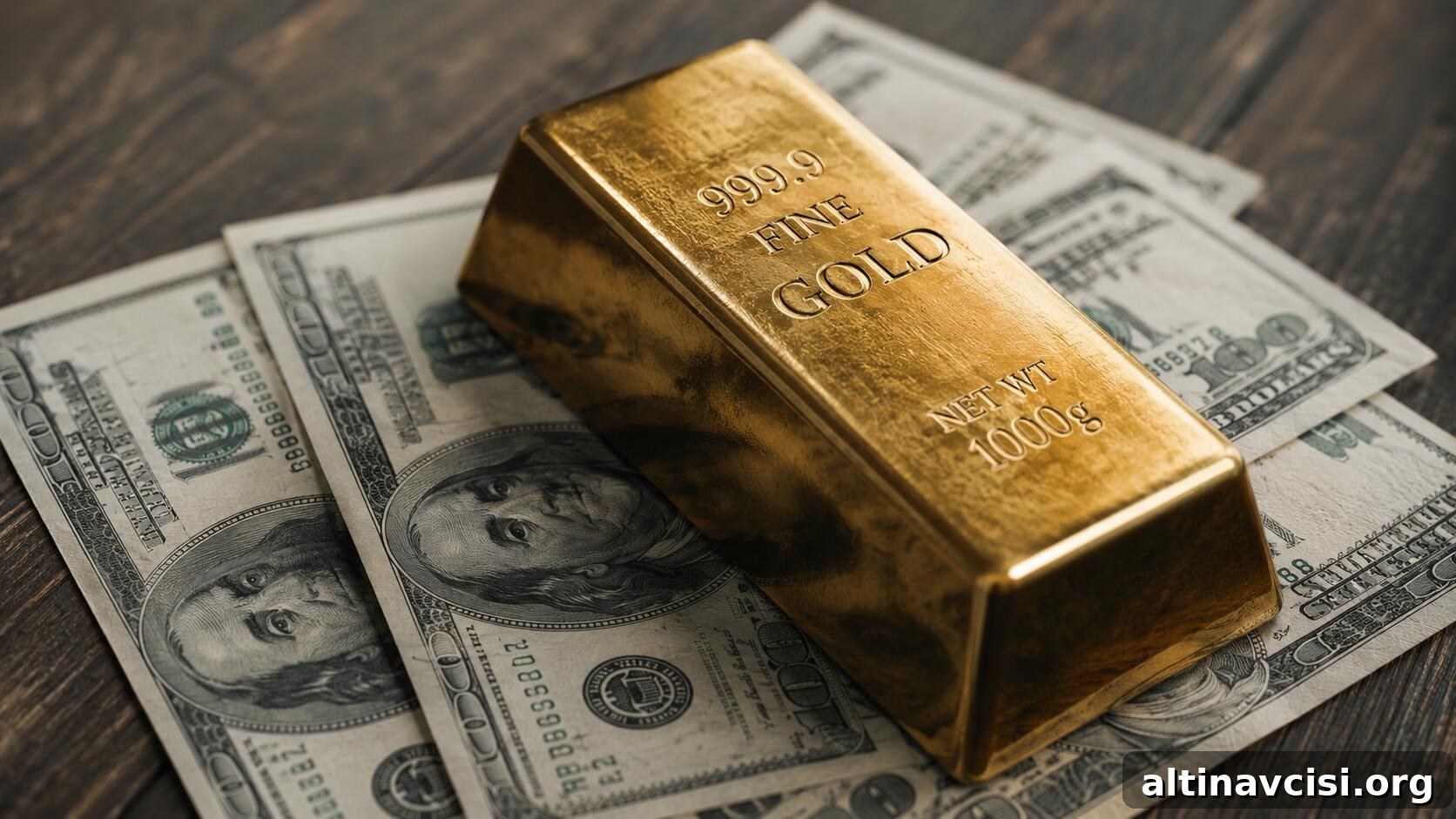
Gold price history is the 100-year record of the dollar’s long decline against a metal that cannot be printed. Over that century, gold rose from $20.67 per ounce under the gold standard to roughly $4,500 as of mid-2026 — an increase exceeding 21,000%. Over the same period the dollar lost about 96.9% of its purchasing power, according to Bureau of Labor Statistics CPI-U data. These two figures tell the same story from opposite perspectives.
This article presents a decade-by-decade account of gold prices, explaining the main drivers behind each major move — because knowing why gold moved is far more useful than merely knowing that it did.
Quick summary
- $20.67 → $4,500: Gold has risen more than 21,000% since the early 20th-century gold standard era, while the dollar has lost 96.9% of its purchasing power over the same period.
- The pivotal date is August 15, 1971. Nixon’s decision to end dollar-to-gold convertibility freed gold to trade in markets and to reflect the real rate of monetary debasement.
- Gold is at a real-terms all-time high. Around $4,500 as of mid-2026, it exceeds the inflation-adjusted 1980 peak of roughly $3,200, meaning the current bull market has genuine historical significance, not only large nominal numbers.
Sources: LBMA, World Gold Council, FRED. Price as of June 2026. Log scale used to show proportional moves across the full century.
What Was the Gold Price 100 Years Ago?
In the 1920s, gold wasn’t a market price so much as a legal definition. Under the Gold Standard Act of 1900, one dollar equaled 1/20.67th of a troy ounce of gold, which made an ounce of gold worth exactly $20.67. That fixed rate had effectively held since 1834 and anchored nearly a century of price stability: every dollar could be redeemed for a specified weight of gold.
The system began to break down during the Great Depression. In 1933, President Roosevelt’s Executive Order 6102 required Americans to surrender most private gold to the Federal Reserve at $20.67 per ounce. In 1934 the Gold Reserve Act revalued the official price to $35 per ounce, devaluing the dollar by about 41% relative to gold and creating an immediate paper gain for the government on the reserves it held.
Gold remained fixed at $35 through the 1940s and 1950s under the Bretton Woods system, which pegged other currencies to the dollar and the dollar to gold. That arrangement worked for a time, but mounting US fiscal spending — including costs associated with the Vietnam War and expanded domestic programs — increased the dollar supply beyond the gold backing and gradually eroded confidence in the peg.
What Happened to Gold Prices After Nixon Ended the Gold Standard?
On August 15, 1971, President Nixon ended dollar-to-gold convertibility — an event often called the Nixon Shock. From that point gold traded freely on open markets and began to reflect the full impact of monetary policy and inflation. The change was dramatic and immediate.
By the end of 1971 gold rose to $43 per ounce and, within two years, climbed above $120. The 1970s produced the most explosive gold bull market in modern history: oil shocks, double-digit inflation peaking near 14.8% CPI, geopolitical crises and monetary expansion pushed gold from $35 to an $850 peak on January 21, 1980 — a rise of more than 2,300% in under a decade.
Gold’s ascent since 1971 reflects the mathematics of currency debasement: when governments expand the money supply, currencies lose purchasing power; gold, which cannot be created by decree, preserves value. Adjusted for CPI, the $35 official price in 1971 corresponds to about $270 in 2026 dollars. With gold trading around $4,500 in mid-2026, the metal has outperformed that inflation-adjusted benchmark by a wide margin over 55 years of free trading.
The Knowledge That Changes Everything
Two essential guides — yours free. Understand why gold matters and why fiat currencies are vulnerable.
Why Did Gold Fall from $850 to $255 Between 1980 and 1999?
The two-decade bear market after the 1980 peak is instructive. Federal Reserve Chairman Paul Volcker tamed inflation by raising interest rates to near 20% in 1981. High real interest rates — yields above inflation — make holding non-yielding assets like gold costly, so investors moved into Treasuries and other yield-bearing instruments. Gold fell from $850 in 1980 to about $252 in August 1999, a decline of roughly 70% over twenty years.
European central banks sold gold reserves in that period, seeing it as a relic of the past; their sales added supply pressure. Meanwhile, the dot-com boom offered higher returns elsewhere, reducing demand for gold until the tech bubble burst and real interest rates declined around 2000.
How Has Gold Performed in the 21st Century?
Gold’s 21st-century path falls into three phases, each driven by different structural forces.
Act One: 2001–2011 — The Financial Crisis Bull Run. After the dot-com bust gold began to rise in 2001. It passed $1,000 per ounce in March 2008 before the collapse of Lehman Brothers and the global financial system. The Fed’s unprecedented monetary response — near-zero interest rates and quantitative easing — pushed real yields deeply negative and helped gold reach $1,921 in September 2011. That decade delivered roughly a 659% gain.
Act Two: 2012–2018 — Consolidation. As stimulus tapered and policy normalized, gold retraced. From the 2011 peak it fell to about $1,050 by late 2015, with 2013 marking a sharp 28% decline. Even so, the metal did not revert to pre-2008 levels; the structural floor had risen.
Act Three: 2019–2026 — The New Regime. Three events reshaped the market. The COVID-19 pandemic in 2020 prompted the largest fiscal and monetary expansion in peacetime, sending gold to $2,075 in August 2020. The 2022 Russian invasion of Ukraine and subsequent freezes on large reserves altered reserve management strategies, accelerating central bank purchases. Persistent inflation after 2021 and continued monetary accommodation pushed gold above $3,000 in March 2025, $4,000 in October 2025, and to a nominal high of $5,589 on January 28, 2026, according to LBMA data.
What Is the Inflation-Adjusted All-Time High for Gold?
The nominal all-time high is $5,589 (January 2026), but the inflation-adjusted peak gives a clearer perspective. Gold’s $850 peak in 1980 equals approximately $3,200 in 2026 CPI-adjusted dollars. With gold trading around $4,500 in mid-2026, it meaningfully exceeds the 1980 peak in real terms. That real-terms break matters for evaluating whether gold is expensive by historical standards and supports the view that this cycle reflects structural repricing as fiat currencies lose credibility.
Notably, gold has delivered positive returns in 20 of the 26 years since 2000 and rose from $279 per ounce in 2000 to over $4,500 by mid-2026 — a gain of more than 1,500% over the period, compared with roughly 500% for the stock market in the same span.
What Is Driving the Gold Price in 2026?
As of June 2026, gold trades near $4,500 per ounce, up roughly $1,150 year‑over‑year. Several structural forces support prices above $4,000 even after the pullback from the January 2026 high.
Central banks remain major buyers: net purchases were strong in early 2026, one of the fastest quarterly paces on record. Gold’s remonetization is occurring across multiple institutional channels simultaneously, creating sustained demand from sovereign reserve managers. The macro backdrop resembles 1970s stagflation more than other historical periods: inflation running above trend while GDP growth is muted, leaving policymakers with difficult trade-offs. Gold benefits from both persistent inflation risk and concerns about currency reliability.
Institutional portfolio allocation is also shifting. In 2026 several large banks published research recommending larger gold allocations than historically typical, which adds a new, sustained source of demand not present in earlier cycles.
The Second Corner: What the 100-Year Record Really Shows
Most coverage emphasizes price action — peaks, drawdowns and percent gains. The deeper lesson from a century of data is structural: every major gold rally has followed a period of dollar overextension. Governments run deficits, expand the money supply to finance spending, and inflation or currency weakness follows. Gold’s price rises because it takes more dollars to buy the same ounce of metal when the money supply grows faster than real productive capacity.
The BLS CPI data underscore this dynamic: the dollar has lost about 96.9% of its purchasing power since 1913, the year the Federal Reserve was created. What cost $1 then costs roughly $33 now. Current fiscal deficits above $2 trillion annually and rising interest costs on the national debt suggest those pressures are ongoing. In that environment gold’s role as a store of value outside the fiat system is not merely speculative — it reflects long-running monetary dynamics.
Key Takeaways
- Gold rose from $20.67 to around $4,500 in 100 years — a gain of more than 21,000% while the dollar lost 96.9% of purchasing power. These are two sides of the same phenomenon.
- The Nixon Shock of 1971 is pivotal. Ending convertibility freed gold to price the true rate of monetary debasement.
- Bear markets in gold are typically driven by high real interest rates. The 1980–2000 decline followed Volcker’s rate hikes, not a permanent loss of gold’s monetary role.
- Gold’s current price is a real-terms high. Around $4,500 in mid-2026, it exceeds the CPI-adjusted 1980 peak and therefore carries meaningful historical weight.
- Central bank buying is a new structural driver. Sovereign re-accumulation of gold signals a lasting shift in reserve management and supports sustained demand.
Stay On Top of Gold & Silver Prices
Get important market alerts sent straight to your inbox.
People Also Ask
Why did gold go from $35 to over $4,000?
Gold rose from $35 to more than $4,000 primarily because the Bretton Woods cap on price ended in 1971. Once the dollar was no longer convertible to gold at a fixed parity, gold began to reflect the cumulative erosion of the dollar’s purchasing power as monetary expansion outpaced real economic growth. Large post-2008 and post-2020 monetary expansions accelerated that trend, producing the move from $35 to $4,500+ as the dollar’s inflation record expressed in ounces of gold.
What was the highest gold price in history?
The nominal record is $5,589 per troy ounce on January 28, 2026, based on LBMA and market data. Gold later pulled back and traded around $4,500 in June 2026. Adjusted for CPI, the current mid-2026 level also surpasses gold’s previous real peak from 1980, making it a real-terms high as well as a nominal one.
How has gold performed against inflation over 100 years?
Over a century, gold has dramatically outpaced CPI inflation in nominal terms. The dollar has lost roughly 96.9% of purchasing power since 1913, while gold rose from $20.67 in the early 20th century to about $4,500 in mid-2026. Performance has varied across cycles: gold underperformed during the high real-rate period of 1980–2000 and outperformed during inflationary or monetary-expansionary regimes. Gold is most effective as an inflation hedge across full monetary cycles rather than over shorter intervals.
What caused the gold price spike in 1980?
The 1980 peak near $850 resulted from a combination of very high inflation (around 14.8% CPI), two oil shocks, geopolitical crises (the Iranian hostage crisis and the Soviet invasion of Afghanistan) and speculative pressure in precious metals. The Hunt brothers’ attempt to corner silver added to the speculative atmosphere. The spike ended when the Federal Reserve under Paul Volcker raised rates sharply, ultimately crushing inflation and sending gold lower for much of the next two decades.
Is gold a good long-term investment based on its price history?
Gold has preserved purchasing power across long monetary cycles and has provided positive returns in most years since 2000. Its suitability depends on objectives: as insurance against monetary debasement, currency volatility and systemic risk, gold performs well. As a growth asset, it lags equities during long bull markets. Historically, a balanced allocation (often 10–20%) best captures gold’s risk‑management benefits without sacrificing growth potential.
SOURCES
1. Bureau of Labor Statistics — CPI-U Historical Data
2. Bureau of Labor Statistics — CPI Inflation Calculator
3. Federal Reserve History — Nixon Ends Convertibility of U.S. Dollars to Gold and the Smithsonian Agreement
4. Federal Reserve History — The Great Inflation
5. National Archives — Executive Order 6102 (1933)
6. London Bullion Market Association — Gold Price Data & Annual Averages
7. World Gold Council — Gold Demand Trends, Q1 2026
8. Bureau of Economic Analysis — GDP & PCE Data
9. CME Group — FedWatch Tool
10. Congressional Budget Office — Budget & Economic Outlook
11. U.S. Treasury — Interest Expense on the Debt Outstanding
Disclaimer: This article is for informational and educational purposes only. It does not constitute investment advice. Please consult a qualified financial adviser before making any investment decisions.
You may also like:
- The Debasement Trade Explained: Mechanism, History, and What It Means for Gold
- Gold or Silver First? A First-Time Buyer’s Framework
- Gold Reserves by Country: The 2026 Rankings
- Gold Portfolio Allocation: Why Wall Street Is Rewriting the 60/40
- What Does the SILVER Act Mean for Precious Metals Investors?
- What Backs the US Dollar? Not Gold. Not Silver.
- Why Is Gold Valuable? The 5,000-Year Answer Most Investors Get Wrong
- 72% of Family Offices Hold No Gold. What They’re Missing.