
Key Takeaways
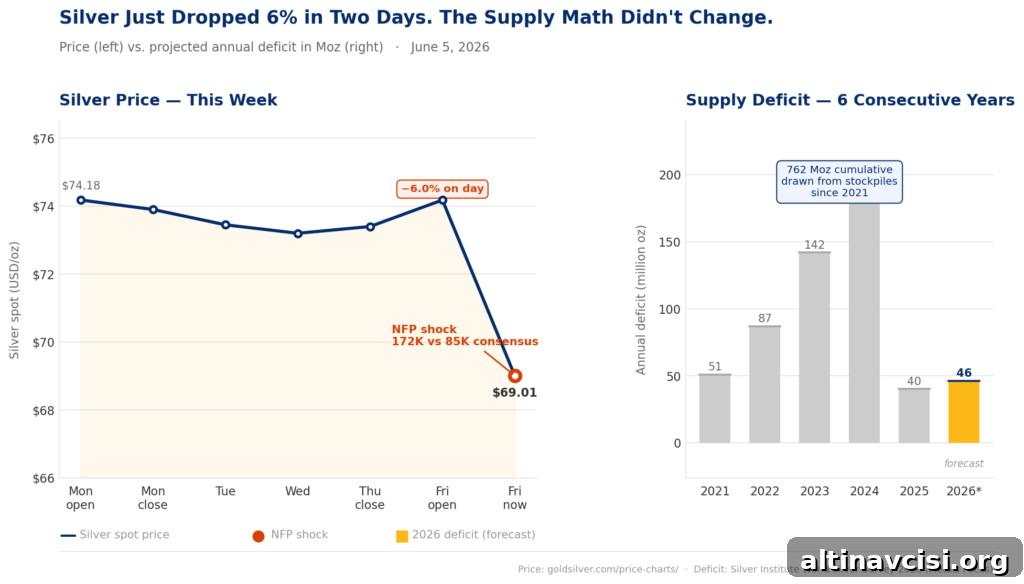
- Silver dropped about 6% on Friday after the May jobs report; gold fell roughly 3%
- May NFP 2026: 172,000 jobs vs. an 80,000–85,000 consensus — third straight beat
- Odds of at least one rate hike by year-end: 67% (CME FedWatch), up from 45% last week
- About 56% of silver demand is industrial and largely unaffected by payroll data
- World Silver Survey 2026 (Silver Institute): 46.3 Moz deficit — sixth consecutive year, a 15% increase versus 2025
- Cumulative above-ground stockpile drawdown since 2021: about 762 million troy ounces
- Gold-silver ratio today: approximately 63 — widening because silver fell more than gold
Silver is trading near $72 this afternoon, down nearly 6% since Thursday’s close. Gold also fell, but by roughly 3%. The white metal tends to move with greater amplitude: it falls harder and rallies stronger. That volatility reflects two structural realities — one monetary, one industrial — and today’s price action highlights how those drivers can diverge.
Friday’s catalyst was the May jobs report. The U.S. economy added 172,000 jobs last month, well above the Dow Jones consensus of 80,000–85,000. This marks the third consecutive month that payrolls exceeded expectations. The unemployment rate remained at 4.3%, and average wages rose 3.4% year-over-year, according to the Bureau of Labor Statistics.
The immediate market reaction was straightforward: the Federal Reserve is less likely to cut rates and may even need to hike. Traders reacted quickly — CME FedWatch now puts the probability of at least one rate increase before year-end at 67%, up from 45% a week earlier. The 10-year Treasury yield jumped to about 4.54% and the U.S. dollar strengthened.
That macro move hit one of silver’s engines directly.
Why Does Silver Move More Than Gold?
Silver runs on two main engines: a monetary dynamic shared with gold, and a separate industrial demand engine. Only the monetary engine responds quickly to jobs data.
On the monetary side, silver behaves like a sound-money asset. When real yields rise — meaning investors earn more on dollar-denominated assets after inflation — interest in non-yielding metals like silver and gold typically falls. Expectations of rate hikes push real yields higher and put immediate pressure on both metals. That is the mechanism responsible for the sharp single-day move.
The industrial side is different. Silver is essential in solar panels, electric vehicles, data center components, medical devices and numerous electronic applications because it is the most electrically conductive metal. Roughly 56% of global silver demand comes from manufacturing rather than investment or jewelry, so a large portion of demand is tied to long-term industrial projects and buildouts.
Here’s the key point: Friday’s strong payrolls number doesn’t change industrial requirements. Solar projects planned for Q3 still need silver, EV production continues, and data centers still require conductive materials. Those multi-year demand drivers don’t pause because a monthly employment print surprised.
The Edge Every Investor Needs
Smarter precious metals investing starts here. The Nuggets Newsletter brings essential market insights, Fed updates, global trends, educational videos, and more.
Has the Silver Supply Deficit Changed?
In short: no. The supply picture remains tight.
Although silver’s price has retreated from the January 29 high of $121.67, the underlying physical market has not loosened. The Silver Institute’s World Silver Survey 2026 estimates a 46.3 million ounce deficit this year, up from 40.3 million ounces in 2025 — a 15% increase. This is the sixth consecutive annual deficit.
Since 2021, global above-ground stocks have fallen by about 762 million troy ounces. The institute characterizes this as an “era of reduced stocks.” Despite a strong price environment — silver averaged around $40 per ounce in 2025, a sizable annual gain — mine production is expected to be roughly flat at about 844 million ounces in 2026. New mines and expansions typically require five to ten years to come online, so supply has not adjusted to recent price signals.
That mismatch matters: the market is meeting its deficit by drawing down inventories, which is sustainable only until stockpiles can no longer cover the gap.
What Is the Gold-Silver Ratio Telling Investors?
The gold-silver ratio is near 63 today, meaning it requires about 63 ounces of silver to equal one ounce of gold. That ratio widened from about 60 last week because silver’s percentage decline outpaced gold’s. Historically, when both metals fall on macro-related pressure, silver often overshoots and later recovers more quickly once the monetary shock subsides.
What Does This Mean for Sound Money Investors?
For investors focused on sound money, silver reflects two forces simultaneously: shifts in real yields and long-term industrial demand. The yield-sensitive monetary effect reacts quickly to data and trading flows, while industrial demand and supply trends evolve over years. When both forces align — accommodative monetary policy and robust industrial demand — silver tends to outperform gold. When they diverge, silver faces larger short-term moves.
Friday’s job print mainly informs rate expectations; it does not alter the structural supply-demand gap documented in the World Silver Survey. The survey counts ounces. Those physical deficits remain real and persistent.
This is not a prediction; it is arithmetic based on reported production, consumption and inventory data.
Stay On Top of Gold & Silver Prices
Get important market alerts sent straight to your inbox.
SOURCES
1. Bureau of Labor Statistics — The Employment Situation, May 2026
2. Axios — Markets anticipate higher interest rates after strong jobs report
3. CNBC — 10-year Treasury yield moves after strong jobs report
4. CNBC — Jobs report May 2026: U.S. added 172,000 jobs, unemployment at 4.3%
5. Silver Institute — World Silver Survey 2026: Sixth Consecutive Annual Market Deficit
6. InvestingNews — Silver Institute: Sustained Supply Deficit Exposes Market to Squeezes
7. MiningVisuals — Silver Supply and Demand: A 2026 Update
8. InvestingNews — Silver’s Record-Breaking Surge: The All-Time High Price
9. Barchart — Gold and Silver Price Analysis, June 2026
10. Trading Economics — Silver Price Chart and Historical Data
11. Morningstar — May Jobs Report Shows Strong Hiring, but a Fed Rate Hike Isn’t a Done Deal
12. RBC Economics — US May Jobs Report: Broadening Gains, White-Collar Weakness, and a Leisure Distortion
Disclaimer: This article is for informational purposes only and does not constitute financial or investment advice. Always consult a qualified financial adviser before making investment decisions.
You May Also Like:
- Gold Rate Hike Fears Are Weighing on Prices. Here’s the Full Picture.
- Gold at $4,480: Physical Demand Hits a 50-Year Milestone
- Gold Holds $4,481 With Rate Hike Risk Rising. Here’s the NFP Decision Map.
- Gold Surges 1.5%: ADP, ISM, and Beige Book Trap the Fed
- Gold at $4,454 Says the Fed Is Trapped. Here’s Why.
- Central Banks Picked Gold Over Treasuries. Should You?
- Central Banks Just Crossed a Line Not Seen Since 1996
- Factory Costs Hit 82.1. That Number Is Now Working for Your Gold.
- Gold at $4,500: What Fort Knox, China, and Silver Are Telling You
- Silver Has Two Engines. Stagflation Is the One Condition That Fires Both at Once.
- The Buyer List for Gold Just Got Longer. These Countries Have Never Bought Before.