Gold and silver market update — May 11, 2026
Key Takeaways
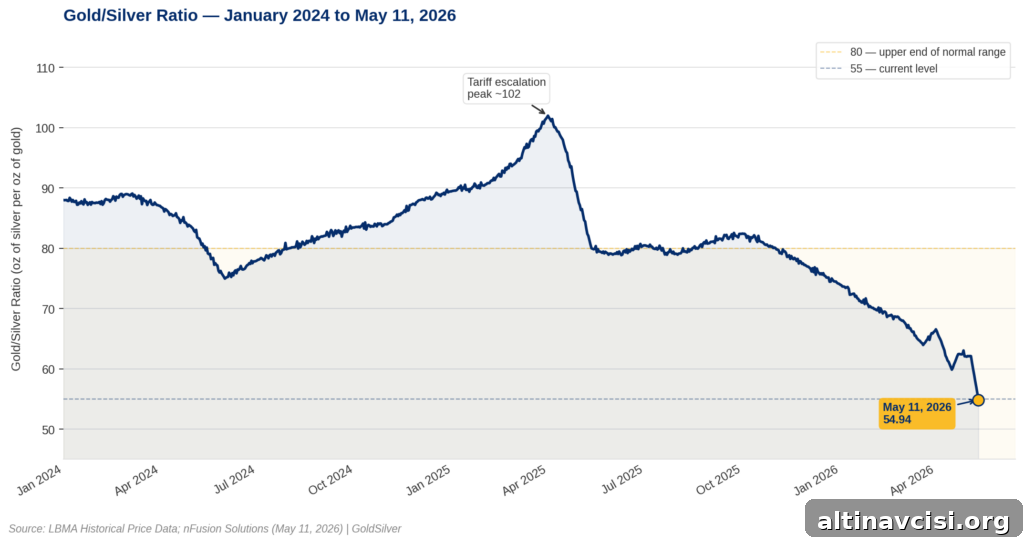
- The gold/silver ratio shows how many ounces of silver buy one ounce of gold. As of May 11, 2026 it sits at 54.94, down from 62.05 a week earlier.
- Silver jumped 7.1% to $86.10/oz today while gold was largely unchanged at $4,730. The immediate catalyst was a US-China 90-day tariff truce that improves silver’s industrial demand outlook (prices per nFusion Solutions, ~3:49 PM ET).
- The Silver Institute reports six consecutive years of silver supply deficits, with roughly 762 million troy ounces drawn from above-ground stockpiles since 2021 — a structural shortage that predated this week’s move.
The gold/silver ratio measures how many ounces of silver are required to buy one ounce of gold. A falling ratio means silver is outperforming gold. Over the past week that ratio moved sharply lower, from 62.05 to 54.94, driven by a 7.1% surge in silver to $86.10 after news of a US-China tariff truce. Such rapid compression is uncommon and usually reflects a catalyst hitting a market already positioned to move. In silver’s case, the market entered this week with a structural supply deficit that has persisted for years.
What Is the Gold/Silver Ratio — and What Does 54.94 Actually Mean?
The ratio is a relative-value indicator, not a direct buy or sell signal. A ratio of 55 indicates one ounce of gold costs the equivalent of 55 ounces of silver. Historically, the ratio has generally ranged between roughly 40 and 80, with extremes tending to revert. It reached an outlier high of 125 in March 2020 during pandemic turmoil and later compressed toward the mid-60s. At 54.94 today the ratio sits near the lower end of its historical range. That shows silver has already closed significant ground against gold, which makes future moves more meaningful but does not by itself dictate action.
Context matters: a low ratio reflects silver’s recent strength, and that strength is driven by specific demand and supply forces. Investors should treat the ratio as a scoreboard that tracks relative performance rather than a stand-alone trading rule.
Why Is Silver Outperforming Gold Right Now?
Two factors converged this week to lift silver.
First, trade: the US and China announced a 90-day tariff truce that substantially reduced headline tariff rates. While the move is roughly neutral for gold, it directly affects silver’s industrial demand outlook. The Silver Institute estimates around 60% of annual silver consumption is industrial — used in solar panels, EV batteries, electronics and semiconductors — much of which flows through China. Lower tariffs reduce near-term friction in those supply chains, prompting traders to reprice expected industrial demand and driving a rapid price adjustment.
Second, structure: silver has been in a multi-year supply deficit. The Silver Institute projects a 2026 deficit of about 46.3 million ounces, up roughly 15% from 2025, and notes cumulative draws from above-ground stocks since 2021 of roughly 762 million troy ounces. The tariff truce acted as a trigger; the persistent deficits provided the fuel for a sustained move.
Has a Ratio This Low Ever Predicted a Bigger Silver Move?
Low ratios have preceded significant silver rallies in the past, but the broader setup matters. The clearest recent example is 2020: the ratio spiked to 125 during the pandemic panic and then compressed as silver rallied roughly 45% in the months that followed. Today’s starting point is far less extreme, but the speed and direction of the move are similar. The 90-day truce is temporary, so a breakdown in talks before it expires could reverse some gains. Still, long-running supply deficits documented by the Silver Institute are longer-term forces that do not disappear if negotiations falter.
What Does the Ratio Tell Long-Term Precious Metals Holders?
For long-term holders, the ratio offers perspective rather than timing. Silver acts both as a monetary metal and an industrial commodity. When real yields fall, gold often leads; when industrial activity accelerates, silver tends to overshoot. At present both dynamics are supporting silver’s move, which explains the faster pace compared with gold.
A ratio of 54.94 signals that silver has closed much of the gap versus gold since early 2024, when the ratio was around 88. That movement reflects both monetary considerations and material demand. Investors should view the ratio as a useful metric for relative valuation and portfolio context, remembering it does not substitute for a full assessment of risk, time horizon and objectives.
Prices as of May 11, 2026, approximately 3:49 PM ET.
Stay On Top of Gold & Silver Prices
Get important market alerts sent straight to your inbox.
SOURCES
1. nFusion Solutions — Spot Price Data
2. Silver Institute — World Silver Survey 2026
3. White House — US-China Trade Statement, May 2025
4. London Bullion Market Association — Historical Precious Metals Price Data
Disclaimer: This article is for informational purposes only and does not constitute financial or investment advice. Consult a qualified financial adviser before making investment decisions.
You May Also Like:
- What’s Moving Gold Prices This Week: CPI, Seoul & Beijing
- Silver Jumps 6% Before Trump-Xi Summit. Here’s Why
- April Jobs Beat 115K. Gold Held. The Dollar Didn’t. Here’s Why
- Jobs Beat, Ceasefire, Deficit: What It Means for Gold
- Gold Price Outlook: Oil Futures Disagree With Stock Markets
- Why Silver Hit $82 Today: Iran, Oil, and the Fed
- Gold Hits $4,746 as Oil Crashes. Here’s Why That’s Bullish
- Gold Price and Nonfarm Payrolls: Why the Fed Is Trapped