
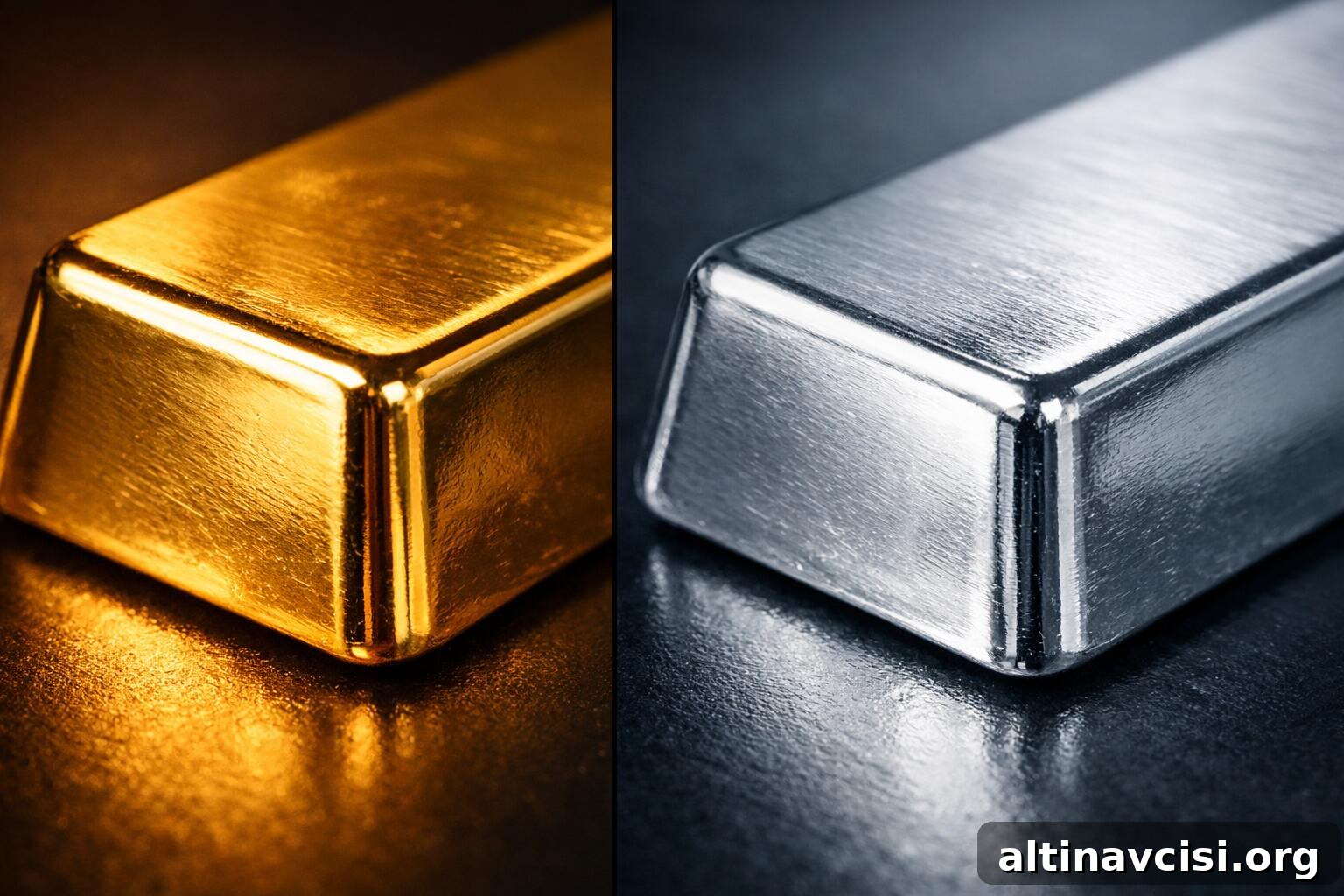
Silver plays two roles: an investment metal and a widely used industrial commodity. In times of market fear, investors rush to safe-haven assets and drive gold higher. At the same time, economic weakness reduces industrial demand for silver, pushing its price lower. Because gold lacks significant industrial exposure, the two metals can move in opposite directions under the same conditions.
If you follow precious metals markets, you’ve likely seen this pattern: gold rising while silver declines, sometimes sharply. Although investors often group them together, gold and silver respond to different forces. Understanding those differences — and what they mean for your portfolio — is essential for effective precious-metals investing.
Why Do Gold and Silver Move Differently?
Gold and silver trade by the ounce on global markets, but they’re driven by distinct dynamics. Gold’s price reflects investor sentiment, monetary policy, and macroeconomic uncertainty. Silver straddles two worlds: it functions as both an investment metal and an industrial input. That dual identity creates frequent divergence in performance.
When fear grips markets — from geopolitical tensions, banking stress, or currency instability — demand for gold as a store of value rises sharply. Central banks, institutions, and individual investors all seek its safety. Silver, however, typically does not benefit from the same flight-to-safety buying. Industrial demand for silver often declines during economic stress, leaving its price exposed on both the investment and industrial fronts.
The net effect is straightforward: gold often rallies while silver weakens.
The Industrial Factor: Silver’s Double-Edged Sword
Silver’s industrial uses are extensive: solar panels, electric-vehicle components, semiconductors, medical devices, and consumer electronics all consume silver. As a result, silver demand is highly sensitive to economic cycles. Slower growth and reduced manufacturing typically translate into weaker industrial demand and lower silver prices.
This industrial linkage helps explain silver’s greater volatility. Between 2014 and 2023, silver’s annual price swings often exceeded gold’s by a wide margin. For example, silver rose about 48% in 2020 while gold gained roughly 25%. In contrast, 2014 saw silver fall nearly 20% while gold slid only about 1.5%. Silver’s upside can be dramatic — and so can the downside.
Gold, by contrast, carries little industrial baggage. It is held mainly as a store of value, so its demand tends to be more stable in times of stress. That structural difference explains why gold can hold its ground or rally precisely when silver struggles.
The Gold-to-Silver Ratio: A Key Diagnostic Tool
Monetary policy matters too, but the gold-to-silver ratio is the primary tool many investors use to track relative value. The ratio measures how many ounces of silver are needed to buy one ounce of gold. When the ratio rises — for example, from 75:1 to 85:1 — it indicates silver is losing ground relative to gold.
From 2014 through 2023, year-end ratios generally ranged between about 70:1 and 85:1, though intra-year extremes can be much larger. During the March 2020 panic, the ratio briefly exceeded 120:1 before retracing. Historically, when the ratio reaches high levels, silver has sometimes had room to rebound; when it compresses toward low levels, gold has tended to underperform. A widening ratio can signal that silver has been disproportionately punished and may be poised for mean reversion — but it’s not a guarantee.
Monetary Policy and the Safe-Haven Premium
Interest-rate moves influence both metals, but in different ways. Higher rates increase the opportunity cost of holding non-yielding assets, which can pressure gold. Still, during deep financial stress the safe-haven premium often outweighs yield considerations, and gold can hold up or even rally.
Silver typically suffers more when central banks tighten. Rate hikes can slow industrial activity, reducing demand for silver from manufacturers at the same time investor appetite wanes. Conversely, when monetary policy eases, both metals tend to rally — silver often more aggressively due to its smaller market size and stronger sensitivity to capital flows.
Understanding silver’s volatility is important for investors positioning ahead of policy shifts and economic cycles.
What Should Investors Do When This Divergence Happens?
The short answer: don’t panic, and don’t ignore the signal.
A period where gold rises while silver falls isn’t necessarily a reason to exit silver. For many experienced investors, such divergence creates accumulation opportunities — particularly when the gold-to-silver ratio stretches to historical extremes. Strategy should align with your risk tolerance:
Conservative investors: Favor a larger allocation to gold for stability. Many conservative portfolios emphasize gold as the core precious-metals holding, with a smaller silver position for selective upside.
Moderate investors: Use divergence as a chance to rebalance. A mix of gold for stability and silver for growth potential offers exposure to both scenarios.
Aggressive investors: A sharp silver selloff relative to gold can present a tactical entry point. If your view anticipates a recovery phase, a meaningful silver allocation can amplify returns.
Across risk profiles, dollar-cost averaging helps manage silver’s volatility. Building a position gradually reduces the impact of short-term swings compared with trying to time the bottom.
The Bigger Picture: Why Both Metals Still Matter
Divergence between gold and silver doesn’t mean one metal is “broken” and the other is the automatic winner. It reflects different economic roles. Gold anchors a portfolio during turbulence; silver amplifies returns during recoveries. Together they offer a complementary dynamic that neither provides alone. The important task for investors is recognizing the cycle phase and allocating accordingly.
The landscape continues to evolve: central-bank policy, growing green-energy demand for silver, and shifting geopolitics all shape supply and demand. Those forces will keep generating both risks and opportunities for gold and silver investors.
Key Takeaways
- Silver can fall while gold rises because silver carries material industrial demand risk that gold does not.
- The gold-to-silver ratio is a useful diagnostic for relative value and potential mean reversion, though it’s not a prediction guarantee.
- Monetary tightening and economic slowdowns typically hit silver harder due to reduced industrial activity.
- Intra-year ratio extremes can far exceed year-end figures; for example, the ratio spiked during the March 2020 panic before reverting.
- Divergence periods may create strategic buying opportunities for silver depending on your risk tolerance and time horizon.
- A balanced approach — gold for stability, silver for growth — remains a resilient long-term framework for precious-metals allocations.
Your Gold Buying GuideMost investors overpay when they buy gold and again when they sell. This guide explains what to own and why.
Stay On Top of Gold & Silver Prices
Get important market alerts sent to your inbox.
People Also Ask
Why does silver fall while gold rises?
Silver serves both as an investment and as an industrial commodity. In economic slowdowns, investors seek gold’s safety while industrial demand for silver declines, putting downward pressure on silver. Gold’s lack of meaningful industrial use explains why it can rise while silver falls in the same environment.
Is silver more volatile than gold, and why?
Yes. Silver’s market is smaller and demand is split between investment and industrial consumption, making its price more sensitive to shifts in manufacturing and investor sentiment. Historically, silver has experienced larger percentage swings than gold in both directions.
What is the gold-to-silver ratio and what does it tell investors?
The gold-to-silver ratio shows how many ounces of silver buy one ounce of gold. When the ratio is high, silver may be undervalued relative to gold and could present a buying opportunity for tactical investors; when it’s low, gold may be comparatively cheaper.
What should investors do when silver prices drop but gold prices rise?
Instead of selling silver, consider whether the divergence creates relative value. If the gold-to-silver ratio is elevated, silver may rebound as conditions normalize. Dollar-cost averaging is a practical approach to build exposure while reducing timing risk.
How does monetary policy affect the gold-silver price gap?
Rate hikes often hit silver harder because they slow industrial activity and reduce investor demand for non-yielding assets. Gold tends to maintain a safe-haven premium during severe financial stress. When policy eases, silver usually rallies more sharply than gold.
SOURCES
World Gold Council — Gold Price Data & Demand Trends; The Silver Institute — Supply & Demand; IRS publications on investment taxation.
Disclaimer: This article is informational and educational only. It is not investment advice. Past performance does not guarantee future results. Consult a qualified financial advisor before making investment decisions.
You May Also Like:
- Why Are BRICS Countries Buying So Much Gold?
- Gold Price Forecast 2026–2027: Key Predictions from Top Analysts
- Is Now a Good Time to Buy Gold? Here’s the Macro Case
- Is Gold a Better Investment Than Bitcoin Right Now?
- What the Silver-to-CPI Ratio Reveals That Spot Price Hides
- Gold & Silver Supply and Demand: What Really Drives Prices Over Time
- Dow to Gold Ratio: 100 Years of History Decoded
- How the 50 Day SMA Helps You Understand Gold & Silver
- Gold Silver Ratio Forecast (75): Buy Gold, Add Silver, or Wait?