
Written by: The MacroButler
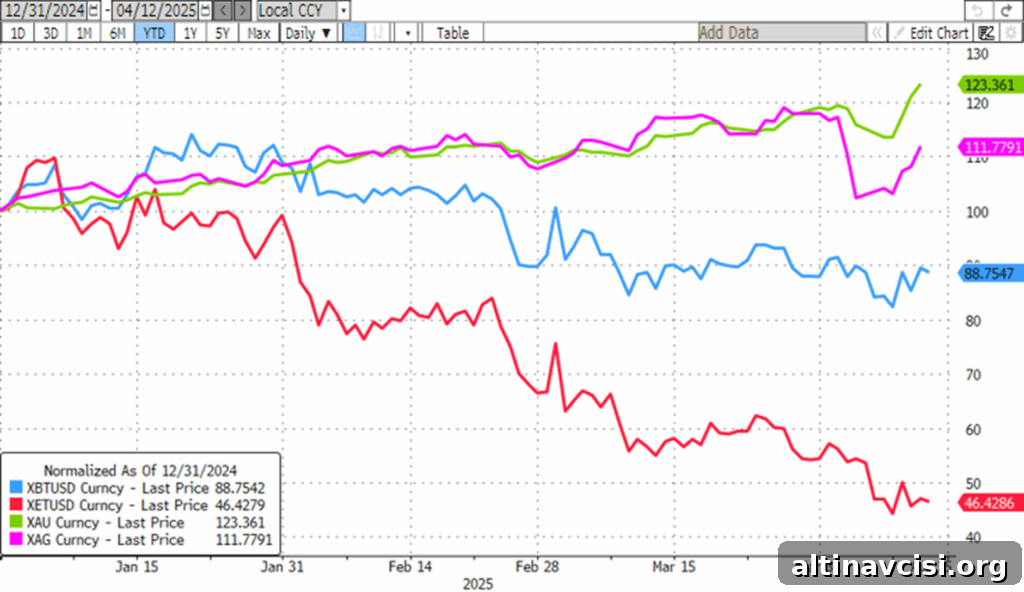
As the so-called “Forward Confusion” campaign accelerates under the current administration, one point is unmistakable: Bitcoin has not proven itself as a reliable store of value. Despite enthusiastic endorsements from some corners of government and finance, Bitcoin peaked shortly after inauguration and has been drifting downward since. Ether, promoted by some as “digital silver,” has lost nearly half its value since the start of the Jubilee Year. Meanwhile, physical silver and gold—often dismissed by crypto evangelists—have delivered steady single- to double-digit gains. The promise of a digital, antifragile salvation has not materialized.
Performance of Bitcoin (blue); Ether (red); Gold (green); Silver (purple) in USD since December 31, 2024.
When the 47th U.S. president called “Bitcoin the new oil” during the campaign, the comment echoed earlier episodes in economic history. In the 1970s, inflated oil prices were used to support the dollar and manage post-war debt—an arrangement that benefited some at the expense of others. Today, some observers see a parallel: Bitcoin being elevated to absorb speculative capital and ease fiscal pressures, enriching a relatively small group of insiders.
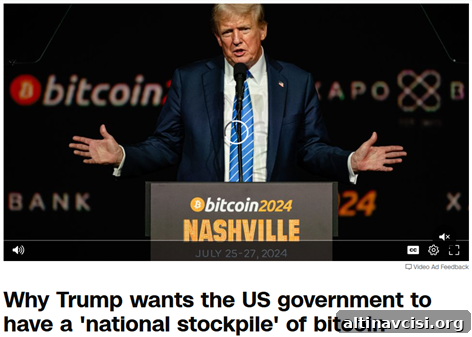
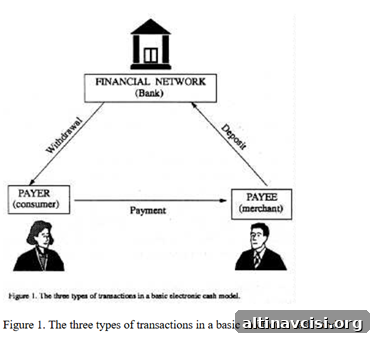
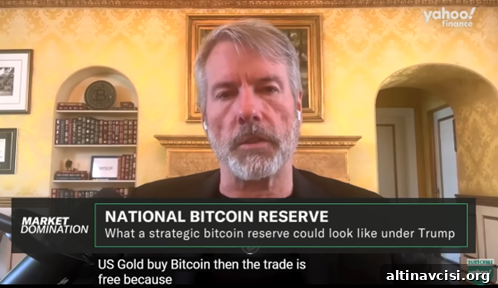
This creates a plausible scenario: inflate Bitcoin to generate speculative demand, link it to dollar-backed stablecoins, and allow retail and institutional investors to shoulder fiscal liabilities indirectly. If that is the case, Bitcoin’s narrative as an anti-establishment, decentralized alternative is contradicted by its potential to become part of a highly centralized financial strategy. Large institutions and influential figures now publicly back Bitcoin, while some notable advocates even urge dramatic policy shifts—signals that should prompt careful scrutiny.
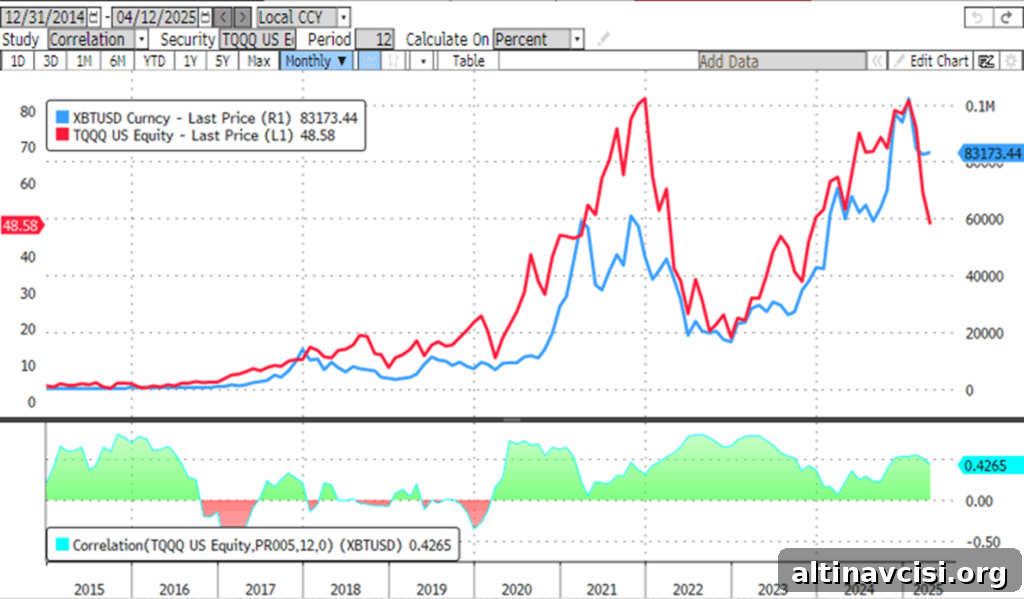
Beyond politics, market behavior matters. Bitcoin has often moved in close correlation with other high-volatility assets. Its correlation with leveraged tech ETFs like TQQQ has frequently exceeded 0.5, underlining that Bitcoin tends to behave like a speculative risk asset rather than a safe store of wealth. In many cycles, cryptos and growth-focused equities rise and fall together.
Price of Bitcoin (blue); ProShares UltraPro QQQ (TQQQ US) (red) & correlation.
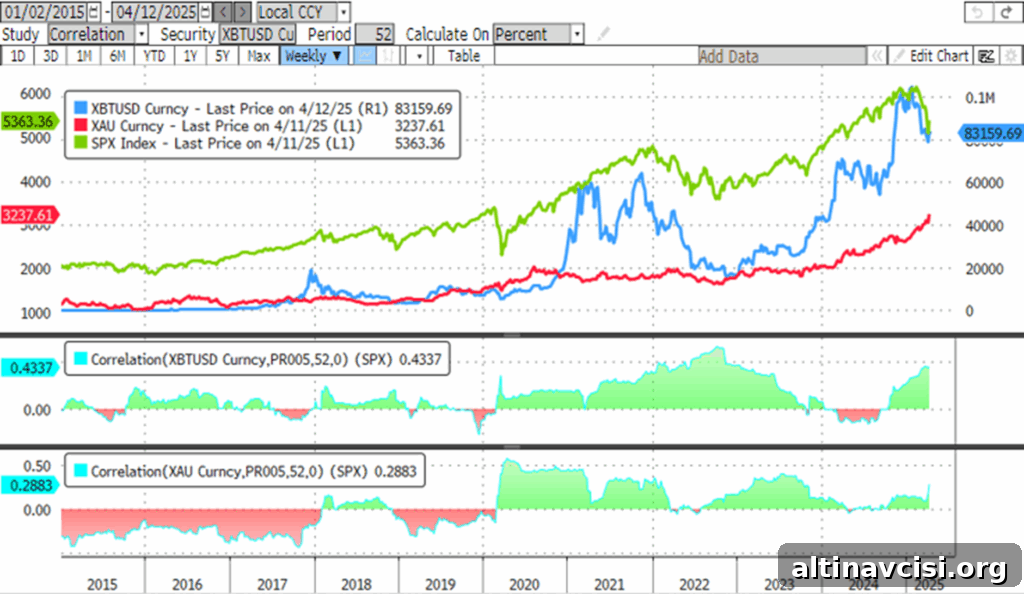
Since their peaks, the S&P 500 has corrected substantially and Bitcoin even more so, while gold has continued to reach new highs. This divergence highlights a deeper truth: gold’s role as a store of value is supported by broader monetary dynamics, while Bitcoin’s fortunes appear tied to risk-on market sentiment. Bitcoin’s 52-week correlation to the S&P 500 has risen, whereas gold’s correlation to equities has declined since late 2024.
Bitcoin price (blue); Gold price (red); S&P 500 index (green) & correlation.
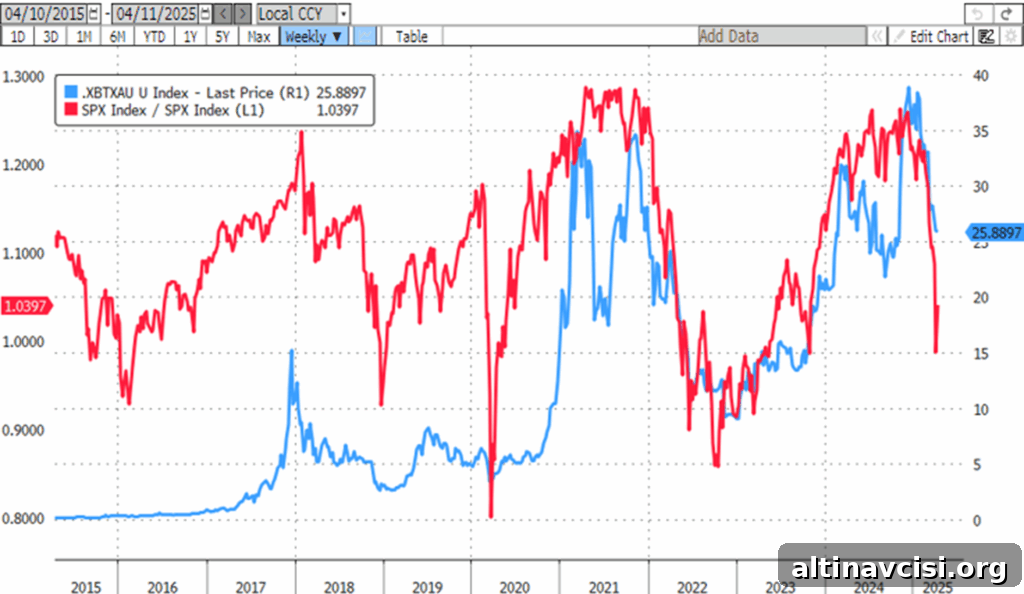
Measured against gold, Bitcoin remains at historically elevated valuations. The Bitcoin-to-gold ratio, which traded under 3x in 2019, sits near 26x today. Part of what keeps that ratio elevated is the long run-up in equity and risk-asset prices since the post-financial crisis recovery. If those risk assets revert materially toward long-term averages, Bitcoin could experience significant downside along with them. Historically, the 10x Bitcoin-to-gold level has acted as an important pivot since 2017.
Bitcoin-to-Gold ratio (blue); S&P 500 to its 100-week moving average (red).
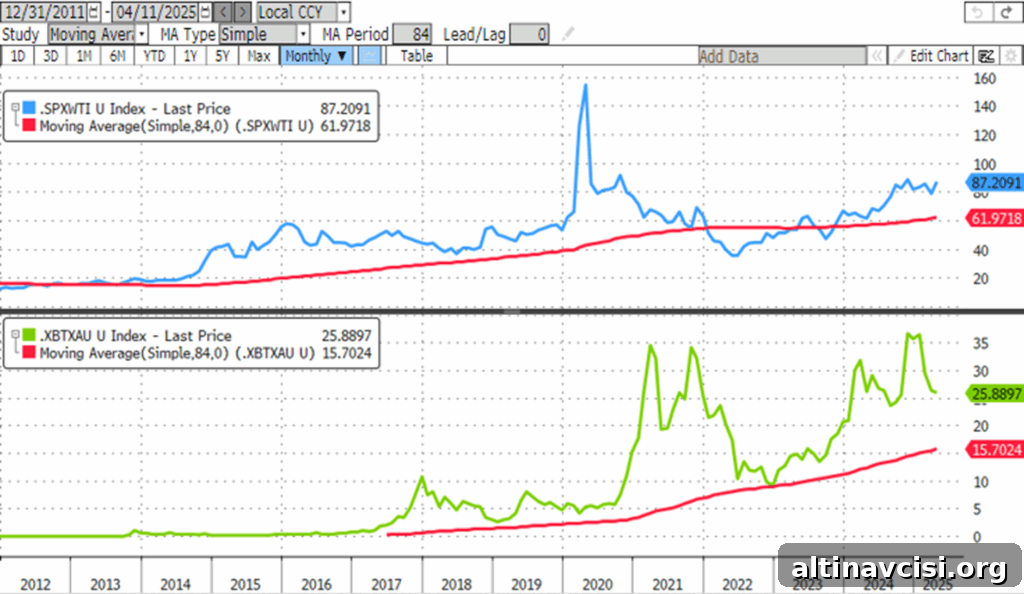
Comparing the Bitcoin-to-gold ratio with other market ratios reinforces that these cross-asset relationships often peak together ahead of broader market inflection points. Peaks in Bitcoin-to-gold have historically coincided with peaks in ratios like S&P 500-to-oil, and those peaks have typically preceded meaningful corrections in equity and commodity ratios by a few months.
S&P 500-to-Oil ratio (upper panel) and Bitcoin-to-Gold ratio (lower panel) versus their 7-year moving averages.
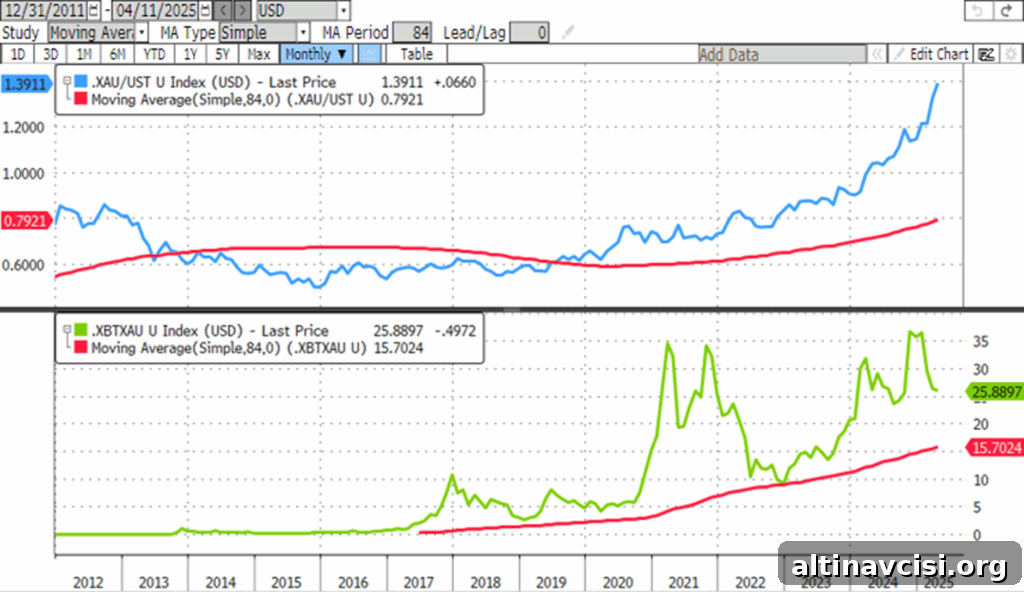
Over the past decade, the Bitcoin-to-gold ratio has not provided a reliable signal to time a transition between inflationary and deflationary regimes on its own. However, when used alongside broader indicators—such as S&P 500-to-gold or gold-to-bond ratios—it can help inform allocation decisions by quantifying the extent to which risk assets are stretched relative to traditional stores of value.
Gold-to-Bond ratio (upper panel) and Bitcoin-to-Gold ratio (lower panel) with 7-year moving averages.
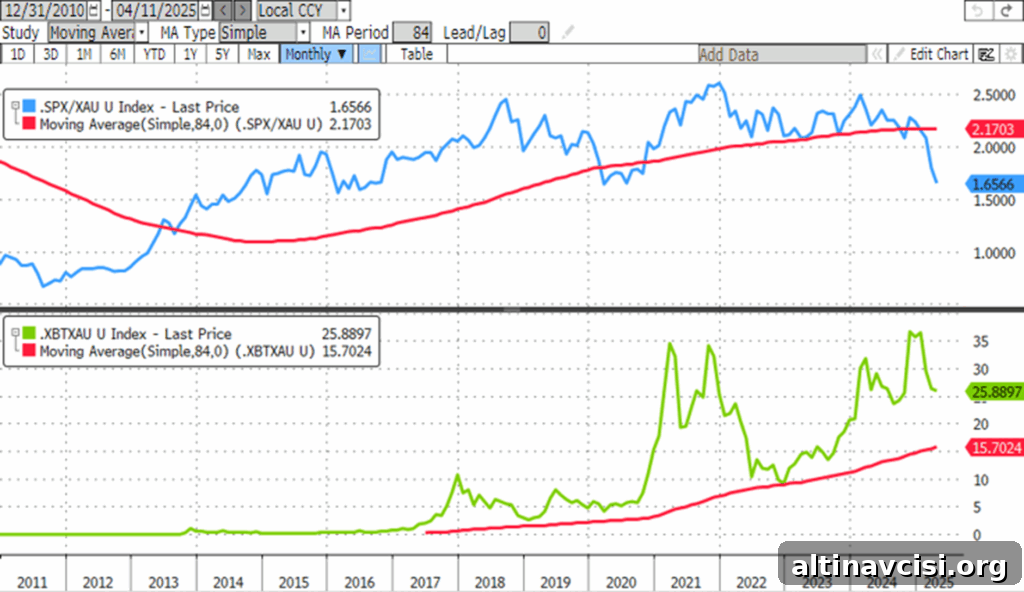
In practice, the S&P 500-to-gold ratio is a useful market-driven indicator of monetary illusion. Breaks below its long-term moving average have correlated with major shifts in risk appetite and with peaks and troughs in the Bitcoin-to-gold ratio. These relationships were apparent in early 2020, late 2021, and again in early 2025.
S&P 500-to-Gold ratio (upper panel) and Bitcoin-to-Gold ratio (lower panel) with 7-year moving averages.
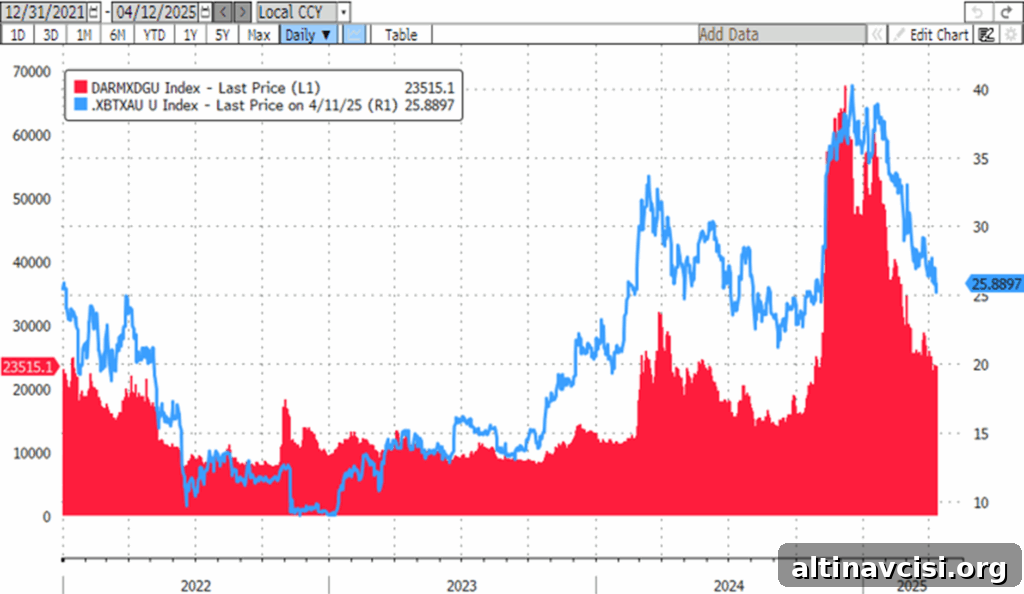
Some comparisons are stark. At times the Bitcoin-to-gold ratio has tracked speculative meme-asset market caps, reinforcing the point that Bitcoin behaves as a highly speculative instrument rather than a reliable, non-correlated store of value. For investors focused on capital preservation, that distinction matters.
Bitcoin-to-Gold ratio (blue); Dogecoin market cap (red histogram).
The political embrace of Bitcoin has turned it into a partisan talking point for some, which adds another layer of risk. Beyond politics and rhetoric, the enduring strengths of gold remain clear: universal acceptance, long-term purchasing power preservation, and no counterparty risk. Central banks and major global players continue to value gold as a settlement asset and a Tier-1 reserve holding, reinforcing its role as a true store of value.

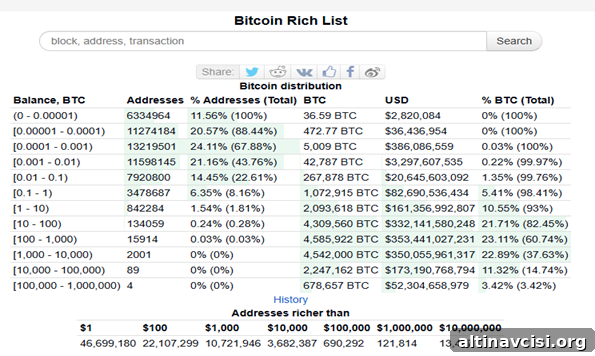
Skeptics who view Bitcoin as a potential reserve asset or replacement for fiat should weigh the facts: Bitcoin is volatile, concentrated in a small number of large wallets, and its supply and ownership distribution raise questions about its resilience under stress. Until Bitcoin’s fundamental characteristics change materially, it is better understood as a speculative trading vehicle than as a reliable currency or store of wealth.
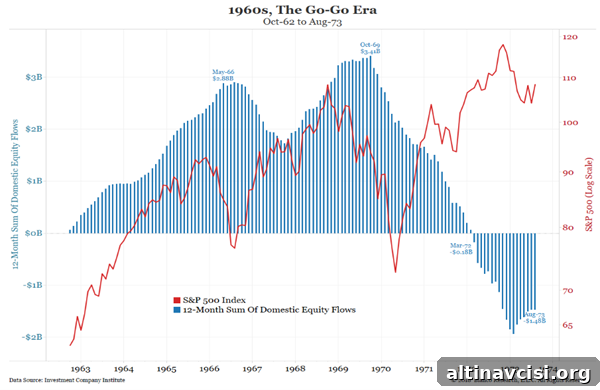
Comparisons to historical speculative episodes are instructive. Just as mutual funds traded at steep premiums and later collapsed in the 1960s, Bitcoin’s structural volatility makes it vulnerable to large drawdowns. Without a change to its fundamental role in the financial system, Bitcoin is unlikely to evolve into a stable medium of exchange or a deposit-like store of value.
In contrast, physical gold and silver offer tangible protection. They carry no counterparty risk, are not dependent on digital identity systems, and are not programmable or easily seized through software. As central banks and authorities explore digital currencies and programmable money, those who value autonomy and capital preservation find continued appeal in physical precious metals.
When central banks and institutions design digital currency frameworks, many proposals incorporate gold as an anchor or reference point to preserve credibility. For investors, the practical takeaway is straightforward: buy gold to protect capital, not necessarily to get rich. Gold is insurance against monetary debasement and widening public debt—an asset to preserve purchasing power.
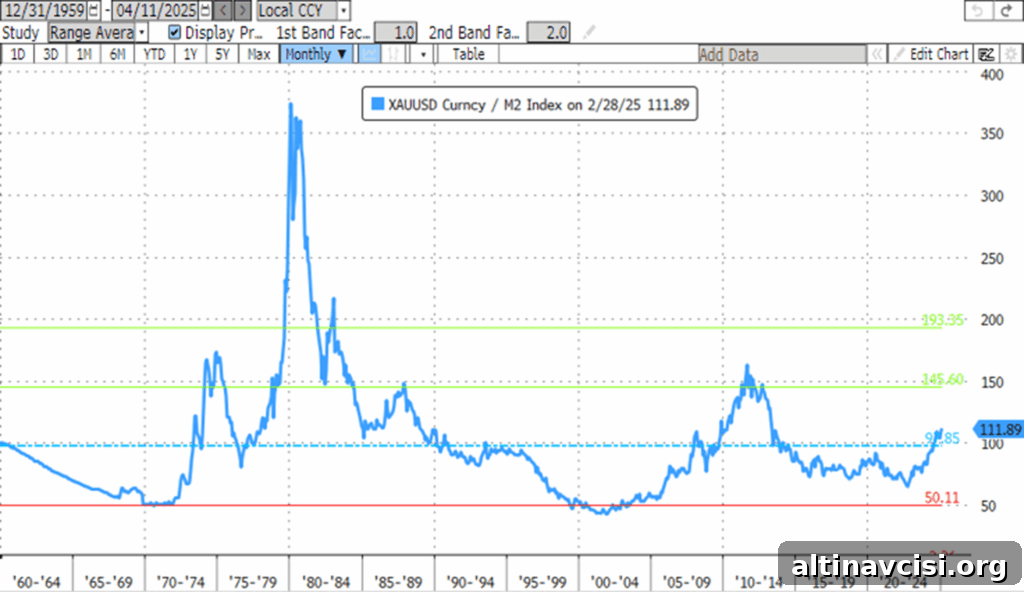
Gold price relative to US money supply (M2) rebased to 100 as of December 1959.
But don’t buy gold to speculate—buy it to protect capital. If your goal is speculative growth, high-beta tech or crypto may offer upside. If your goal is to preserve purchasing power through volatile monetary cycles, physical gold and silver remain the most reliable options.
Looking ahead, anticipate policy measures that favor tighter control over money and capital—yield curve control, capital controls, and broader financial repression are realistic possibilities. Those developments increase the appeal of non-confiscable, non-digital stores of value. Relative to the money supply, gold remains inexpensive by historical standards, suggesting more room for appreciation if monetary debasement continues.

To preserve wealth through the cycles, investors should align allocations with the business cycle rather than fight it. Priorities include owning physical precious metals, favoring commodities and commodity producers during inflationary phases, and holding short-duration investment-grade USD bonds and Treasury bills for liquidity and capital preservation. Equity exposure should emphasize low-leverage companies with solid earnings and free cash flow, particularly in energy and materials rather than high-beta consumer tech names.
KEY TAKEAWAYS
Summary conclusions:
- Despite geopolitical and trade tensions, global inflation dynamics and commodity cycles remain central to asset allocation decisions.
- Bitcoin and Ether have underperformed traditional stores of value; gold and silver have shown steady gains.
- Bitcoin behaves like a risk asset and often moves in tandem with high-beta equities.
- Cross-asset ratios—Bitcoin-to-Gold, S&P 500-to-Gold, and S&P 500-to-Oil—are useful gauges of the business cycle and risk appetite.
- Bitcoin is a speculative asset, not a reliable store of value.
- Investors should emphasize capital preservation—Return OF Capital—over Return ON Capital during stagflationary or transitionary phases.
- Physical gold and silver remain the most dependable hedges against monetary and political risk.
- Trust in public institutions continues to decline, increasing interest in assets with no counterparty risk.
- Long-dated government bonds may no longer serve their historical diversification role; short-duration, investment-grade fixed income is more appropriate for cash management.
- Expect heightened volatility and subdued real returns in the near term.
HOW TO TRADE IT?
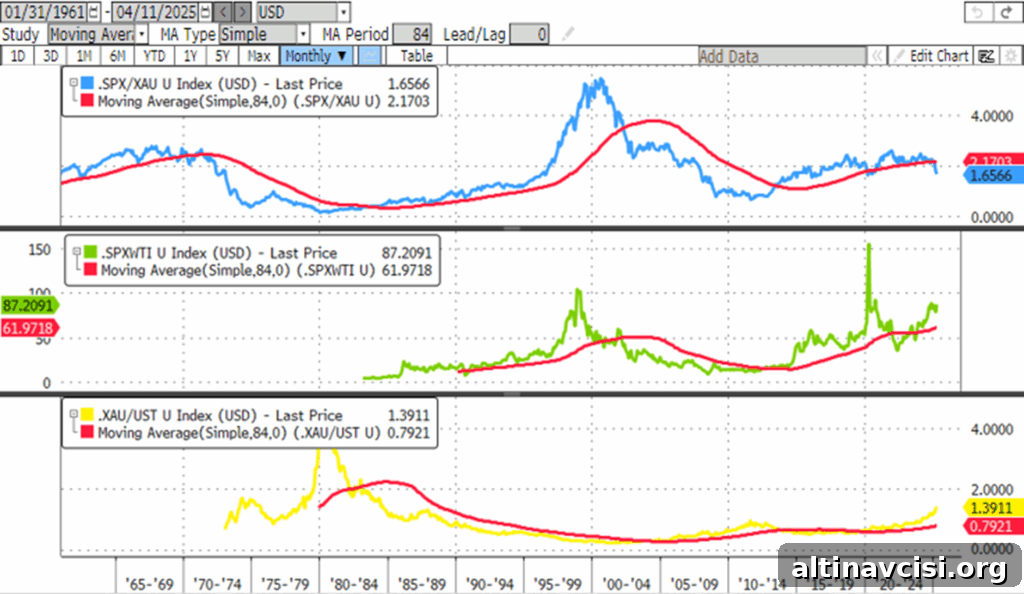
As of April 11, 2025, the U.S. is navigating an inflationary boom that may turn to bust sooner than many expect. Investors should remain disciplined and rely on market-driven indicators to time shifts in the business cycle. Historical patterns suggest that monitoring ratios like S&P 500-to-Gold and Bitcoin-to-Gold against their long-term moving averages can guide allocation between stocks, commodities, and cash.
For most investors, the practical approach is clear: hold physical gold and silver for capital preservation, maintain liquidity in short-dated investment-grade USD instruments and T-bills, and favor equities with strong balance sheets and cash generation—especially energy and commodity producers—over highly leveraged, momentum-driven names. Tactical use of market ratios and moving averages can improve timing and allocation decisions during turbulent cycles.
By owning physical precious metals outside centralized digital systems, investors retain autonomy and protection from counterparty and digital risks. Gold held in private vaults requires no digital ID, no compliance rails, and provides a long-tested hedge against monetary instability. In short: physical gold and silver remain essential components of a preservation-focused portfolio.
Gold matters—yesterday, today, and especially tomorrow.