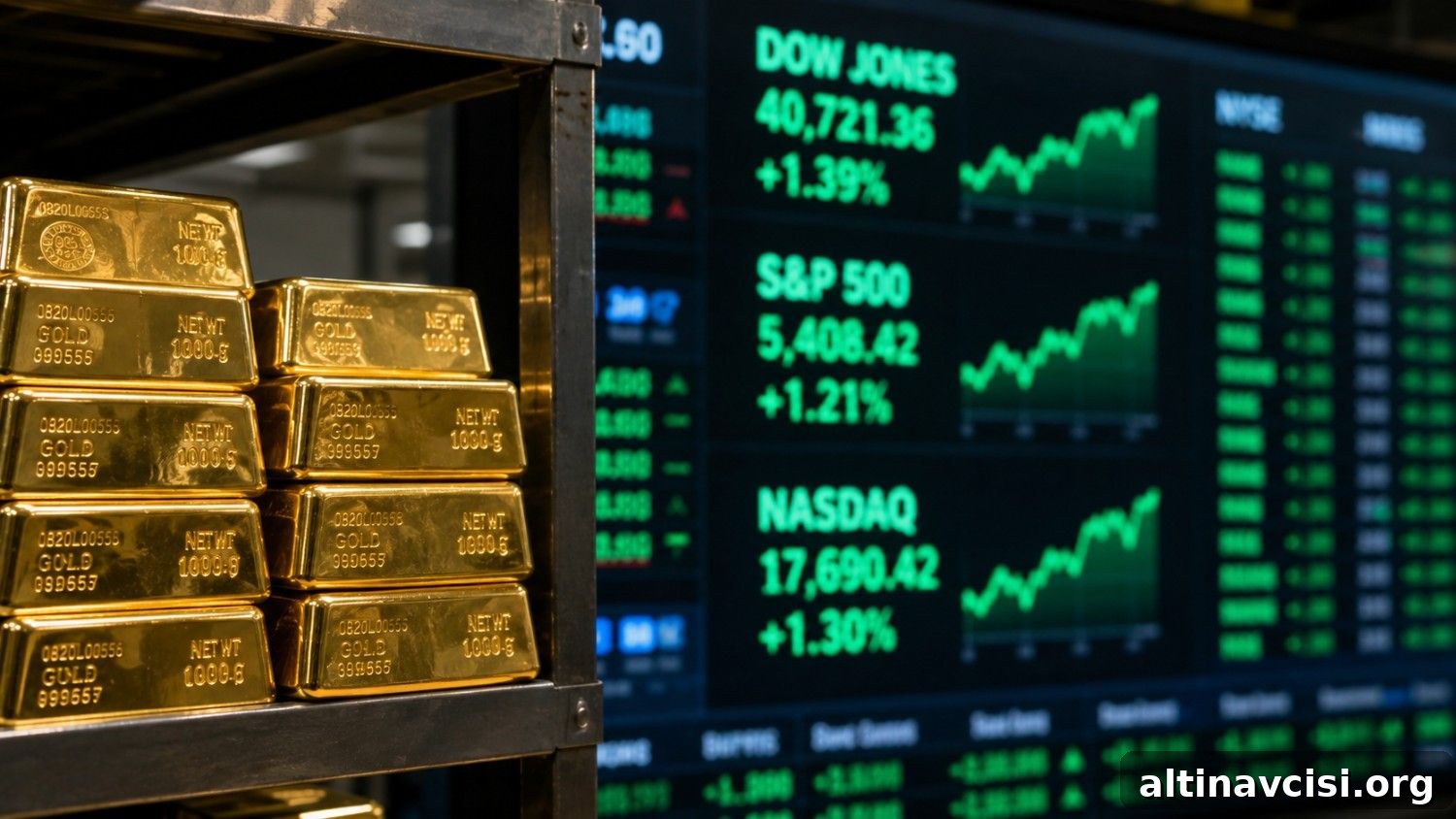
Gold is moving higher today, trading at $4,347, even as broader financial markets show strong risk appetite. The S&P 500 has closed at a record high, the Nasdaq has posted its strongest session since March, and oil has fallen to a two-month low. At the same time, the war premium that helped keep inflation elevated over recent months is fading quickly.
Under conventional market logic, gold prices should be under more pressure. When stocks rally and investors become more comfortable taking risk, money often rotates away from safe-haven assets. In that environment, gold is usually sold as capital moves into equities and other growth-sensitive assets.
That is not what is happening now. Gold is holding firm while stocks push to new highs, suggesting that investors are not only reacting to fear or geopolitical headlines. The market is showing that gold’s current strength is being driven by something deeper than short-term anxiety.
Why Is Gold Holding Up While Stocks Hit Record Highs?
Gold does not always move in the opposite direction of stocks. The common explanation is that gold is a “fear trade”: investors buy it when they are nervous and sell it when confidence returns. That view is simple, but it is not complete.
Gold is influenced by two major forces at the same time.
The first is the geopolitical and fear bid. This is safe-haven demand created by conflict, instability, market stress, and investor anxiety. It is the part of the gold price most people understand. It is also the part that has recently weakened. The Iran peace deal removed a significant portion of the war premium, and oil prices confirm that shift. West Texas Intermediate crude is now near $80 per barrel, down from conflict-period highs above $100.
The second force is the monetary bid. This is demand for gold as protection against fiscal deficits, currency debasement, rising debt burdens, and the gradual erosion of purchasing power. This driver is not dependent on war, peace talks, or short-term headlines. It is linked to the US debt path, central bank policy, real yields, and the long-term relationship between money supply and savings.
That monetary bid remains in place.
The US national debt stands near $39 trillion, and annual interest payments on that debt have crossed $1 trillion this year. A peace agreement does not change those figures. The Federal Reserve’s target rate remains at 3.50 to 3.75 percent, unchanged since December 2025. The Fed meets today and tomorrow, with its decision scheduled for Wednesday at 2 p.m. Eastern. Markets are pricing in a hold with near certainty, but investors are watching closely for what Fed Chair Kevin Warsh says at his 2:30 p.m. press conference about the rate path for the rest of 2026.
Central banks also continue to buy gold. The World Gold Council’s 2026 survey found that 45 percent of central banks plan to increase their gold reserves over the next 12 months, while 89 percent expect global gold reserves to rise over the same period. In Q1 2026 alone, central banks bought a net 244 tonnes. That demand did not disappear when the peace deal was signed.
The Edge Every Investor Needs
Smarter precious metals investing starts here. The Nuggets Newsletter brings you essential market insights, Fed updates, global trends, educational videos, and much more.
What Is the Difference Between Gold’s War Premium and Its Monetary Bid?
Gold’s current price can be understood as having two layers.
The first layer was the conflict premium. This was the extra demand created by investors seeking safety during active US-Iran hostilities. That layer has been unwinding since the peace memorandum of understanding was signed on June 14. Gold fell from its January 28 all-time high of $5,589 to near $4,000 earlier this month. Much of that decline reflected the inflation shock created by the war: oil above $100, May CPI at 4.2 percent year over year, and a Federal Reserve that could not cut rates into an energy-driven inflation surge.
The second layer is the monetary premium. This is the structural case for owning gold, and it has been developing for years. It is based on fiscal deficits, central bank reserve diversification away from US Treasuries, and the long-term purchasing power of money. This layer does not require a war to exist. It only requires governments to continue spending more than they collect and central banks to maintain large balance sheets.
That layer has held through the entire war-period correction. It is still holding now, with the VIX near 16 and the S&P 500 at all-time highs.
When gold stays above $4,300 while other fear assets are being sold and risk assets are being bought, the market is not necessarily signaling an imminent collapse in gold. It is separating the short-term war premium from the longer-term monetary bid in real time.
Source: goldsilver.com/price-charts/ | goldsilver.com
What Does the FOMC Meeting Tomorrow Mean for Gold?
Wednesday afternoon’s rate decision is widely expected to be a hold. Markets price a greater than 98 percent probability that the Fed keeps rates at 3.50 to 3.75 percent. The decision itself is not the main issue for gold investors.
The more important event is Warsh’s press conference.
This is Warsh’s first meeting as Fed Chair. He was confirmed by a 54 to 45 vote, making it the most contested Fed Chair confirmation in history. His first meeting also includes the updated Summary of Economic Projections, often called the dot plot, where each committee member indicates where they expect rates to move over the next three years.
Two outcomes matter most for gold prices.
If Warsh describes the war-era inflation surge as geopolitical and temporary, and points to the reopening of Hormuz as a reason the main inflation driver is fading, markets may price in a more favorable rate path. Lower real yield expectations would support the monetary bid for gold.
If Warsh treats the inflation backdrop as structural and signals that the Fed intends to stay restrictive even as oil prices fall, rate expectations could shift higher. In that case, gold may consolidate near current levels instead of extending its recovery.
Either way, the broader foundation under gold has not changed because of one central bank press conference. The long-term gold thesis does not move tick by tick with every policy comment.
What This Means for Long-Term Holders
The past five months become easier to understand when the noise is separated from the signal.
Gold climbed to $5,589 on a combination of the monetary debasement thesis and a geopolitical risk premium. The war added fuel to the move. Then the inflation consequences of the conflict made rate cuts difficult and rate hikes more likely, compressing both sources of support at the same time. Gold dropped to near $4,000.
Now the geopolitical bid is fading, but gold is still trading at $4,347. It is not at $3,800 or $3,500. It is holding up while stocks celebrate record highs and the VIX remains near 16. That resilience shows the monetary bid is doing what the long-term case says it should do: persist independently of the news cycle.
For investors who own physical gold because of fiscal deficits, reserve diversification, and the long-term purchasing power of money, those reasons did not disappear when the peace deal was signed.
The war premium has faded. The underlying thesis has not.
Stay On Top of Gold & Silver Prices
Get important market alerts sent straight to your inbox.
SOURCES
1. LBMA — Precious Metal Prices
2. CME Group — FedWatch Tool
3. Bureau of Labor Statistics — Consumer Price Index, May 2026
4. World Gold Council — Central Bank Gold Reserves Survey 2026
5. World Gold Council — Gold Demand Trends Q1 2026
6. Federal Reserve — FOMC Meeting Schedule & Rate Decisions
7. US Treasury — Debt to the Penny
8. Committee for a Responsible Federal Budget — Trillion-Dollar Interest Payments Are the New Norm
Disclaimer: This article is for informational purposes only and does not constitute financial or investment advice. Always consult a qualified financial adviser before making investment decisions.
You May Also Like:
- Why Is Silver Up Today? The Iran Deal Changed the Fed Math
- Gold Up 3%, Silver Up 4.7%: Five Forces Driving Metals Higher Today
- Iran Peace Deal Sends Oil Down 5%, Gold Up 3%
- Gold & Silver Surge on Iran Peace Deal — Then Pull Back
- Silver Fell 22% in 30 Days. Gold-Silver Ratio Hits 63.
- Every Bearish Catalyst Landed at Once. Gold and Silver Went Up Anyway.
- Gold at Seven-Month Lows: Why Geopolitical Fear Is Not Enough
- Gold Slides to $4,130 as Iran War Turns Inflation Against It
- May CPI Printed 4.2%. Core Inflation Beat. So Why Did the Gold Price Drop?
- Gold Is Down 9%. The CPI Print That Could Either Extend the Drop — or End It.