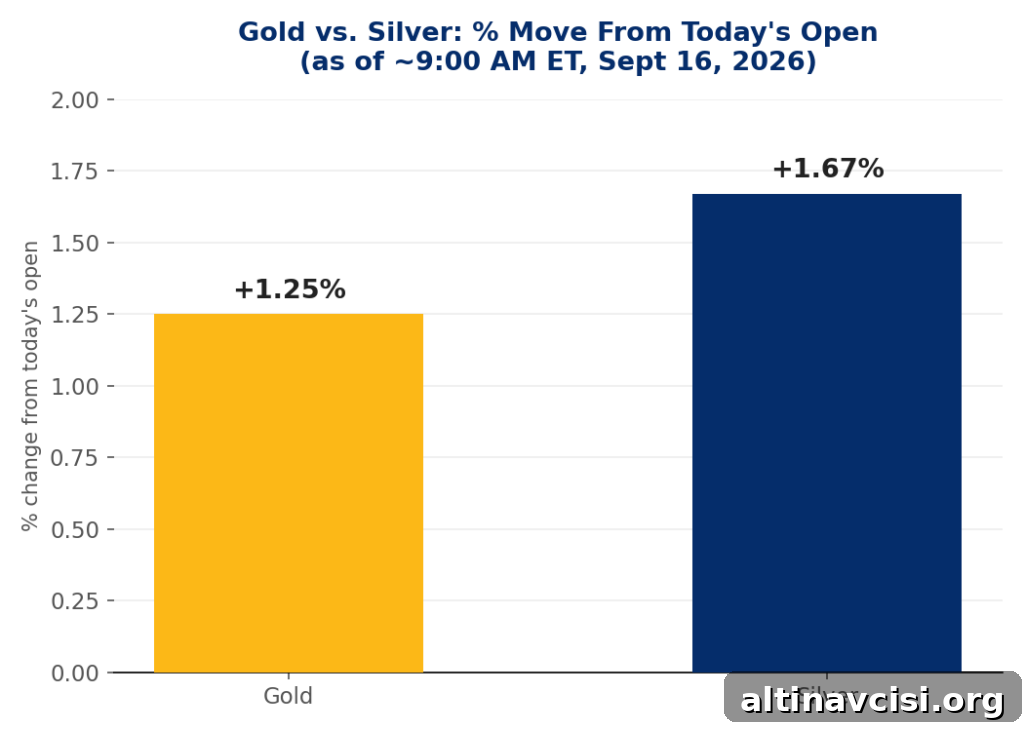
Gold and silver often move in step when a Federal Reserve decision approaches. Today they diverged. This morning silver’s gain is roughly one-third larger than gold’s, even though both metals face the same headline event: the Fed announcement.
Gold trades near $4,348 today, up about 1.25% from the morning open. Silver sits near $64.74, up about 1.67%. Both metals are bouncing off Tuesday’s six-week low close: Comex gold settled at $4,291.60 and Comex silver at $63.24. Earlier a rise in yields driven by oil pushed both metals lower before the bounce.
What Is the Fed Expected to Decide Today?
The Federal Reserve’s 2 p.m. ET announcement is the obvious market catalyst. Futures pricing shows a strong probability of a 25-basis-point hike — a move that would be the first in roughly three years. That probability rose quickly over the past few sessions, and a hike that is well flagged typically moves gold and silver by similar amounts. Today’s price action, however, shows a meaningful difference between the two metals.

The Edge Every Investor Needs
Smarter precious-metals investing starts with clear information. Concise market updates help readers weigh the implications of Fed action, commodity moves, and structural supply-demand trends.
Is Oil, Not the Fed, Behind Today’s Yield Pressure?
A significant portion of the yield move earlier today traces back to the oil market. Brent crude eased slightly overnight to the low triple digits and WTI slipped as well. Traders are balancing a surprising U.S. inventory print with ongoing concerns about regional pipeline disruptions. Commodity strategists have pointed out that these supply-side shocks can push Treasury yields higher because they raise near-term inflation expectations. That dynamic differs from a demand-driven growth story: a supply shock boosts real-world inflation pressures without removing the structural debt and deficit arguments that support gold as a long-term store of value. For long-horizon investors, that distinction matters.
Why Is Silver Decoupling From Gold’s Rate Story?
Silver’s market is partly monetary but largely industrial. Around three in five ounces consumed each year go into industrial uses such as solar panels, electronics, and electric vehicles. That industrial demand exposes silver to different forces than gold. Where gold responds primarily to monetary conditions and safe-haven flows, silver must also account for cyclical demand in manufacturing and energy sectors. That dual role makes silver more volatile: it can amplify moves that gold registers more moderately.
Technically, silver traded below its 200-day exponential moving average during early Asian hours, with support levels from the July–August advance acting as nearby buffers. The bounce in the U.S. session has brought silver back toward that moving average. Whether the rebound holds will matter for traders and investors trying to tell if today’s strength is a simple pre-decision bounce or the start of a more sustained run.
Does Silver’s Supply Deficit Explain the Divergence?
A longer-term structural picture helps explain why silver can outpace gold on a shared monetary catalyst. The silver market has run persistent supply deficits in recent years, and industry estimates project continued shortfalls. When a metal faces a multi-year structural deficit, small changes in investor sentiment or in the broader macro backdrop can trigger larger percentage moves than in a metal with a healthier supply pipeline. In other words, silver’s floor is supported by structural scarcity as well as by sentiment. The gold-silver ratio remains well above the lower ranges that characterized much of the 20th century, which implies that silver has room to narrow that gap relative to gold.
What Happens to Gold and Silver After the Fed Decision?
The immediate direction for both metals will depend on how the Fed frames today’s move. If the statement signals the start of a sustained tightening cycle, both gold and silver would likely give back gains, with silver falling further because of its higher beta. If, instead, the message presents the hike as a defensive response to temporary, commodity-driven inflationary pressure rather than the beginning of prolonged tightening, silver’s outperformance could extend. Commentary from the Federal Reserve chair and the updated rate projections are likely to matter more than the 25-basis-point move itself.
What Should Investors Watch Next?
After the 2 p.m. announcement, two items deserve attention. First, the Fed’s updated rate projections and any shift in forward guidance, because changes to expected policy paths can move gold more than a single rate change. Second, watch whether silver can close the trading day above its 200-day exponential moving average. A sustained daily close above that technical level would suggest today’s outperformance has structural legs rather than being a short-lived pre-decision spike.
Stay On Top of Gold & Silver Prices
Get important market alerts sent straight to your inbox.
SOURCES
1. CME Group — FedWatch Tool (reference)
2. Federal Reserve — FOMC schedule (reference)
3. Yahoo Finance — market commentary (reference)
4. CNBC — oil-price coverage (reference)
5. Trading commentary and analysis (reference)
6. FXStreet — gold analysis (reference)
7. The Silver Institute — World Silver Survey and industry data (reference)
Disclaimer: This article is for informational purposes only and does not constitute investment advice. Past performance is not indicative of future results. Consult a qualified financial advisor before making investment decisions.
You May Also Like:
- The Fed Votes Wednesday. Gold’s Other Vote Lands Friday.
- The Fed Vote Is Already Priced In. These Five Things Aren’t.
- The 10-Year Yield Just Hit an 18-Year High. Gold Isn’t Falling For It.
- Gold Fell 1.62% Today. Gold Miners Didn’t. Here’s the Math.
- Gold Fell to $4,271 Today. Five Bigger Stories Are Moving Underneath It.
- Gold Just Ignored a War. Here’s What It’s Actually Watching.