Gold climbed 0.96% today to $4,370.27 an ounce, while silver rose 1.37% to $64.95. Both metals bounced off two-week lows as investors awaited this week’s employment data. Yet a more informative trend comes from earlier in the year: during the first half of 2026, investors in one major region sold gold ETF positions aggressively while other regions were net buyers.
Which Region Sold Gold ETFs in 2026?
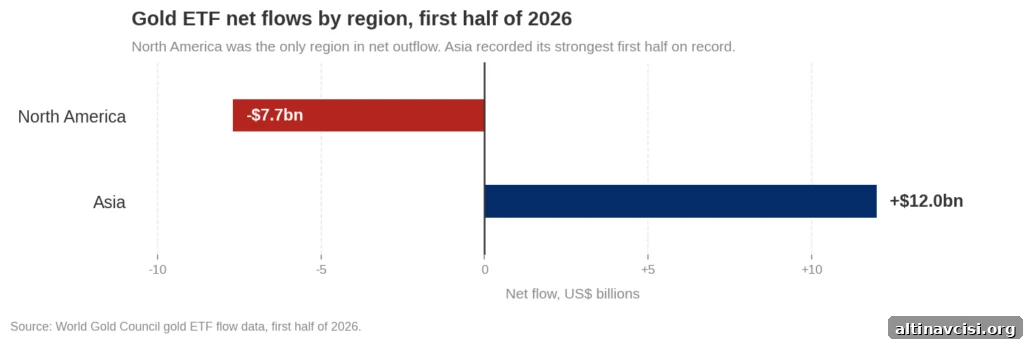
North America was the outlier. In the first six months of 2026, North American-listed gold ETFs recorded the only regional net outflow, shedding roughly $7.7 billion. Those figures come from the World Gold Council’s ETF flow data for the period. In contrast, Asia-listed funds accumulated about $12 billion in the same timeframe — Asia’s strongest first half on record.
This pattern doesn’t indicate a global disagreement about gold’s outlook; rather, it shows that one region exited the ETF trade while others were buying into it at the same price levels.
July narrowed but did not erase that gap. According to the World Gold Council’s July report, global gold ETFs added about $3 billion that month. Holdings rose by 23 tonnes to 4,068 tonnes, still below the 4,176-tonne peak reached on 27 February 2026. For July, European funds led inflows. North America turned marginally positive in the month — roughly $71 million, or about a third of a tonne — but the Council noted this barely affected its year-to-date deficit.
Year to date through July, global ETF inflows totaled about $11 billion, equal to roughly 39 tonnes, while North America remained the only region in net outflow.
A brief note on timing: July is the latest month for which the World Gold Council has published flows. August figures were not available at the time of the report, so the most recent monthly data should be interpreted with that limitation in mind.
What Is the Disadvantage of Gold ETFs?
A gold ETF share represents a claim on allocated metal held by a custodian through the fund. That structure offers real advantages: liquidity, low fees relative to some physical storage options, and tight tracking of the spot price. But it is not the same as owning physical metal outright.
Physical coins or bars registered in your name carry no counterparty risk — their value does not depend on any issuer’s solvency. By contrast, ETFs introduce custodian and fund-structure risk, however small, as well as operational considerations. Mining equities expose investors to company-specific and equity-market risk. Futures introduce leverage and roll costs. Physical metal carries storage and insurance costs, but avoids issuer risk.
When a region reduces its ETF holdings, the key question is whether those ounces have been converted into other forms of ownership — for example, allocated or segregated bars — or whether they were simply sold back into the market, reducing overall physical demand. The distinction matters for how we interpret the shift.

The Edge Every Investor Needs
Receive concise market insights on precious metals, central bank moves, and global trends delivered by email.
Sign up on the site to get timely updates and analysis on gold and silver markets.
Are Investors Moving From Gold ETFs to Physical Bars?
Some wealthy clients appear to be shifting from gold-backed ETFs into allocated and segregated bars held in private vaults. Media coverage has reported increased capacity at vault operators in London and Switzerland to accommodate demand for allocated storage. These flows represent a different subset of investors from those who sold ETFs earlier in the year.
Put simply, two separate trends emerged: one group — largely North American ETF holders — reduced ETF exposure, while another group, including high-net-worth individuals in certain markets, sought direct ownership in allocated vaults. These are distinct behaviors measured in different ways, but both suggest a reallocation of how investors hold gold rather than a unanimous bearish stance.
Is It Better to Invest in Physical Gold or an ETF?
The right choice depends on your investment objective. Short-term traders and those who value liquidity and low transactional friction often prefer ETFs. Long-term holders who want to minimize counterparty exposure may favor allocated physical metal despite storage and insurance costs.
Interest-rate and real-yield dynamics also matter. On 31 August, the 10-year Treasury inflation-indexed yield stood at about 2.44%, representing a positive real return available in government bonds. Higher real yields tend to weigh on gold, which pays no income, and that dynamic contributed to gold’s softer performance toward the end of August.
The Federal Reserve had maintained a target range of 3.50% to 3.75% since December 2025. Ahead of the mid-September meeting, market attention focused on the possibility of another rate increase rather than a cut. In the near term, that environment is not favorable for gold. Nevertheless, the long-term structural case for precious metals rests on what continued fiscal deficits and broad money growth do to the purchasing power of savings — an argument that unfolds over years rather than months.
What the Regional Split Actually Tells You
Allocating to gold involves two decisions: how much to hold and in what form to hold it. The first half of 2026 suggests many North American investors revisited the “how much” question, reducing ETF allocations. Meanwhile, demand for allocated and segregated storage in other regions indicates a concurrent re-evaluation of the “in what form” question.
If you are focused on the form of ownership, consider the trade-offs: ETFs offer ease of access and low relative costs; physical allocated storage provides direct ownership and eliminates issuer or custodian claims on pooled assets. Each approach carries distinct costs and risks, so the best option depends on your priorities for liquidity, counterparty exposure, and long-term preservation of purchasing power.
Stay On Top of Gold & Silver Prices
Get important market alerts sent straight to your inbox.
Check live spot prices and charts on the site for up-to-date market information.
Sign up on the website to receive timely alerts and in-depth market commentary.
SOURCES
1. World Gold Council — Gold ETF holdings and inflows (regional flows, first half 2026).
2. Federal Reserve / FRED — Inflation-indexed and nominal Treasury yields (data as reported at end of August 2026).
3. World Gold Council — July 2026 ETF flows and holdings update.
4. Reports on private vault demand and allocated storage trends in major bullion-storage centers.
Disclaimer: This article is for informational purposes only and does not constitute investment advice. Past performance is not indicative of future results. Consult a qualified financial advisor before making investment decisions.
You May Also Like:
- Gold’s Sellers Are Trading Weeks. Its Buyers Are Counting Decades.
- The Iran Conflict and Market Reactions: Why Gold Has Been Relatively Unmoved.
- Silver Moves Faster Than Gold — Why the Supply Deficit Matters.
- Wall Street Buying Gold While Policymakers Send Mixed Signals.
- Sanctions, Geopolitics, and Gold Market Dynamics.
- Rate Odds and Real Yields: How They Influence Precious Metals.
- COMEX Registered Gold Trends and Inventory Dynamics.