

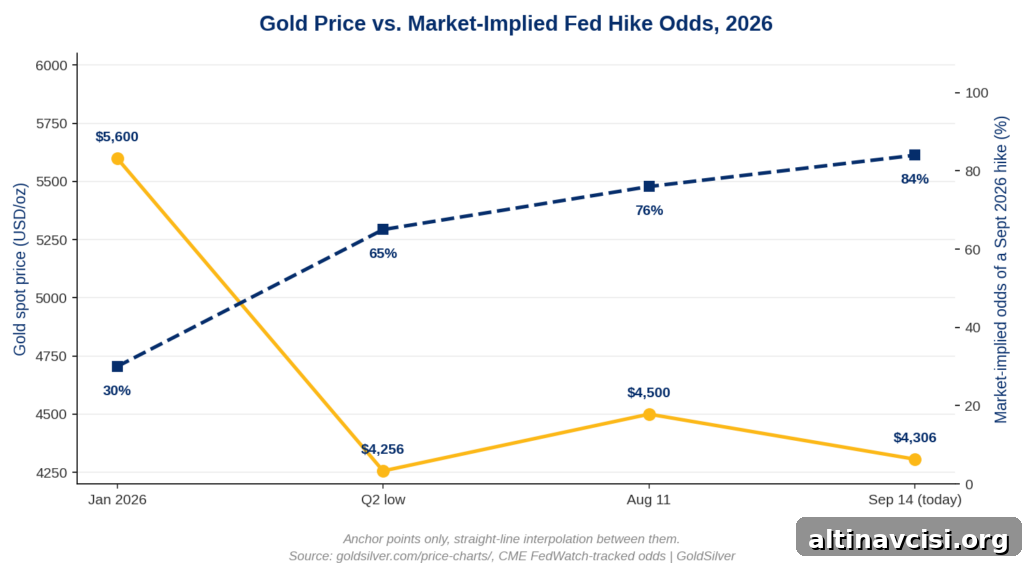
Gold is trading near $4,306 an ounce today, down about 1% from this morning’s open. Silver is around $63.59, off roughly 1.6%. Both metals are pulling back into a Federal Reserve decision that, at face value, should have produced a much larger decline than the modest dip seen so far.
On September 16, the Federal Reserve is widely expected to raise its policy rate for the first time in this cycle. Market-implied odds show a strong probability that a hike will occur. A rate increase of this kind would, in the classic textbook relationship between interest rates and gold, typically push gold lower and keep it there.
But that traditional relationship has been behaving differently. Gold set an all-time high above $5,600 in January, then corrected by roughly 25% through the spring. Since mid-year it has been rebuilding toward the mid-$4,000s. All the while, market odds of a Fed hike climbed from a coin-flip to near-certainty. If the old rate/gold dynamic still fully governed price action, that sequence would be hard to reconcile with the reality of persistent buying and resilience in the metal’s price.
Why Did Gold Stop Reacting to Real Yields?
The conventional view is straightforward: gold yields nothing, so when real interest rates rise, the opportunity cost of holding gold increases and capital tends to flow into interest-bearing assets like bonds. That relationship held for large parts of the post-2008 era, driven mainly by Western investors and ETF flows that chased yield and rate sensitivity.
Since 2022, however, the correlation between real yields and gold has weakened significantly. Gold reached new highs during periods when real yields on 10-year Treasury Inflation-Protected Securities were firmly positive—precisely the environment in which the classic model predicts downward pressure on gold. A temporary breakdown in correlation can happen, but three years of a repeated pattern across different Fed cycles and inflation episodes points to a structural shift: the identity of the marginal buyer that sets gold’s price has changed.
The Knowledge That Changes Everything
Two essential guides — yours free. Understand why gold matters and why fiat currencies always fail.
Who Is Buying Gold Instead of Selling Into the Hike?
For much of the post-2008 period, Western investors and large ETFs like GLD were the marginal buyers and sellers. They moved in response to rate and yield signals, increasing gold exposure when yields fell and trimming it when yields rose. That rate-sensitive investor dominated the market picture that older models describe.
Beginning in 2022, central banks emerged as a major, persistent source of demand. Central-bank purchases are far less sensitive to short-term rate shifts. According to World Gold Council reporting, official-sector buying exceeded 1,000 tonnes in each of 2022, 2023 and 2024, with another large amount in 2025. At an annual value of roughly $60–85 billion, central-bank purchases have absorbed a substantial share of global mine production. A reserve manager building long-term reserves does not typically unwind a position because one central bank raises rates 25 basis points.
A Second Buyer Has Joined the Central Banks
More recently, retail and non-U.S. institutional investors have increased their participation, joining central banks as consistent buyers. These additional buyers are not primarily trading a short-term real-yield story; many are buying gold for diversification, to hedge currency risk, and as protection against counterparty exposure. Official-sector purchases remain strong as well—several countries added meaningful official reserves in recent quarters—so the marginal demand now comes from buyer groups that are far less likely to liquidate positions over a single monetary policy announcement.
That structural change helps explain why many bank price targets for gold have not moved lower despite rising Fed-hike odds. Several major research desks continue to publish year-end and next-year targets at or above current prices. Those forecasts reflect an expectation that central-bank and long-term investors will keep supporting gold even as rates rise moderately.
What Will the Fed’s September 16 Decision Actually Change?
A Fed rate hike still matters. A surprise increase or language more hawkish than the market already expects can push gold lower in the short term. Real yields continue to influence flows at the margin. What has changed is that yields are no longer the sole driver of gold’s price. Three years of consistent buying by central banks, and growing demand from long-term institutional and retail investors, means that a single Fed meeting is less likely to reverse the broader structural bull case.
For individuals deciding how much of their savings to hold in physical metal, the practical distinction is the hedge you seek. If you treat gold primarily as a short-term trade against interest-rate moves, then the Fed’s decision on September 16 is critical and may work against you. If you own gold as protection against currency debasement, inflation, or counterparty risk, a single policy meeting has limited impact on the longer-term case. That long-term rationale is also why central banks are accumulating reserves.
Stay On Top of Gold & Silver Prices
Get important market alerts sent straight to your inbox.
People Also Asked
Does a Fed rate hike always hurt gold prices?
Historically, higher real yields have tended to weigh on gold because they raise the opportunity cost of holding a non-yielding asset. Since 2022, however, that relationship has weakened as central-bank reserve buying and longer-term investors have shaped the marginal price.
Why are central banks buying gold instead of Treasuries?
Central banks are diversifying reserves to reduce exposure to currency and sovereign counterparty risk. These purchases are driven by strategic reserve considerations rather than near-term yield signals, so they tend to be persistent.
Have bank gold price targets changed ahead of the September hike?
Many major banks have maintained year-end and next-year targets at or above current prices, reflecting an assumption that structural demand from central banks and long-term investors will continue to support gold through modest rate moves.
How much gold have central banks bought since 2022?
Official-sector buying surpassed 1,000 tonnes in each of 2022, 2023 and 2024, with a similarly large amount in 2025, according to available industry data. That level of buying represents a material share of annual global mine production.
SOURCES
1. Industry reporting on bank forecasts and gold price outlooks.
2. World Gold Council — official statistics on central-bank gold purchases and demand trends.
3. Major financial institutions’ published gold price targets and research notes.
4. Historical price records and market commentary on gold and real yields.
Disclaimer: This article is for informational purposes only and does not constitute investment advice. Past performance is not indicative of future results. Always consult a qualified financial advisor before making investment decisions.
You May Also Like:
- How Much Gold Should You Own at 25, 45, or 65?
- Gold Price Outlook September 2026: What the Fed’s Meeting Means for Your Metals
- Do You Have to Report Gold Stored in a Foreign Vault? FBAR and FATCA Rules Explained
- Tokenized Gold: What It Actually Is, and Where the “Just Like Owning Gold” Pitch Breaks Down
- IRA-Eligible Gold: The Coins and Bars That Actually Qualify
- The No-Home-Storage-IRA Myth: Why the IRS Requires a Depository
- What Is a Gold IRA? The Purity Rule the IRS Never Wrote
- What Is ZIRP (Zero Interest Rate Policy) and How It Changed Gold Forever