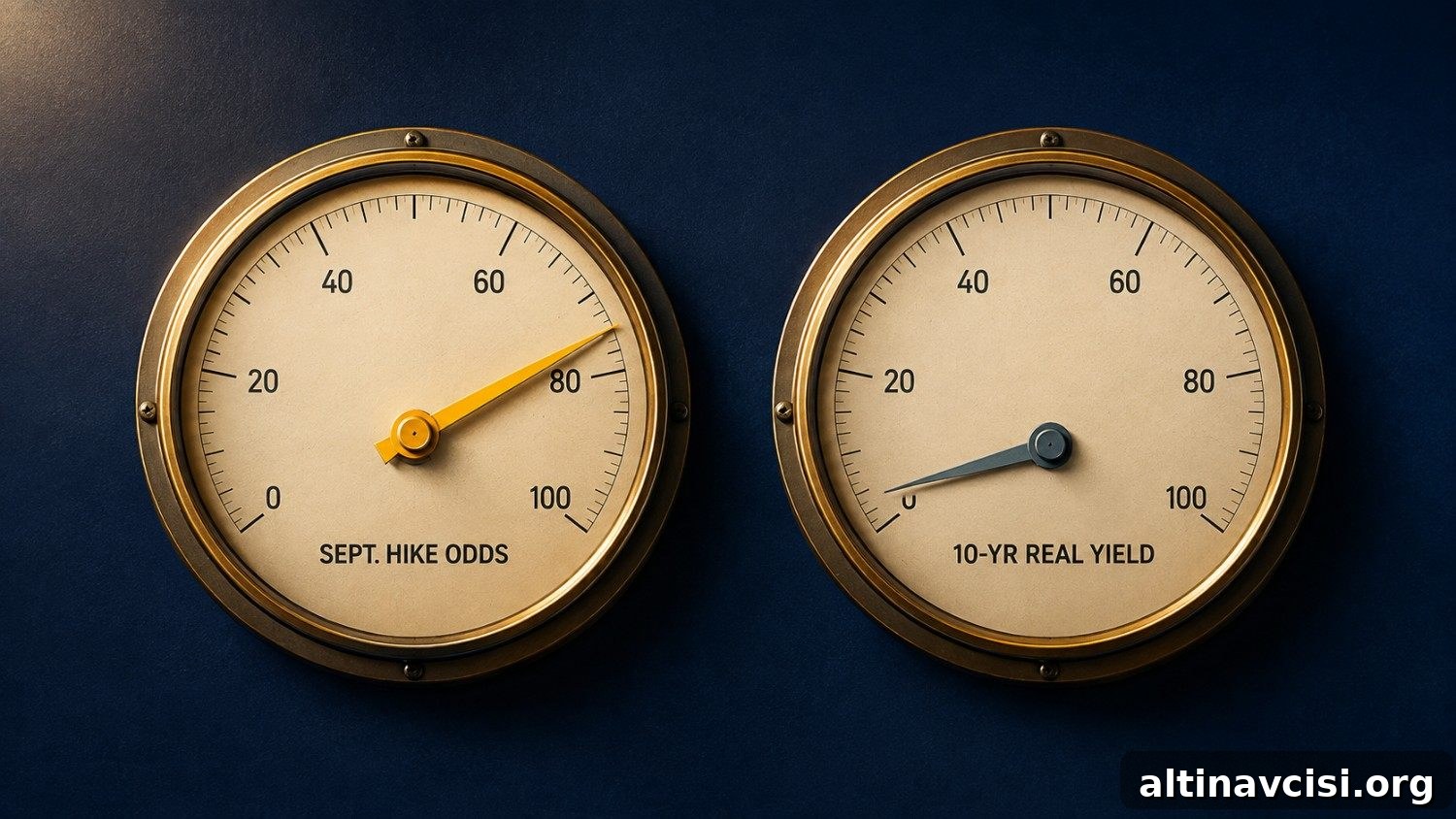
September’s odds for a Fed rate hike jumped sharply this week — from about 35% to 57% — after a single high-profile speech. Yet the 10-year real yield, the measure that most directly influences gold prices, moved only a couple of basis points in the same period. Over the next four days investors will get JOLTS, ADP, ISM, and the August jobs report. Those four data releases will help determine which market signal is more accurate: the sudden jump in hike expectations or the relative calm of real yields.
Why Does This Week’s Data Matter So Much for Gold?
Gold was trading near $4,427 an ounce on August 31, a modest decline from the morning’s open near $4,455. Silver held around $66.12, essentially unchanged. The prices themselves are subdued; the real question is how this week’s macro calendar will change expectations. JOLTS job openings and the ISM manufacturing report arrive Tuesday, September 1. ADP’s private payrolls estimate follows on Wednesday, and the official August payrolls report is due Friday, September 4. Together these releases are the last major inputs the Federal Reserve will see before its September 15–16 meeting.
Markets repriced aggressively after Fed Chair Kevin Warsh’s Jackson Hole speech on August 28. In that address he argued that underlying inflation “has not meaningfully improved” and that policymakers still have “work to do.” Within hours the CME FedWatch-implied probability of a September hike rose sharply, reflecting a new market view. This week’s data will either validate that repricing or cause some of it to reverse.
The Edge Every Investor Needs
Smarter precious metals investing starts with clear information. The Nuggets Newsletter offers market context, Fed updates, trend analysis, and educational content.
What Do Economists Expect From This Week’s Jobs Data?
Consensus expectations for August payrolls are muted: the market forecast centers around a gain of 55,000 jobs, with a range stretching from a decline of 25,000 to growth of about 102,000. The backdrop includes a surprising July report that showed a headline loss of 23,000 jobs, well below forecasts that had expected gains. June’s payrolls were also revised down, compounding concerns about recent labor-market strength.
Major banks’ internal forecasts sit modestly above the consensus. Several institutions project August payrolls in the 60,000–80,000 range, arguing that July’s weakness reflected sector-specific drops — notably in leisure, hospitality, and local education — that could partially reverse. Most professional forecasts do not view another negative print as the base case, so a renewed decline would be a notable surprise to markets.
What Happens If the Fed Hikes After Two Weak Jobs Reports?
Traders are debating whether the Fed would raise rates after two weak payroll reports. Historically, Fed rate hikes following consecutive negative payroll prints are rare, and that raises a delicate policy question: would the Fed prioritize fighting inflation even as the labor market softens, or would it pause and risk appearing to yield to market pressure? Fed commentary in recent weeks has emphasized inflation concerns over a strong labor market, which increases the odds policymakers might act to preserve their inflation-fighting credibility.
There is also a positioning angle to consider. Speculative long positions in gold expanded in the weeks leading up to the recent speech, meaning market positioning may amplify moves when the data arrives. Traders who already built bullish positions expecting hawkish policy may rush to adjust if incoming data contradict expectations, intensifying price swings in either direction.
Why Are Real Yields the Number That Actually Matters?
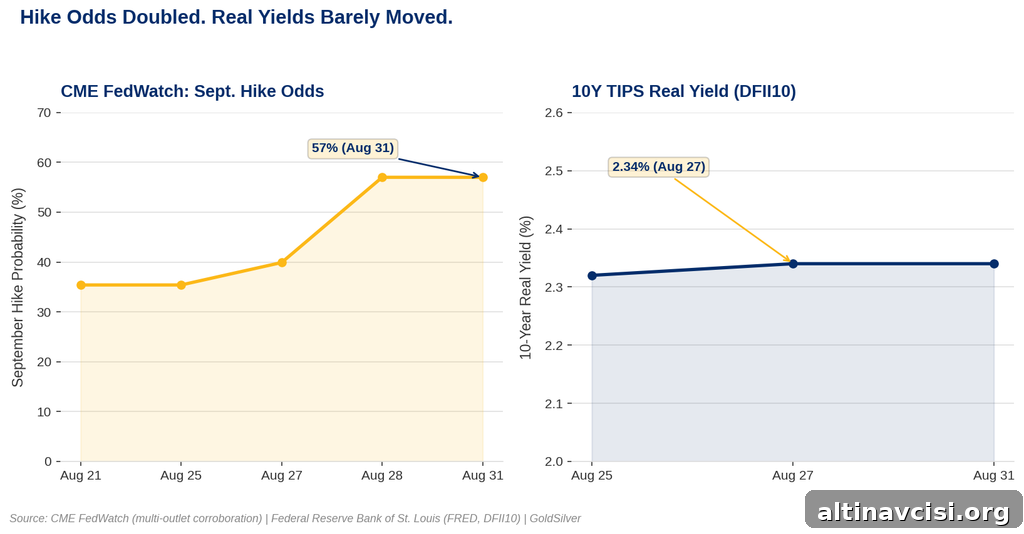
Gold’s price responds to real yields — the return investors demand above expected inflation — far more directly than to the headline probability of a Fed hike. As of late August the 10-year inflation-protected real yield hovered near 2.34%, barely changed even as Fed-hike odds rose materially. That divergence implies two possible paths: real yields could catch up to the higher hawkish pricing, which would pressure gold, or real yields could remain anchored, in which case a nominal-rate move would matter less for gold than the headlines suggest.
The difference between a September hike that comes with a real-yield breakout and one that leaves real yields flat is crucial for precious metals. Fiscal dynamics, debt servicing costs, and global demand for safe assets constrain how high nominal rates can go, and those constraints shape the path of real yields. This week’s data will help clarify which scenario markets are moving toward.
What Should Investors Watch This Week?
Focus on the sequence of releases, not just the Friday headline. Pay attention to the unemployment rate — consensus holds at 4.1% — and to wage growth, with year-over-year average hourly earnings expected around 3.0%, down slightly from prior months. Those internal details will either support the notion of a stabilizing labor market or reinforce a weakening trend. A report close to consensus will likely keep the Fed’s attention on inflation, while another weak print would sharpen the debate about whether policymakers should pause.
This week is pivotal because it shapes how the market prices the cost of holding a non-yielding asset over the months ahead. Whether or not the Fed ultimately hikes on September 16, these data releases will influence expectations for real yields, positioning, and therefore gold’s path for the near term.
SOURCES
1. Federal Reserve Board — Keynote Remarks by Chairman Warsh at the 2026 Jackson Hole Economic Policy Symposium
2. Time News — Gold Prices Slip as Hawkish Fed Outlook Revives September Rate Hike Bets
3. NBC News — July Jobs Report: US Economy Shed 23,000 Jobs, a Sudden Reversal
4. FinancialJuice — US NFP Prep (4th September)
5. ZeroHedge — Key Events This Week: Jobs, JOLTS, Beige Book and ISM
6. CFTC — Commitments of Traders Report, Gold (Legacy, Futures Only)
7. Federal Reserve Bank of St. Louis — 10-Year Treasury Inflation-Indexed Security Yield (FRED)
Disclaimer: This article is for informational purposes only and does not constitute investment advice. Past performance is not indicative of future results. Consult a qualified financial advisor before making investment decisions.
You May Also Like:
- COMEX Registered Gold Just Fell Below 15 Million Ounces. It’s Still Refilling.
- Gold Isn’t Falling on a Hawkish Fed. Here’s Why.
- Gold and Silver Sink as Warsh Cites AI Boom to Justify More Fed Tightening
- Five Things Moved Gold and Silver This Week. Only One Was Kevin Warsh.
- The Treasury’s Next Move Isn’t a Rate Cut. It’s a $967 Billion Checking Account.
- Six Paper Claims, One Ounce of Silver: What First Notice Day Reveals
- Five Gold Signals Fired This Week. None of Them Are About Today’s Price.