
Gold and silver both dipped within minutes of this morning’s US jobs report. That immediate move made headlines, but four hours later the more useful questions are different: why was the overall reaction smaller than one might expect, and why did mining stocks fall several times more steeply than the metal itself? Below are three concise threads from today’s session that answer the questions investors are actually asking.
Why Did the Bond Market Barely Move on a 3x Payrolls Beat?
August nonfarm payrolls surprised to the upside at roughly 162,000 jobs, about three times the consensus near 55,000–56,000. Unemployment remained steady at 4.1%. On the surface, that sort of upside surprise tends to push Treasury yields higher. Yet the 10-year yield moved only about 1–2 basis points, while the more rate-sensitive 2-year rose roughly 5 basis points.
The muted 10-year response is easier to understand when you look at the week’s prior moves. The 10-year had already traded through a wider range earlier in the week, reaching as high as about 4.82% and then falling back after a string of dovish comments. In that context, today’s small rise looks more like a partial reversal of those dovish repricings than a decisive fresh assessment of economic strength. For precious metals owners, that distinction matters. Gold responds over the medium term to real yields and inflation expectations rather than to a single payroll number, and real yields only moved modestly today—consistent with a contained reaction in the gold price.
The Edge Every Investor Needs
Smarter precious metals investing starts here. The Nuggets Newsletter brings essential market insights, Fed updates, global trends, educational videos, and more.
What Does Speculative Positioning Say About Why Gold Fell as Hard as It Did?
The latest Commitments of Traders snapshot through August 25 showed managed-money speculators with a significantly long net position in gold futures. Speculators had already built a stretched long book heading into this week’s data, which makes the market vulnerable to position unwinding when a hawkish surprise hits.
When positioning is crowded on one side, price moves after an unexpected data point often reflect forced exits and profit-taking rather than a brand-new consensus on fundamentals. That same dynamic shows up in divergent interpretations of rate-hike odds: different desks can read identical data and come away with materially different probabilities for a September move. Those disagreements aren’t measurement errors; they reveal a market that is still trying to decide what one payroll print means for Fed policy in the absence of clear forward guidance. Today’s drop, therefore, reads more like a repricing of stretched positioning than a definitive change to the macro outlook.
Why Did Gold Miners Fall Three to Four Times Harder Than Gold Itself?
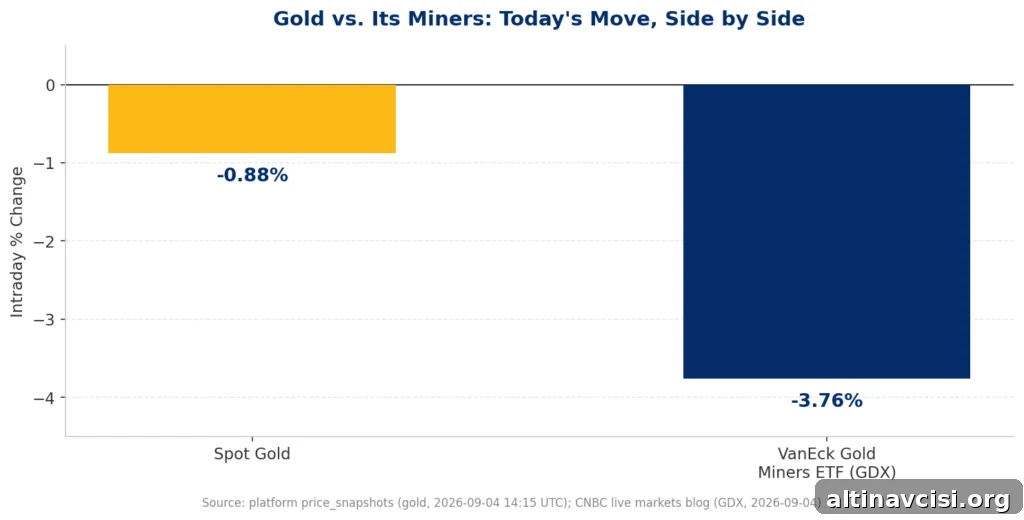
Spot gold fell about 1% today while the VanEck Gold Miners ETF traded down roughly 3.7% intraday. Individual miners showed similar moves, with several names down more than 3.5% in early trading. That divergence is a classic example of operating leverage in mining equities.
A miner’s cash costs—labor, equipment, energy, and regulatory expenses—are largely fixed in the short run. When the gold price moves a few percent, a miner’s profit margin often swings by a larger percentage because those fixed costs don’t fall in proportion to the metal. Investors therefore expect mining stocks to amplify moves in the underlying commodity: two-to-three times on the way up and the same on the way down. The result is that owning bullion provides a direct claim on the metal itself, whereas owning miners is exposure to a business whose profits magnify the metal’s moves.
That distinction is practical, not theoretical. Someone holding physical gold absorbed today’s weakness in nearly the same proportion as the metal’s move. An equity holder absorbed the same news through a corporate balance sheet that magnifies price swings even before company-specific operational risks are considered. For portfolio construction, the choice between physical metal and mining equities should reflect this difference in risk and return behavior.
None of today’s intraday volatility alters the structural reasons many investors hold gold and silver: they remain tools to protect purchasing power in an environment of fiscal deficits and central banks that have not committed to a strict rule for future policy. The immediate action, however, is best interpreted as a correction of stretched positioning against an ambiguous data print rather than as a decisive change in that structural story. Watch spot metal prices and upcoming macro events—especially next week’s consumer price index and the Fed’s September decision—to see whether this repositioning continues or reverses.
Stay On Top of Gold & Silver Prices
Get important market alerts sent straight to your inbox.
SOURCES
1. Bureau of Labor Statistics — August 2026 Employment Situation report (nonfarm payrolls, unemployment rate)
2. CME Group FedWatch Tool — September 2026 rate-hike probability data
3. CFTC Commitments of Traders report — gold futures, week ending August 25, 2026
4. CNBC — coverage of market reaction to the jobs report, September 4, 2026
5. Federal Reserve Board — selected interest rates data, September 2026
6. VanEck — Gold Miners ETF (GDX) holdings and fund data
Disclaimer: This article is for informational purposes only and does not constitute investment advice. Past performance is not indicative of future results. Always consult a qualified financial advisor before making investment decisions.
You May Also Like:
- Gold and Silver Drop as August Payrolls Blow Past Forecasts. Four Other Threads Moved Today Too.
- The Fed Just Priced Out Half a Rate Hike. Gold Barely Noticed.
- Gold Up, Silver Up. The Five Reasons Behind It Don’t All Agree.
- Barrick Just Delayed Its Biggest Move in Years. Gold Isn’t Why.
- Gold ETF Outflows Came From One Region. The Buying Came From Everywhere Else.
- Gold’s Sellers Are Trading Weeks. Its Buyers Are Counting Decades.
- The Iran War Just Got Worse. Gold Barely Noticed.