
The Federal Reserve delivered a notably hawkish message this week. Logically, that should push gold sharply lower. Instead, gold is down less than 1% and silver is roughly unchanged. The market that’s supposed to dread a September rate hike appears unconvinced one is imminent.
Gold is trading near $4,440 per ounce, slightly below Friday’s close, while silver is hovering around $67 after a choppy session. Two major forces are clashing: a new U.S. military strike near the Strait of Hormuz, and renewed debate about whether the Fed will actually raise rates in September. Today, neither force is decisively dominating prices.
What Happened Overnight in the Strait of Hormuz?
On August 30, U.S. forces struck two Iranian rocket launchers on Larak Island. According to U.S. Central Command, those launchers were being prepared to fire rockets fitted with sea mines into the Strait of Hormuz. Iran’s Revolutionary Guards acknowledged the strike and said they responded by targeting U.S.-linked bases in Jordan and the UAE, and by claiming to have downed a U.S. drone over the strait. The incident pushed oil prices higher — West Texas Intermediate crude rose about 1.3% to 2% — reflecting the strait’s importance as a conduit for roughly a fifth of global oil shipments.
The Edge Every Investor Needs
Smarter precious metals investing starts here. The Nuggets Newsletter brings you essential market insights, Fed updates, global trends, educational videos, and much more.
Why Isn’t Gold Rallying on a Fresh Middle East Strike?
Events like a strike in the Middle East typically drive investors toward gold as a safe haven. But a countervailing force — the rising probability of a Fed rate increase — is pushing in the other direction. Higher interest rates raise the opportunity cost of holding non-yielding assets like gold. When two strong influences push opposite ways, the market’s short-term price action reflects which influence traders believe will matter immediately. At the moment, the Fed-rate narrative appears to be winning that tug of war.
That narrative shifted after Fed Chair Kevin Warsh’s Jackson Hole remarks last Friday, when he described inflation as “more concerning” than labor-market dynamics and highlighted the Personal Consumption Expenditures price index running well above the Fed’s 2% goal. Media coverage labeled Warsh’s comments hawkish, but headlines simplified a more nuanced picture. The key question is not whether the speech sounded hawkish, but how much the market actually moved toward pricing in a September hike.
How Confident Is the Market That the Fed Will Actually Hike?
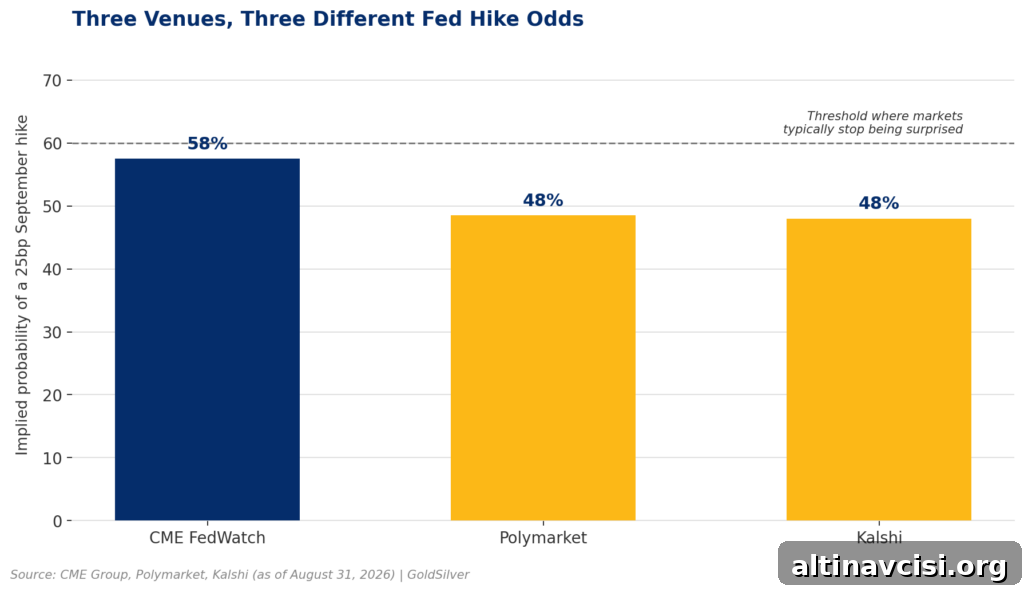
Market confidence is significant but not unanimous. The CME FedWatch tool translates fed funds futures into implied probabilities and currently shows roughly a 57%–58% chance of a 25-basis-point hike in September, up from near 40% before Warsh spoke. That’s a notable increase, but it’s far below the 90%-plus level markets usually treat as a foregone conclusion.
Prediction markets tell a similar story of uncertainty. Polymarket is pricing the same outcome at roughly 48%–49%, while Kalshi places the probabilities near a 52% chance of hold versus 48% for a hike. Three venues, three distinct readings — none indicate a market that has fully made up its mind.
Observers in finance have been blunt. Jim Bianco, founder of Bianco Research, called the September meeting a “lean hike” rather than a done deal. Institutional voices including ABN AMRO Investment Solutions and Brandywine Global have also emphasized the lack of consensus. In short, the Fed-odds story remains fluid and market participants are parsing competing signals.
If a Hike Happens, Would It Even Be Bad for Gold?
Not everyone accepts the simple assumption that a rate hike would automatically crush gold. Robin Brooks, a former chief economist at the Institute of International Finance and now a fellow at Brookings, argues that a September hike would be more about restoring Fed credibility and anchoring the 10-year yield than tightening financial conditions in a lasting way. In his view, the bond-market reaction after the July meeting — not the act of hiking itself — was the true tightening signal.
That distinction matters because a hike that is largely symbolic leaves the underlying economic reality unchanged: inflation running above target and a central bank balancing its dual mandate of price stability and employment. If a move is perceived as performative — meant to influence optics and yields rather than truly restrict demand — gold’s role as a hedge against persistent debasement remains intact. Investors focused on preserving purchasing power tend to prepare for that longer-term outcome, regardless of a single monthly decision.
What Does This Mean for Gold and Silver Investors?
The more important story is not the Hormuz strike alone and not any single Fed speech. Multiple signals moved markets this week, and the prevailing theme is uncertainty about what a September Fed decision would really signify. A hike priced as a credibility-restoring measure looks very different from a hike that signals a genuine shift toward tighter monetary policy. That nuance will shape real returns for holders of gold and silver.
Investors should monitor two near-term events closely. First, the August jobs report due Friday, September 4, which could swing rate-hike probabilities before the Federal Open Market Committee meets on September 16. Second, the language the Fed uses if it does hike: wording focused on anchoring yields and restoring credibility will be read differently than language emphasizing cooling aggregate demand, even if both outcomes produce the same headline action.
Stay On Top of Gold & Silver Prices
Get important market alerts sent straight to your inbox.
SOURCES
1. CoinDesk — “Bitcoin and gold may have room to surge further as September Fed rate-hike fears look overblown,” August 31, 2026
2. CoinDesk — “Bitcoin barely blinks, XRP drops as U.S. strikes Iran and oil rallies,” August 31, 2026
3. Associated Press via NBC News — “U.S. forces strike Iranian rocket launchers on the Strait of Hormuz in first military action in weeks,” August 30, 2026
4. CNBC — “September Fed decision is now a coin flip as rate hike odds increase post Warsh,” August 28, 2026
5. Bitcoin.com News — “Fedwatch Turns Hawkish With 57% Odds of September Rate Increase,” August 30, 2026
6. Robin Brooks (Brookings Institution) — “Will a September hike hurt gold?”
7. CME Group — FedWatch Tool, September 2026 FOMC meeting probabilities
Disclaimer: This article is for informational purposes only and does not constitute investment advice. Past performance is not indicative of future results. Always consult a qualified financial advisor before making investment decisions.
You May Also Like:
- Gold and Silver Sink as Warsh Cites AI Boom to Justify More Fed Tightening
- Five Things Moved Gold and Silver This Week. Only One Was Kevin Warsh.
- The Treasury’s Next Move Isn’t a Rate Cut. It’s a $967 Billion Checking Account.
- Six Paper Claims, One Ounce of Silver: What First Notice Day Reveals
- Five Gold Signals Fired This Week. None of Them Are About Today’s Price.
- Gold Fell 9% the Last Time Warsh Spoke. He’s Back Tomorrow.
- Gold Ran Past Wall Street’s Own Price Targets. Four Banks Disagree on What Happens Next.