Gold is trading about 2.0% lower today, near $4,357 per ounce, while silver has fallen roughly 2.6% to about $64.79. Those moves might look connected to recent geopolitical developments, but the price action is being driven primarily by interest-rate expectations, not by sanctions headlines. Earlier this week the U.S. Treasury named gold among five Iranian economic sectors now exposed to secondary sanctions, and Treasury Secretary Scott Bessent is meeting G20 counterparts in Asheville, North Carolina, to press for enforcement. Neither the sanctions announcement nor the G20 diplomacy is the immediate cause of today’s drop; market pricing around policy rates is.
What Did the U.S. Just Sanction in Iran’s Gold Sector?
On August 24 the Office of Foreign Assets Control (OFAC) issued a determination that expands the scope of Executive Order 13902 to include Iran’s aviation, digital-asset, gold, shipping, and technology sectors. The determination, signed by OFAC leadership, means anyone anywhere who participates in Iran’s gold trade or knowingly conducts a significant transaction tied to it could face U.S. secondary sanctions. Treasury describes the effort as part of “Operation Economic Outcast.”
Gold is singled out because physical bullion can move value without relying on banks, wire transfers, or the dollar-based financial plumbing once access to SWIFT and correspondent banking is cut. That characteristic makes gold useful both to entities seeking to evade sanctions and to central banks looking to reduce exposure to financial-counterparty or currency-access risk. The same property that can help a sanctioned actor move value is also attractive to reserve managers aiming to diversify away from fiat-based vulnerabilities.
The Edge Every Investor Needs
Smarter precious metals investing starts here. The Nuggets Newsletter brings essential market insights, Fed updates, global trends, educational videos, and much more.
Why Are Central Banks Buying the Same Asset Iran Is Being Sanctioned For Using?
The connection is historical and logical. After Western authorities froze roughly $300 billion in Russian central-bank reserves following the 2022 invasion of Ukraine, several emerging-market central banks openly cited that action as a motivating reason to shift reserves away from dollar-denominated assets and toward gold. A claim on a currency or a foreign account can be revoked or restricted; a physical bar of gold in a domestic vault cannot be seized through the same financial channels. Iran’s use of gold to circumvent sanctions and central banks’ accumulation of gold as a hedge against currency and access risk are two sides of the same precautionary impulse: protecting value when reliance on another country’s financial infrastructure looks risky.
What Is Happening at the G20 Meeting in Asheville Today?
The G20 finance ministerial in Asheville is the diplomatic layer of that story. Secretary Bessent, leading the U.S. finance track, is urging counterparts—including major oil importers still buying Iranian crude—to cut financial ties with Tehran. His message has been forceful, framing the pressure as necessary to deny financing for destabilizing activities. Whatever immediate policy steps emerge from the meeting, the broader signal is clear to central bankers and reserve managers: access to the dollar-based financial system can be used as leverage, and the United States is willing to use it.
So Why Are Gold and Silver Actually Falling Today?
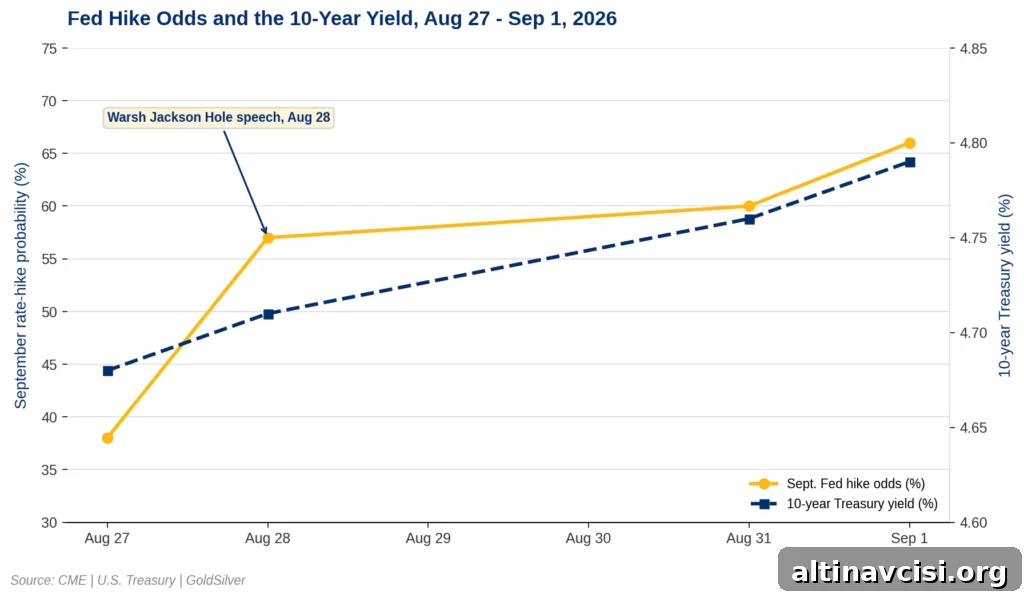
Today’s decline is being driven by interest-rate dynamics, not sanctions. Kevin Warsh’s August 28 speech at Jackson Hole reiterated the Fed’s 2% inflation target and argued that unconventional tools, such as large-scale bond purchases, should be used sparingly in the future. That rhetoric reinforced the market’s sense that the Fed may remain restrictive. Futures-based odds for a 25-basis-point Fed hike in September jumped to roughly 65–68% from about 40% a week earlier. At the same time, the 10-year Treasury yield rose for a fifth straight session to 4.79%, its highest since January 2025.
Rising expected policy rates increase the opportunity cost of holding non-yielding assets such as gold and silver. In other words, as bond yields and the chance of tighter policy climb, bullion becomes relatively less attractive. That explanation accounts for most of today’s price action. It also explains a shift from two weeks earlier when Treasury actions—specifically, expanded long-dated bond buybacks intended to stabilize the bond market—had briefly supported the “debasement” narrative that pushed gold up. Warsh’s comments and stronger rate expectations have reversed that temporary dynamic.
How Does Oil Connect the Sanctions Story to Today’s Selloff?
Oil links the geopolitical and rate stories. Brent has traded above $91 per barrel and WTI above $86, each up roughly 8–9% over the past month after recent strikes around the Strait of Hormuz and retaliatory actions. Higher oil pushes inflation expectations upward, strengthening the case for a hawkish Fed response. That, in turn, feeds directly into higher yields and the pressure on precious metals. So the same geopolitical conflict that broadened sanctions risk also boosts oil-driven inflation expectations, which push yields higher and weigh on gold and silver prices.
Which Story Should Investors Actually Be Watching?
Investors should separate the near-term drivers from the longer-term backdrop. Near term, metal prices are reacting to rate expectations and data flows: the August ISM Manufacturing PMI and the July JOLTS report arrive this week, followed by August employment data on Friday, all feeding into the Fed’s September 16 decision. Those releases will likely matter more to prices over the coming days than the sanctions announcement.
Over a longer horizon, however, the reserve-diversification story remains relevant. The question for central banks is multi-year: how much should a sovereign rely on a currency system whose issuer has, on multiple occasions in recent years, demonstrated it can restrict access to that system? Naming gold as a sanctions target doesn’t resolve that debate; it simply underlines why many governments are reassessing their exposure to dollar-based assets.
Stay On Top of Gold & Silver Prices
Get important market alerts sent straight to your inbox.
SOURCES
1. Federal Register, Aug. 27, 2026 — Publication of a Determination Issued Pursuant to Executive Order 13902
2. Yahoo Finance (AP), Aug. 31, 2026 — G20 Finance Chiefs Gather in North Carolina With Iran Sanctions and Tariffs in Focus
3. Federal Reserve, Aug. 28, 2026 — Chairman Warsh Keynote Remarks, Jackson Hole Economic Policy Symposium
4. CNBC, Sept. 1, 2026 — 10-Year Treasury Yield Rises to Highest Since January 2025 as Surging Oil Rekindles Inflation Fear
5. Yahoo Finance, Sept. 1, 2026 — Silver Prices Today, Tuesday, September 1, 2026
Disclaimer: This article is for informational purposes only and does not constitute investment advice. Past performance is not indicative of future results. Always consult a qualified financial advisor before making investment decisions.
You May Also Like:
- Hike Odds Doubled This Week. Real Yields Didn’t.
- COMEX Registered Gold Just Fell Below 15 Million Ounces. It’s Still Refilling.
- Gold Isn’t Falling on a Hawkish Fed. Here’s Why.
- Gold and Silver Sink as Warsh Cites AI Boom to Justify More Fed Tightening
- Five Things Moved Gold and Silver This Week. Only One Was Kevin Warsh.
- The Treasury’s Next Move Isn’t a Rate Cut. It’s a $967 Billion Checking Account.
- Six Paper Claims, One Ounce of Silver: What First Notice Day Reveals