
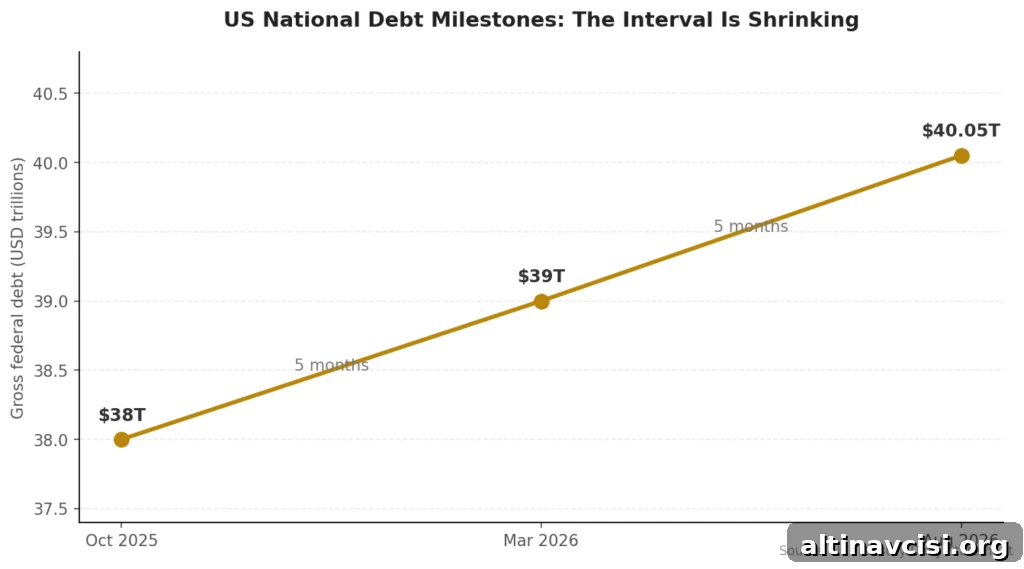
America’s national debt topped $40 trillion on Tuesday, August 18. It had reached $39 trillion only five months earlier and $38 trillion five months before that. In the days following, a prominent Wall Street strategy note highlighted that accelerating debt trajectory and adopted a more bullish stance on gold.
As of Friday morning, gold is trading near its recent highs, while silver has also advanced. The gold-silver ratio sits close to its long-run average, a sign traders watch when assessing relative value between the two metals.

The Edge Every Investor Needs
Smarter precious metals investing starts here. The Nuggets Newsletter delivers essential market commentary, central bank updates, global macro developments, educational videos, and more.
What Did Jefferies Say About Gold?
Jefferies adopted a more bullish tone on gold in its weekly strategy note GREED & fear, authored by Chris Wood. The note identifies three primary drivers behind the bank’s shift: deteriorating public finances in the United States and Japan, shrinking central-bank flexibility, and improving cash generation among gold miners.
The national debt figures underpin this view. Jefferies highlighted a $432 billion federal deficit for July, the largest monthly shortfall since March 2021 and the biggest July on record. For the first ten months of fiscal 2026, the deficit reached $1.799 trillion compared with $1.775 trillion for the full twelve months of fiscal 2025.
That year-over-year comparison merits context: because August 1 fell on a Saturday, about $99 billion of payments scheduled for August were processed in July. Treasury’s adjusted ten-month tally is therefore smaller—near $1.700 trillion. Still, the trend is clear: deficits are large and remain on an upward trajectory, reinforcing concerns about fiscal sustainability.
How Does the National Debt Affect the Gold Price?
The connection runs primarily through the Treasury market. Greater borrowing requires more bonds, and larger supply tends to push yields higher if demand does not keep pace. This week the long end of the curve rose: the 30-year Treasury yield climbed to levels not seen in nearly two decades. In response, Treasury announced a larger buyback operation for longer-term debt, temporarily easing yields.
However, the effect proved short-lived. Yields dipped after the announcement and then returned to previous highs within a session. Persistently higher yields increase the government’s interest burden. Interest payments already consumed roughly 18.5% of federal revenues in fiscal 2025—the highest share on record for the data series—and projections show that burden remaining elevated. That dynamic constrains how far the Federal Reserve can raise rates without dramatically increasing fiscal stress, a problem economists label “fiscal dominance.” Gold, which sits outside the fiscal system, often benefits in such scenarios.
Why Are Gold Miners Now Outearning the S&P 500?
A measurable shift has occurred in miners’ financial returns. The Philadelphia Gold and Silver Index now yields a higher free-cash-flow return—around the mid-single-digit percentages—than the S&P 500. As recently as mid-2023 that index produced negative returns, and mining companies were cash-consuming rather than cash-generating. The reversal happened because the gold price outpaced increases in production costs, boosting miners’ cash flow. That improvement has drawn investor attention and helped support share prices.
Is the Fiscal Case for Gold Actually New?
The fiscal argument for gold is not new. Investors have warned about rising public debt for decades, sometimes prematurely. Jefferies did not place gold at the top of its hedges; the note ranked oil and energy equities ahead of gold, citing geopolitical risk in key chokepoints. Still, the tone matters: the bank anchored its view on concrete arithmetic that has already transpired rather than on short-term rate forecasts. A brokerage turning bullish is a shift in sentiment, but not a guaranteed price signal.
What Does a $40 Trillion National Debt Mean for Savers?
The important point is not only the headline total but the pace at which it is growing. It took roughly two centuries for the national debt to reach the first trillion in 1981; the most recent trillion was added in about five months. Those increasingly compressed intervals, combined with compound interest on the debt, limit realistic policy choices: cut spending, raise taxes, or allow inflation to erode the real value of obligations. Historically, many governments have favored inflationary solutions, which is why understanding sound money and real purchasing power matters for savers.
Gold does not predict which policy path will be chosen. Instead, it provides a market-based measure of the currency’s purchasing power. Holding some allocation to gold is a risk-management choice grounded in arithmetic rather than alarmism.
What Should You Watch Next?
There are three near-term developments to monitor. First, Treasury’s expanded buyback program runs from early September through early November; whether those operations can hold down long-term yields will matter. Second, a major central-bank forum in late August will feature high-profile speeches that could influence expectations about monetary policy. Third, watch key technical levels in gold prices—recent intraday highs provide a near-term reference for momentum.
Stay On Top of Gold & Silver Prices
Get important market alerts sent straight to your inbox.
SOURCES
1. ANI — Jefferies Turns Bullish on Gold as US, Japan Fiscal Strains Constrain Monetary Policy
2. US Joint Economic Committee — July Closes with $432 Billion Deficit, Largest Monthly Deficit Since March 2021
3. Peter G. Peterson Foundation — Monthly Interest Tracker and the Current Federal Deficit and Debt
4. CBS News — National Debt Tops $40 Trillion After Doubling in Less Than a Decade
5. Committee for a Responsible Federal Budget — Treasury Confirms $1.8 Trillion Deficit for First 10 Months of FY 2026
6. CNBC — Treasury Announces Upscaled Buyback Operation, and Yields Rebound the Following Session
7. Federal Reserve Bank of Kansas City — Jackson Hole Economic Policy Symposium 2026
8. Jefferies — Christopher Wood, Global Head of Equity Strategy
9. GoldSilver — Live Gold and Silver Price Charts
Disclaimer: This article is for informational purposes only and does not constitute investment advice. Past performance is not indicative of future results. Always consult a qualified financial advisor before making investment decisions.
You May Also Like:
- Gold Fell and Silver Rose on the Same Report. Here Is the Mechanism.
- Trump Declared Economic War on Iran. Gold Barely Blinked. Here’s Why.
- Gold’s Pullback Isn’t About ETFs. It’s About a Treasury Buyback.
- The Fed Just Confirmed a 9-3 Split. Then It Said Something Bigger.
- Gold and Silver Are Climbing Today. The Textbook Says They Shouldn’t Be.
- Gold Jumped 1.9%. Silver Jumped 2.7%. The Fed Hasn’t Said a Word Yet.