Gold is trading at $4,023 this morning. OCBC (Oversea-Chinese Banking Corporation), one of Southeast Asia’s largest banks, has just cut its year-end gold forecast sharply — from $5,100 to $4,360 — citing higher real yields, a stronger U.S. dollar, and a more hawkish Federal Reserve. These are the same macro forces that typically push model-based price targets lower when geopolitical events increase inflationary pressure rather than pure market fear. Remarkably, in January that same bank was forecasting $5,600.
The gap between those two forecasts — $1,240 per ounce — is the central story today. Not because OCBC must be right, but because the reasons behind the downgrade explain what is driving the current correction in precious metals. Understanding why a prominent institution reversed a bullish call tells you which macro variables matter most right now.
What Did OCBC Actually Say?
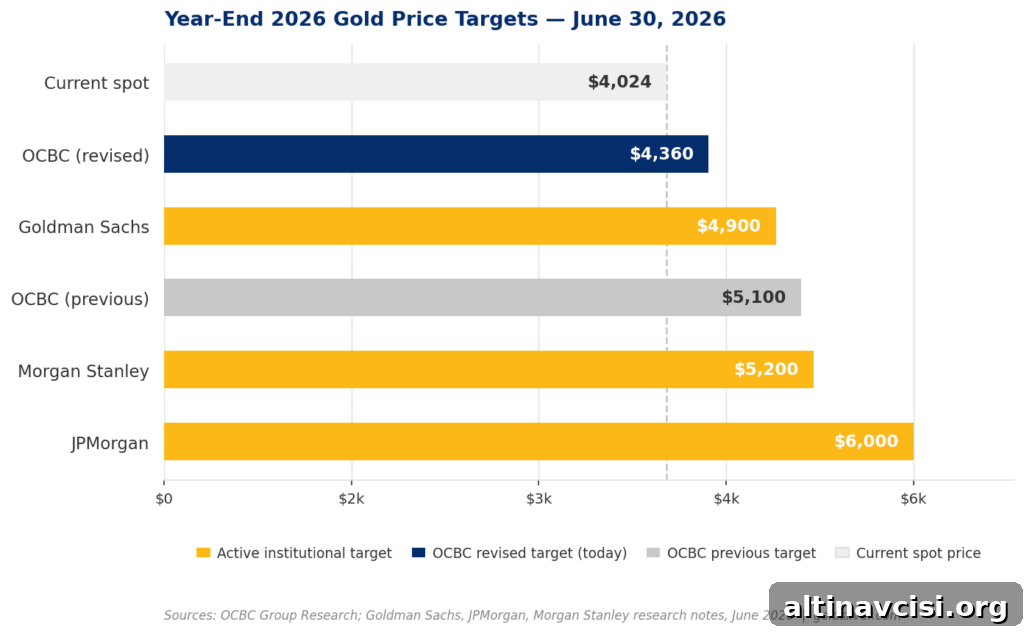
This morning OCBC revised its gold forecast downward by $740 per ounce, from $5,100 to $4,360. Silver was lowered from $89.50 to $67, a drop of roughly 25%. The bank explicitly named higher real yields, a firmer U.S. dollar, a more hawkish Federal Reserve stance, and waning ETF demand as the main drivers behind the revision.
Importantly, OCBC emphasized that its structural view on gold has not changed. Central bank purchases continue, silver still faces supply deficits in many markets, and the long-term fundamentals for precious metals remain constructive. The bank’s message is not that gold is fundamentally broken. It is that the timing has shifted: the near-term environment is less supportive than the bank previously expected.
Why Did OCBC’s Gold Forecast Change?
OCBC’s earlier and more optimistic forecast — including a $5,600 peak set in late January 2026 — rested on a clear list of assumptions: the Federal Reserve would move toward cutting interest rates, the U.S. dollar would weaken, and investor demand for gold would remain robust. Since then, every one of those assumptions has reversed.
The conflict that began on February 28 between the U.S. and Iran pushed oil prices higher. Rising oil helped lift headline inflation. Higher inflation led the Fed to abandon expectations of an easing cycle, and market-implied probabilities shifted toward additional policy tightening instead of cuts. As a result, real yields — the inflation-adjusted returns on Treasuries — have climbed. When real yields rise, the opportunity cost of holding gold increases: bonds now offer higher real returns while gold pays no yield.
OCBC did not abandon its view of gold’s long-term role as an inflation hedge and reserve asset. What it did change was the expected timing of a Fed pivot and the likely near-term path for prices given the new mix of yields, dollar strength, and ETF positioning.
Why Other Banks Still See Higher Prices
OCBC’s revised $4,360 target sits noticeably below many institutional peers. Goldman Sachs trimmed its year-end forecast but still projects $4,900. Morgan Stanley and JPMorgan remain more bullish, with targets above $5,000 and, in JPMorgan’s case, near $6,000. All these institutions still acknowledge the structural bull case for gold.
This divergence largely comes down to time horizon. Some banks emphasize long-term structural flows, especially central bank reserve accumulation that began accelerating after major geopolitical disruptions earlier in the decade. Central bank buying is driven by multi-year policy decisions and balance-sheet strategies, so it can be relatively insensitive to short-term rate repricings. Other banks, like OCBC in this update, are emphasizing the short-to-medium-term effect of rising real yields and a firmer dollar on ETF flows and futures positions.
Put simply, different forecasts reflect different lenses: structural demand and reserve policy versus near-term macro repricing of rate expectations. Both perspectives can be valid simultaneously.
What This Means for Physical Metal Owners
OCBC’s forecast revision primarily affects paper markets: ETF flows, futures contracts, and institutional positioning are the mechanisms that will determine how prices move through year-end. Physical metal owners are exposed to a different set of dynamics. Real yields and central bank policies influence purchasing power and currency stability, but holding physical gold or silver is a long-term store of value that doesn’t directly respond to every short-term forecast change.
If your holdings are physical bullion, a bank model update does not change the intrinsic attributes of that metal. Real yields may compress the relative appeal of non-yielding assets in the near term, but inflation that outpaces interest on cash accounts is precisely why many investors hold physical precious metals: to preserve purchasing power over time. OCBC updated a model; it did not alter the fundamental monetary math or the physical supply-demand picture.
Stay On Top of Gold & Silver Prices
Get important market alerts sent straight to your inbox.
SOURCES
1. Investing.com — OCBC Group Research: Gold and Silver Forecasts Revised Lower, June 30, 2026
2. OCBC — FX and Commodities Market Insights, 2026
3. Bloomberg via Yahoo Finance — Goldman Sachs Cuts Year-End Gold Forecast to $4,900, June 19, 2026
4. J.P. Morgan Global Research — Gold Price Predictions for 2026 and 2027
5. CME Group — FedWatch Tool: Fed Funds Rate Probabilities
6. Council on Foreign Relations — Russia’s Frozen Assets and Sanctions Policy, 2022
7. GoldSilver — Live Gold and Silver Price Charts
Disclaimer: This article is for informational purposes only and does not constitute financial or investment advice. Always consult a qualified financial adviser before making investment decisions.
You May Also Like:
- Gold Is Closing Its Worst Quarter Since 2013. A War Made It Happen.
- 172,000 Jobs Doubled the Forecast. Thursday’s Report Could Move Gold Again.
- The Dot Plot Has 18 Dots. The Chair Withheld His.
- Gold’s Worst Week of 2026. Central Banks Just Filed a Record Buy Signal.
- Silver Looks Like It’s Losing. The Ratio Says It’s Loading.
- Q1 GDP Beat. Jobless Claims Beat. Gold Rose. Here’s Why.
- PCE Hit 4.1%. Gold Went Up. Here’s Why.
- 298 Tonnes of ETF Gold Is Underwater. Central Banks Aren’t.