
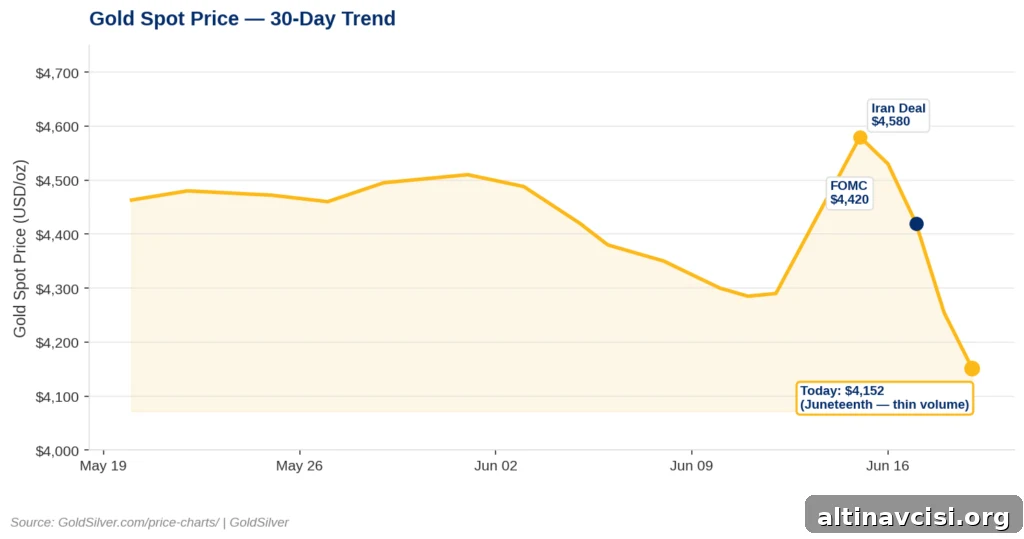
Gold is quoted at $4,152 this morning, down roughly $57 from Thursday’s open, while silver sits near $64.72, about $1 lower. If you’re drawing big conclusions from those figures, pause. The US market is closed today for Juneteenth. The New York Stock Exchange, Nasdaq, US Treasury markets, and major settlement systems are not operating. Regular US trading resumes on Monday, June 22.
What you are seeing now is the effect of London and Asian market participants winding up the week and continuing to process Wednesday’s Federal Reserve surprise in a session with much lighter-than-normal volume. That environment produces price moves driven more by mechanics than by the broad consensus of US-based investors.
Who Is Actually Setting the Gold Price Right Now?
Gold trades around the clock, but trading activity is uneven. The US session, centered on COMEX futures in New York, usually contributes the largest share of daily volume and liquidity. On a normal Friday, US participants set the tone from roughly 8 a.m. to 5 p.m. ET.
On Juneteenth, that primary US session is effectively absent. COMEX operates on a holiday schedule with minimal activity, so current pricing reflects London and Asian desks continuing to adjust positions after the Fed meeting rather than the full complement of global market participants.
The Edge Every Investor Needs
Smarter precious metals investing starts here. The Nuggets Newsletter offers concise market insights, Fed updates, macro trends, and educational material to help informed decisions.
The mechanism matters. In thin sessions, smaller orders move prices far more than they would under typical liquidity conditions. An automated rebalancing order that would register as a minor blip on a regular Tuesday can push gold $10–$20 in a holiday session. Those moves are not reliable signals about long-term demand, inflation expectations, or the structural case for holding metal; they are the predictable result of low liquidity and wider bid-ask spreads.
Following the Fed meeting, nine of the 18 officials who submitted interest-rate projections penciled in at least one rate increase before year-end. While Chair Warsh’s committee held the policy rate at 3.50–3.75% in a unanimous vote, the updated projections were more hawkish than many market participants had expected. The dollar rallied to a multi-month high and gold experienced a sharp selloff across Wednesday and Thursday before arriving at today’s holiday open. The current downward pressure is largely a continuation of that move in a session where fewer traders are present to push back.
What Does a Holiday Price Move Actually Tell You About Gold?
Very little about investor conviction; a lot about market mechanics.
When gold moves 1.5% during the active US session, it typically reflects real-time decisions by a broad range of participants—US investors, institutional traders, hedge funds, and COMEX market-makers—responding simultaneously to the same information. That move is a meaningful signal.
When a similar 1.5% move happens on a Friday morning with the US market closed, it usually mirrors a thin-volume extension of the prior session’s positioning. Wider spreads and thinner depth make price action more sensitive to individual orders and algorithms. Those holiday-session fluctuations are often exaggerated and can be corrected when the full US market reopens.
Historically, major post-FOMC moves often see follow-through over the next 24–48 hours as participants who were not positioned at the time execute trades. A holiday Friday places that follow-through in the hands of fewer desks, which can amplify short-term continuation in either direction. Full-market participation on Monday frequently rebalances those distortions.
Central banks, which bought a substantial amount of gold in the first quarter of 2026 and where many report plans to add more, do not abruptly change multi-decade reserve allocation decisions based on a single holiday trading session or a set of dot-plot projections published by the Fed.
What Should Gold Investors Actually Watch Next Week?
Wednesday’s Fed meeting introduced a notable shift: the Fed removed forward guidance language from its statement, signaling that policy will respond to incoming data rather than to pre-announced communication strategies. That change raises the importance of the economic calendar and monthly data releases.
Key items to monitor next week include:
Tuesday, June 23: S&P Global flash PMIs for June, which provide a snapshot of manufacturing and services activity. Strong readings would support higher-rate expectations and pressure the dollar; weaker readings would raise questions about the economy’s ability to sustain tighter policy.
Thursday, June 25: A heavy data slate: the May Core PCE price index (the Fed’s preferred inflation gauge), the final Q1 GDP revision, and initial jobless claims. Core PCE has been running above the Fed’s long-term comfort range; if May’s reading remains elevated or surprises higher, the case for additional tightening later in the year strengthens. A softer-than-expected print would reduce near-term rate-hike odds and potentially stabilize gold prices.
Put simply: next week’s economic prints matter more for gold’s medium-term path than today’s thin-session move. Treat the holiday price action as a data point, not a turning point.
What This Means for Physical Gold Holders
If you hold physical gold, nothing about the ounces in your vault changes because of Juneteenth. Physical metal carries no counterparty risk, cannot be margin-called, and is not subject to the transient distortions of a thin trading session. What shifted earlier in the week was a set of paper-market projections from some Fed officials; today’s market reaction largely reflects those projections being priced in by a smaller group of active traders.
The longer-term structural case for gold remains driven by inflation dynamics, central bank demand, and portfolio diversification. Inflation was elevated as of recent reports, the Fed’s own forecasts reflect higher-than-target PCE, and central-bank purchases remain significant. Institutional year-end targets published by several large banks remain materially above current spot prices. None of those structural drivers were erased by a holiday price move.
In short: view today’s quotes as provisional. Watch the upcoming data—especially the May Core PCE print—for a clearer signal on policy and the metal’s path.
SOURCES
1. Gold and silver spot price charts, June 19, 2026 (data source).
2. Federal Reserve — FOMC June 2026 statement and summary of economic projections.
3. Market coverage of the Fed dot plot and projections, June 18–19, 2026.
4. News reports summarizing the Fed meeting, June 17–18, 2026.
5. Notices regarding US market closures for Juneteenth, June 2026.
6. Market commentary on dollar strength and gold price movements, mid-June 2026.
7. Weekly outlooks and economic calendars for the week of June 22, 2026.
8. Consumer price index and inflation summaries, May 2026.
9. World Gold Council research on quarterly demand trends and central bank purchases.
Disclaimer: This article is for informational purposes only and does not constitute financial or investment advice. Consult a qualified financial adviser before making investment decisions.
You May Also Like:
- Half the Fed Wants a Hike. Many Central Banks Are Adding Gold to Reserves.
- Silver Spiked Ahead of the FOMC—Then the Fed Meeting Repriced Markets.
- The Fed Shifted Its Communication Strategy. What That Means for Metal Holders.
- Signals Suggesting a Gold Correction Is a Reset, Not a Reversal.
- How Changes to Fed Guidance Could Influence Gold and Silver.
- Why Geopolitical and Macro Events Have Recently Moved Precious Metals.