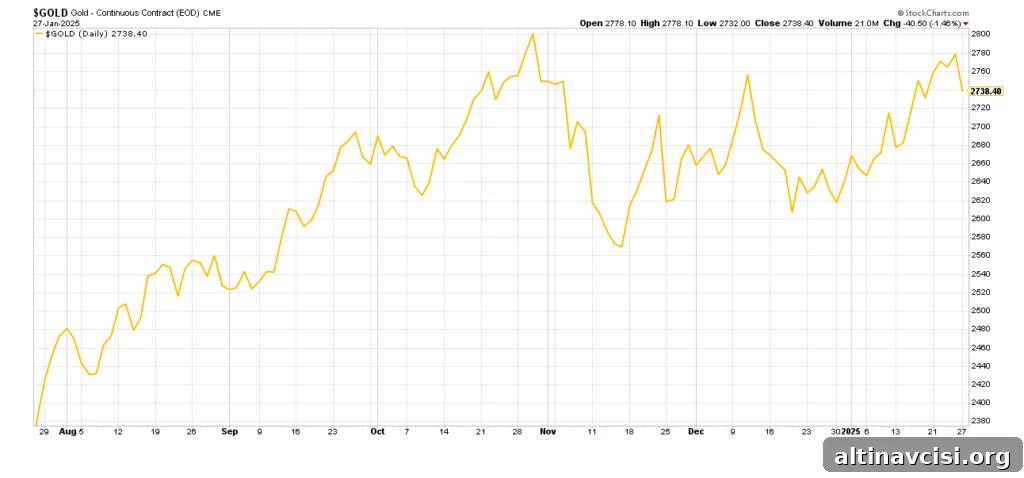
Gold’s recent chart pattern points to a major repricing event tied closely to geopolitical tensions, especially between the United States and China. Rather than reflecting a routine market cycle, the price action resembles historical episodes when safe-haven demand surged, creating sustained price moves that depend on the persistence of geopolitical stress.
Seen through this lens, gold isn’t simply following a short-term trading pattern: it is acting as a barometer for broader geopolitical risk. If diplomatic relations cool and tensions subside, the pattern could stabilize and prices may retreat toward long-term trend lines. Conversely, continued or escalating conflict could drive further inflows and push gold significantly higher as investors seek preservation of capital.
This dual role—both tradable asset and early-warning indicator—changes how investors should view gold. Traditional models that treat market movements as mean-reverting around risk-free rates may understate the metal’s sensitivity to structural shifts in global politics and capital flows. In an environment where great-power rivalry shapes trade, supply chains, and cross-border capital allocation, gold’s price dynamics can reflect perceptions of systemic risk rather than only macroeconomic variables like inflation or real rates.
From a technical perspective, the current setup shows familiar characteristics of previous repricing events: pronounced directional momentum, volume patterns that accompany persistent buying, and price levels that once broken tend to attract further buying as momentum traders and hedgers join the market. What differentiates the present situation is the clear geopolitical catalyst. The US–China relationship has become a dominant narrative for investors, and gold’s movement appears synchronized with shifting assessments of that relationship.
For portfolio construction, recognizing gold’s evolving function is important. Treating it solely as a short-term trade may miss its value as a hedge against geopolitical shock. Allocations to gold can provide asymmetric protection—mitigating downside across other holdings when geopolitical risk spikes—even if that protection occasionally costs performance during calmer periods. Investors should therefore evaluate allocations not only by expected returns but also by the insurance value gold provides in scenarios involving heightened geopolitical friction.
Risk management must incorporate the possibility that gold will continue to diverge from conventional market drivers. Scenario analysis can help: model outcomes where tensions ease, producing mean-reversion in gold prices, and contrast them with scenarios where tensions escalate, creating a more pronounced repricing. Such analysis should inform rebalancing rules, stop-loss levels for traders, and longer-term strategic targets for investors seeking stable purchasing power or crisis protection.
Sectoral impacts should also be part of the investment thesis. Rising geopolitical risk affects industries unevenly—defense contractors, commodity-exporting nations, multinational technology firms, and global shipping are among the areas that can be either negatively or positively influenced. Gold’s behavior therefore offers a signal about which sectors may require hedging, reduced exposure, or closer monitoring.
In practical terms, investors can combine technical and fundamental inputs: monitor price-action thresholds and momentum indicators while tracking diplomatic developments, policy announcements, and capital-flow data. This blended approach helps translate gold’s price movements into actionable portfolio decisions rather than treating them as isolated market noise.
Ultimately, gold’s present pattern underscores its role beyond a commodity or speculative vehicle. It serves as a strategic indicator of global stability and a hedge within diversified portfolios. Whether the metal continues its ascent or consolidates will depend largely on the trajectory of geopolitical tensions; therefore, investors and risk managers should keep gold’s signal in mind when evaluating broader asset allocation and contingency planning.