Something important is unfolding in the global financial system that many everyday investors haven’t fully noticed: central banks are buying gold again, and they’re doing so at rates not seen in decades. This is not a short-term reaction to a single event. It represents a structural shift in how major monetary authorities view reserves, risk, and long-term financial stability.
Why are central banks increasing their gold holdings, and what could this mean for individual investors?
The Numbers Tell the Story
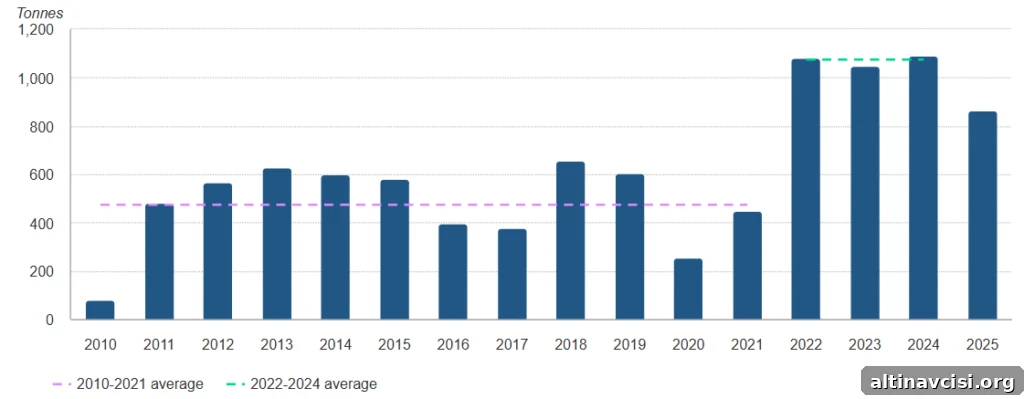
Central bank gold buying over recent years has been substantial. According to the World Gold Council, central banks added more than 1,000 tonnes of gold to reserves in each of 2022, 2023, and 2024. In 2022 alone net purchases reached 1,082 tonnes—the highest annual total since 1950. Purchases in 2023 totaled about 1,037 tonnes and roughly 1,045 tonnes in 2024. Full-year 2025 data shows 863 tonnes added globally—below the recent four-figure pace but still well above the long-term average.
To put this in context: between 2010 and 2021 the average annual pace was about 473 tonnes. Central banks nearly doubled their accumulation rate in a few years. Even as buying eased in 2025—partly because gold reached record prices—the strategic commitment persisted: 23 countries added to reserves in the first half of 2025. Central banks have now been net buyers of gold for 16 consecutive years, reversing a long period of net sales.
Why Now? The Key Drivers Behind the Trend
1. De-Dollarization and Reserve Diversification
For decades the U.S. dollar has dominated global reserves, with central banks holding large quantities of dollar-denominated assets. That dynamic has been shifting. A watershed moment occurred when the U.S. and its allies froze portions of Russia’s foreign exchange reserves after the 2022 invasion of Ukraine. The move highlighted a vulnerability: dollar assets held abroad can be restricted or seized in times of geopolitical conflict. Gold, in contrast, cannot be frozen or sanctioned by a foreign government, making it an appealing alternative for reserve diversification.
Emerging markets in particular—China, India, Poland, Singapore, Turkey and others—have moved to reduce reliance on dollar assets while increasing gold holdings.
2. Geopolitical Risk and Global Instability
Rising geopolitical tensions, shifting trade alliances, and the risk that financial infrastructure can be used as a geopolitical tool have pushed central banks toward assets considered politically neutral and universally accepted. Gold fits that profile: it has no nationality, carries no counterparty risk, and is universally recognized as a store of value. In an increasingly unstable global landscape, central banks view gold as a form of financial insurance.
3. Inflation Concerns and Currency Devaluation
The inflation surge after the COVID-19 pandemic underscored a core weakness of fiat currencies: governments can print money, which erodes purchasing power. Gold cannot be printed. Even as many central banks raised interest rates in 2022 and 2023 to combat inflation, they continued to buy gold—reflecting long-term risk management rather than short-term speculation. Gold serves as a multi-decade hedge against the systemic risks of debt-driven monetary expansion.
With global government debt-to-GDP ratios rising—and U.S. public debt exceeding 122% of GDP—the probability that policymakers might resort to inflationary measures to manage debt has increased, and gold is a logical counterbalance.
4. Growing Distrust of Sovereign Debt
U.S. Treasuries long held reputations as the world’s safest asset, but rising debt levels, fiscal pressures, and concerns about real returns erosion have prompted central banks to reassess that status. Gold carries no credit risk, no counterparty, and no maturity date—its value does not depend on any government’s fiscal choices. For institutions managing reserves across decades, those characteristics are increasingly attractive.
Who Is Buying—and How Much?
Emerging market central banks have led the accumulation trend, though developed economies are participating as well. China is a prominent buyer, officially adding 225 tonnes between late 2022 and 2023 and reporting total reserves of roughly 2,300 tonnes. Even so, gold represents only about 5–7% of China’s total reserves, suggesting room to increase allocations.
Poland has been an aggressive European buyer, adding over 100 tonnes in 2025 and bringing reserves to about 550 tonnes—nearing its revised target of roughly 30% of international reserves. India has also steadily increased holdings, adding more than 200 tonnes since 2017 and repatriating 100 tonnes from overseas vaults in 2024, signaling shifting attitudes toward foreign custodianship.
Countries such as Singapore, Turkey, Kazakhstan, Brazil and the Czech Republic have also added meaningful amounts. The geographic breadth of buyers is as notable as the aggregate volume. Additionally, about 68% of central banks now store most of their gold domestically, up from around 50% in 2020, reflecting concerns triggered by the freezing of overseas assets.
Central bank demand in 2025 remained resilient in the face of record gold prices
Annual central bank net purchases, tonnes*
Source: World Gold Council
How Central Bank Buying Impacts Gold Prices
Central banks buy for long-term strategic reasons rather than short-term trading, which creates a persistent price floor. While record-high prices in 2025 led to some moderation in buying, the long-term accumulation trend has become an independent driver of gold prices. Between 2021 and mid-2024, gold ETFs were net sellers even as prices rose—an unusual divergence that underscores the strength of central bank demand.
Because central banks continue to accumulate, gold demand has stayed robust even in periods of high interest rates and a strong U.S. dollar—conditions that historically would have pressured gold.
Is This a Sign of Economic Uncertainty?
Yes—though it reflects deeper structural concerns rather than fleeting market anxiety. Central banks manage reserves across decades, so a sustained shift in allocation signals declining confidence in a dollar-centric reserve system, growing worry over geopolitical and financial instability, and a reassessment of what constitutes a truly safe reserve asset. When the most sophisticated financial institutions move in the same direction for years, the signal is meaningful.
What This Means for Individual Investors
Central bank buying validates gold’s role as a long-term strategic asset. The same risks that motivate central banks—inflation, currency devaluation, geopolitical instability—also affect individual investors. A diversified portfolio that includes a modest allocation to physical gold, silver, or related ETFs can reduce correlation with traditional financial assets, hedge against currency weakness, and help preserve purchasing power.
Many advisors suggest a precious metals allocation in the 5–15% range depending on individual goals and risk tolerance. Whether invested through physical metal, ETFs, or other instruments, the strategic case for gold has strengthened as global central banks continue to add to reserves.
The Bottom Line
Central banks are not buying gold for a quick profit. They are adjusting reserve strategies in response to a shifting international monetary landscape—moving away from single-currency dominance toward a more multipolar reserve environment. Gold’s universal acceptance, political neutrality, and long history as a store of value place it at the center of that transition.
The institutions with the deepest research, the longest time horizons, and the most at stake have been consistently increasing gold allocations for years. That trend is a signal worth paying attention to.
Stay On Top of Gold & Silver Prices
Get important market alerts sent straight to your inbox.
People Also Ask
Why are central banks increasing their gold reserves?
Central banks are increasing gold reserves to diversify away from reliance on the U.S. dollar, hedge against inflation and currency devaluation, and protect against geopolitical risk. The 2022 freezing of some foreign exchange assets highlighted the vulnerability of dollar-denominated reserves and accelerated the shift toward gold, which cannot be frozen or sanctioned in the same way.
How does central bank gold buying affect gold prices?
Central bank buying creates a durable support under gold prices because these institutions buy for long-term reserve management rather than short-term profit. Their sustained demand has become a major price driver and can offset selling from other investor groups, helping sustain higher price levels even in challenging macro environments.
Which countries are buying the most gold?
Emerging market central banks such as China, India, Poland, Singapore, and Turkey have been among the most active buyers. China added significant tonnes between 2022 and 2023, Poland has pursued aggressive purchases to reach a higher gold-to-reserve target, and India has steadily increased holdings while repatriating some gold from overseas storage.
Is central bank gold buying a sign of economic uncertainty?
Yes, but it reflects structural concerns rather than short-lived market panic. Sustained and coordinated accumulation by central banks points to long-term doubts about dollar dominance, rising global debt, and a reassessment of what defines a secure reserve asset.
Should individual investors buy gold because central banks are buying it?
Central bank buying reinforces gold’s role as a strategic reserve asset and highlights risks that individual investors also face. Personal investment choices should align with individual goals and risk tolerance, but many advisors recommend a modest allocation—often 5–15%—to precious metals as part of a diversified portfolio.
This article is provided for informational purposes only and does not constitute investment advice. Consult a qualified financial advisor before making investment decisions.
You May Also Like:
- Gold vs Inflation: What 100 Years of Data Shows
- Why Silver Is More Volatile Than Gold (And Why It Matters for Investors)
- Silver Bars vs. Silver Coins: Which Is the Better Investment?
- Gold vs. Silver: Roles, Risks, and Portfolio Strategy
- Gold Silver Prices: Short-Term Noise, Long-Term Signal