
The performance of gold and silver in 2025 was not only remarkable by historical measures — it was one of the strongest showings for precious metals in decades.
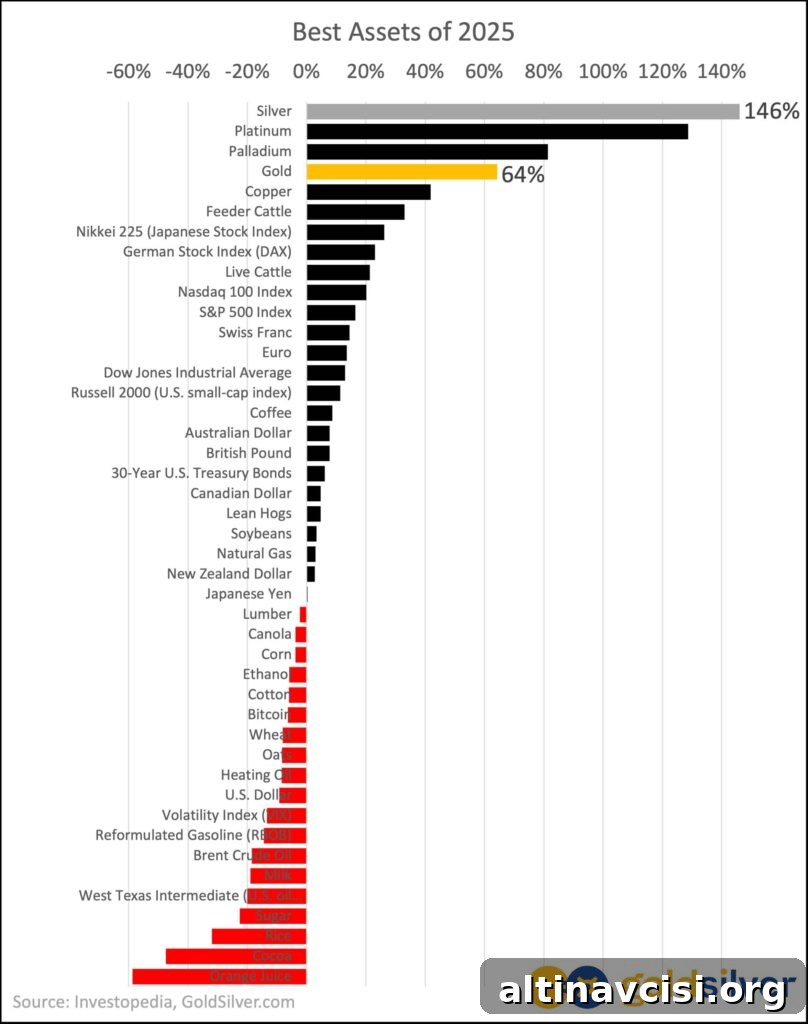
Silver surged 146%.
Gold climbed 64%.
Those are once-in-a-generation moves, especially for assets many investors still view as “boring” or defensive.
But how exceptional was 2025, really?
This chart from Alan Hibbard highlighting the ‘best assets of 2025’ helps put the year in perspective.
Best Assets of 2025
Source: Investopedia, GoldSilver.com
When every major asset class is lined up side by side, the message is unmistakable: precious metals didn’t just do well — they dominated.
Silver wasn’t merely the top performer; it obliterated the field. Gold didn’t just hedge risk — it outperformed the majority of stocks, bonds, currencies, and other commodities.
And this was not a one-metal fluke.
Metals Swept the Asset Leaderboard
Look at the top five assets of 2025:
- Silver — 146% gain
- Platinum — 129% gain
- Palladium — 81% gain
- Gold — 64% gain
- Copper — 42% gain
Every one of them was a metal. That matters.
This was not speculative froth chasing meme stocks or leverage-driven crypto rallies. Capital flowed deliberately into hard, tangible assets — assets with no counterparty risk, real industrial demand, and deep monetary history.
Meanwhile, many assets investors had been told would protect them — long-duration bonds, fiat currencies, and broad equity indices — either lagged or lost ground.
Why This Was a Structural Shift — Not a One-Off Rally
What made metals’ 2025 gains notable wasn’t just their size, but how decisively they outpaced nearly every major asset class.
2025 favored assets that:
- Can’t be printed
- Can’t be defaulted on
- Aren’t dependent on financial engineering or political promises
Inflation uncertainty, rising sovereign debt, geopolitical stress, and waning confidence in monetary policy all contributed. More importantly, investors quietly changed what they trusted.
When trust shifts, capital follows.
Gold and silver didn’t rise because of hype. They rose because, in an increasingly unstable system, they remain among the few assets that do not depend on someone else’s ability or willingness to pay.
Old Money Beats New Money in Uncertain Times
A quiet lesson of 2025 is this:
When the system gets stressed, old money tends to beat new money.
Gold and silver are not new ideas. They do not rely on complex financial structures, novel narratives, or perpetual liquidity. Precious metals don’t need to “work” for returns to exist — they simply are.
That’s why they often outperform during transitions, when confidence in paper claims, digital abstractions, and leveraged promises erodes.
New money thrives when trust is abundant. Old money endures when trust is questioned. 2025 was defined by uncertainty, and uncertainty exposes which assets depend on faith and which stand on their own.
Counterparty Risk: The Risk No One Notices Until It Matters
At the heart of this shift is a concept many investors overlook in calm markets: counterparty risk.
Counterparty risk is the chance someone else must perform — pay, deliver, honor, or remain solvent — for your asset to retain value.
Stocks, bonds, bank deposits, ETFs, derivatives, and many “hard asset” proxies all depend on institutions functioning as promised.
Physical gold and silver do not. They carry no counterparty risk. They are not claims on another balance sheet. Precious metals do not require intermediaries, clearinghouses, custodians, or government guarantees to exist.
Gold and silver settle instantly. They are final payment. They don’t default.
That distinction can feel academic — until it matters. When confidence is high, counterparty risk is invisible. When confidence cracks, it becomes critical.
The Takeaway Most Investors Will Miss
Many will dismiss 2025 as “a great year for metals.” The more important question is: Why weren’t you positioned before the move?
The chart is more than a recap; it’s a snapshot of what markets rewarded and what they punished. For investors focused on long-term preservation of purchasing power, 2025 delivered a clear message:
Hard assets aren’t an alternative anymore. They’re essential.
Investors who recognized that early didn’t just protect wealth — they grew it substantially.
Ready to position your portfolio for the next market shift? Consider studying the case for precious metals and evaluating how physical gold and silver might fit your objectives.

The Financial System Isn’t Safer — And You Know It
As risks mount, see why gold and silver are projected to keep shining in 2026 and beyond.
Stay On Top of Gold & Silver Prices
Get important market alerts sent straight to your inbox.
People Also Ask
What was the best performing asset in 2025?
Silver was the top-performing asset in 2025, rising 146% for the year. That gain outpaced major asset classes including stocks, bonds, real estate, and cryptocurrencies.
How much did gold go up in 2025?
Gold climbed 64% in 2025, placing it among the top-performing major assets and exceeding returns from many traditional investments that year.
What were the top 5 performing assets in 2025?
The top five assets of 2025 were all metals: silver (146%), platinum (129%), palladium (81%), gold (64%), and copper (42%). This metal-dominated leaderboard reflected a shift toward hard, tangible assets without counterparty risk.
What is counterparty risk and why does it matter?
Counterparty risk is the chance that someone else must perform — pay, deliver, or remain solvent — for your asset to retain value. Physical gold and silver carry no counterparty risk because they don’t depend on any institution or government promise to maintain their worth.
Are precious metals a good investment during economic uncertainty?
Precious metals historically hold value during uncertainty because they are independent of government policy, currency strength, and many financial system fragilities. The 2025 results underscored this pattern, with metals outperforming as traditional assets struggled.
You May Also Like:
- Why New CME Trading Rules Could Push Silver to $100
- Central Banks Keep Buying Gold at Record Prices
- Why Silver Prices Are Rising — And What Comes Next
- Best Investment Of 2026: Silver’s Setup Is Hard To Ignore
- What the Falling Gold-to-Silver Ratio Means for Investors