
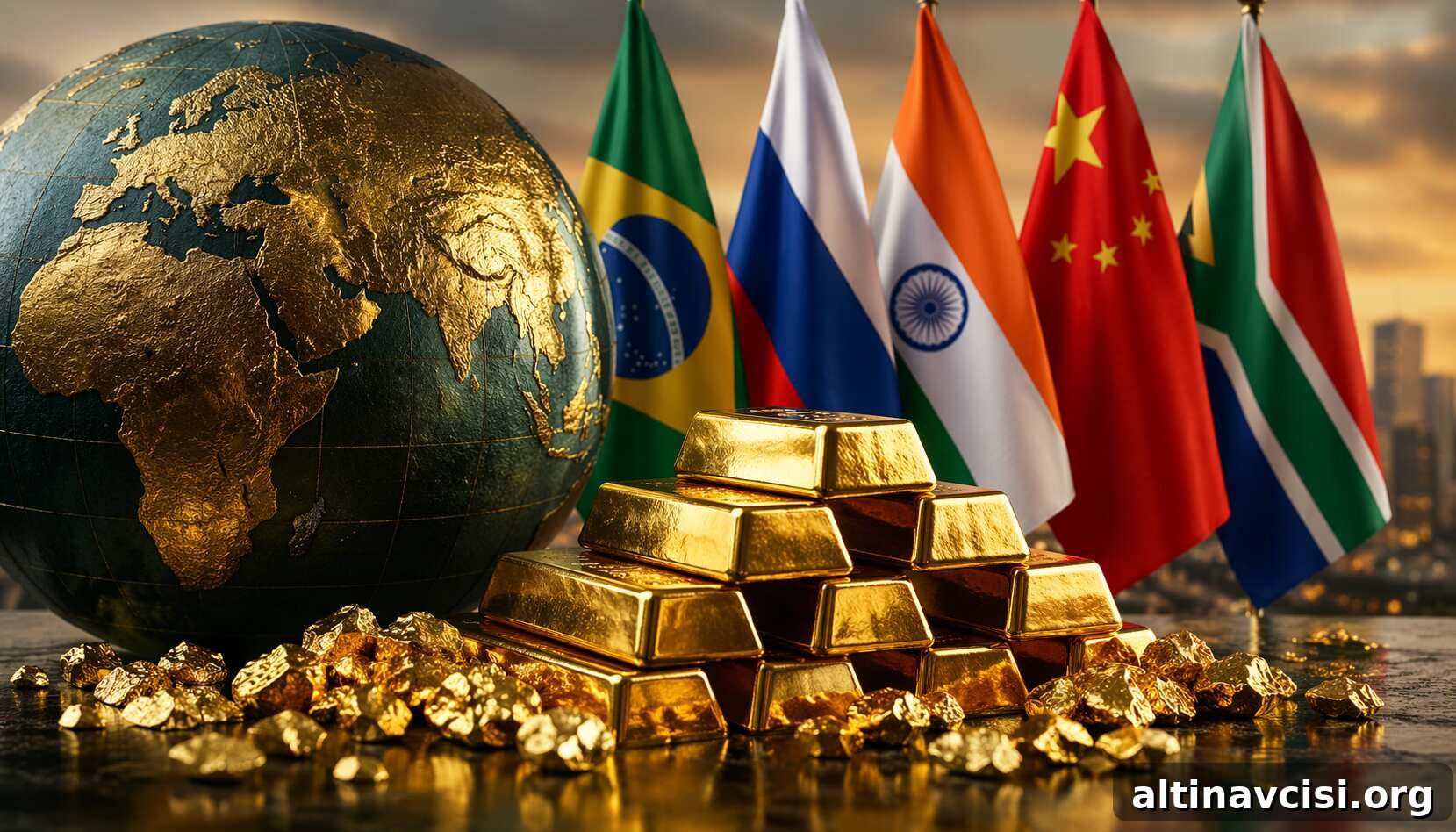
BRICS nations are accumulating gold for three core reasons: to reduce dependence on the U.S. dollar, to protect reserves from potential sanctions, and to hedge against a debt-driven depreciation of currencies they did not create. The 2022 freezing of roughly $300 billion of Russia’s foreign reserves held in Western institutions illustrated that dollar-denominated reserves can be rendered inaccessible overnight — a lesson central bankers could not ignore.
Unlike bank balances or foreign bonds, physical gold held domestically cannot be frozen by a foreign power.
Gold traded near $4,850 per ounce as of April 2026, a rise of more than 40% over twelve months, yet the significance of BRICS purchases lies less in the price and more in what the buying reveals about how large emerging economies now view money, risk, and reserve management.
What Is BRICS — and Why Does Its Gold Strategy Matter?
BRICS is a coalition of major emerging economies that has treated sovereign gold accumulation as a deliberate policy priority. The original five members—Brazil, Russia, India, China, and South Africa—were joined in January 2024 by Egypt, Ethiopia, Iran, and the United Arab Emirates, and in January 2025 by Indonesia, bringing confirmed full membership to ten. Saudi Arabia was invited but its formal accession remains unconfirmed; Argentina declined an invitation in late 2023.
Together this expanded BRICS+ bloc accounts for roughly 40% of global GDP on a purchasing-power-parity basis and about half of the world’s population. When economies of this scale coordinate reserve decisions, the effects are structural rather than temporary, shifting demand patterns for reserve assets worldwide.
How Much Gold Are BRICS Nations Actually Buying?
Combined BRICS+ official gold reserves now exceed 6,000 tonnes. Russia leads with about 2,336 tonnes, China holds roughly 2,298 tonnes, and India around 880 tonnes. Brazil returned to the market in September 2025 with a 16-tonne purchase, bringing its total to 145.1 tonnes.
Between 2020 and 2024, BRICS+ central banks accounted for more than half of global central-bank gold purchases. Their share of world gold reserves rose from 11.2% in 2019 to about 17.4% today. Global central bank buying exceeded 1,000 tonnes annually in 2022–2024 — the longest consecutive purchasing streak in modern history — with BRICS nations driving much of that demand. In 2025, central banks purchased 863 tonnes, reflecting continued but somewhat lower net buying.

Your Gold Buying Guide Most investors overpay when they buy gold and often again when they sell. This concise guide explains what to own and why.
Why Are BRICS Nations Buying Gold? The Four Drivers
1. De-dollarization: The dollar’s share of official global reserves has declined from about 71% in 1999 to roughly 57% today. Instead of switching primarily into euros or yuan, many BRICS central banks are increasing gold holdings — an asset with no issuer, no counterparty, and no single political jurisdiction.
2. Sanctions-proofing: Foreign-held dollar assets can be frozen; domestically held physical gold cannot. The 2022 episode with Russia made that distinction central to reserve strategy.
3. Hedging against dollar debasement: Rising U.S. federal debt and persistent deficits have pushed reserve managers to seek assets governments cannot create. Gold is one of the few such instruments.
4. Building a post-dollar architecture: Research initiatives and pilot schemes, including proposals for gold-anchored settlement units, suggest BRICS members are exploring a parallel financial architecture that relies less on the dollar and more on a mix of gold and regional currencies. These remain exploratory but signal a strategic direction.
What Did the 2022 Russia Sanctions Change?
When Western governments froze a substantial portion of Russia’s foreign reserves in 2022, central bankers worldwide reevaluated what qualifies as reliable reserves. Assets kept at foreign institutions can be rendered inaccessible; gold stored domestically cannot. That realization helped trigger a sharp rise in central-bank gold buying, and the Bank of Russia’s gold holdings increased significantly between early 2022 and the end of 2025, partially offsetting frozen foreign assets.
Is BRICS Gold Buying a Threat to the Dollar?
The dollar remains the dominant global reserve currency and has not collapsed. However, its share of official reserves has been declining for decades while gold’s share of official reserves has risen. Central-bank surveys show many reserve managers expect the dollar’s share to fall further in coming years. These trends reflect strategic hedging rather than an immediate replacement of the dollar.
What Does BRICS Gold Buying Mean for Individual Investors?
The drivers that lead sovereign reserve managers to gold—deficit spending, currency debasement, and geopolitical risk—also erode individual purchasing power. Physical gold offers a form of protection that cannot be seized by a foreign government. A large share of central banks plan to increase gold holdings in the near term and none report plans to reduce them; when well-resourced institutions align on an asset, it is worth attention from individual savers as part of a diversified plan.
What the Data Is Really Telling Us
BRICS nations are increasing gold reserves because the postwar dollar system, while reliable for decades, has been shown to be vulnerable to geopolitical intervention. If reserves held abroad can be frozen, central banks must reassess what constitutes accessible, dependable reserves.
The numbers behind the shift
BRICS+ share of official global gold reserves rose from 11.2% in 2019 to about 17.4% today. Central-bank purchases averaged over 1,000 tonnes annually from 2022 through 2024, and a large majority of central bankers expect the dollar’s reserve share to decline further. These are operational reserve decisions already in motion.
What it means for individual savers
The same logic that drives sovereign managers toward gold applies to personal financial resilience. Debt that cannot be repaid tends to be inflated away; currencies issued by governments running large deficits lose purchasing power over time. Gold carries no issuer risk and cannot be diluted by a monetary authority, which is why it remains a longstanding component of diversified portfolios.
Stay On Top of Gold & Silver Prices
Get important market alerts sent straight to your inbox.
People Also Ask
What are BRICS nations?
BRICS began as a group of five emerging economies—Brazil, Russia, India, China, and South Africa—and later expanded. By early 2025 confirmed membership reached ten countries. The enlarged BRICS+ bloc represents a significant share of global GDP and population, giving its coordinated economic choices material influence on global markets.
How much gold do BRICS countries hold?
Combined BRICS+ gold reserves exceed 6,000 tonnes, with Russia, China, and India holding the largest shares. From 2020 to 2024, BRICS+ central banks accounted for more than half of central-bank gold purchases worldwide.
Why are BRICS nations buying gold instead of other assets?
Gold carries no issuer risk and no counterparty risk. Physical gold stored domestically cannot be frozen by foreign authorities and does not depend on any single government’s policies, making it attractive for countries seeking reliable, sovereign-controlled reserves.
Did the Russia sanctions cause BRICS nations to buy more gold?
Yes. The 2022 freezing of a large portion of Russia’s foreign reserves prompted many central banks to rethink reserve composition, accelerating a shift into gold and nearly doubling annual central-bank gold purchases for a period following those events.
Are BRICS countries trying to replace the dollar with gold?
Not immediately. The more accurate description is that BRICS countries are building capacity for a less dollar-dependent system, experimenting with alternative settlement mechanisms and deepening regional currency use alongside increased gold holdings. These are strategic steps rather than an abrupt displacement of the dollar.
SOURCES
1. World Gold Council — Gold Demand Trends: Full Year 2025
2. World Gold Council — Central Bank Gold Reserves Survey 2025
3. IMF — Currency Composition of Official Foreign Exchange Reserves (COFER)
4. IMF — World Economic Outlook
5. BRICS Brazil Presidency — BRICS Data
6. Congressional Budget Office — The Budget and Economic Outlook: 2026 to 2036
7. European Central Bank — The International Role of the Euro, June 2025
8. Bloomberg — Russia Gains $216 Billion in Gold Rally, Replacing Lost Assets
Disclaimer: This article is for informational and educational purposes only and does not constitute investment advice. Past performance is not a guarantee of future results. Consult a qualified financial advisor before making any investment decision.
You May Also Like:
- Gold Price Forecast 2026–2027: Key Predictions from Top Analysts
- Is Now a Good Time to Buy Gold? Here’s the Macro Case
- Is Gold a Better Investment Than Bitcoin Right Now?
- What the Silver-to-CPI Ratio Reveals That Spot Price Hides
- Gold & Silver Supply and Demand: What Really Drives Prices Over Time
- Dow to Gold Ratio: 100 Years of History Decoded
- How the 50 Day SMA Helps You Understand Gold & Silver
- Gold Silver Ratio Forecast (75): Buy Gold, Add Silver, or Wait?