5 Warning Signs Mainstream Analysts Missed on Gold and Silver
Gold and silver market update — April 24, 2026
In this update: Silver’s structural supply deficit stretches into a sixth year while US inflation holds near 3.3%. This week featured a wide Bank of America silver scenario, a notable CME margin cut for silver futures, Kevin Warsh’s comments on AI and productivity at his confirmation hearing, and a US silver mine that expanded its resource base by 19% through drilling and analysis rather than new discoveries.
Why Does Bank of America’s Silver Forecast Span $135 to $309?
Bank of America’s metals team, led by Michael Widmer, illustrated two scenario endpoints for silver of $135 and $309 per ounce conditioned on gold trading near $5,000. Both numbers use the same gold input but different historical gold-to-silver ratios: the 2011 ratio low (~32:1) implies about $135/oz for silver; the extreme 1980 Hunt Brothers ratio (~14:1) implies roughly $309/oz. Widmer stressed these are conditional scenarios rather than precise predictions.
The wide spread highlights silver’s dual role as both an industrial metal and a monetary asset. Under a steady bull market driven by rising precious-metals sentiment, silver could follow the lower scenario; if a physical delivery squeeze or disorderly allocation to physical metal occurs, prices could run far higher. Because silver is pulled by both industrial use and monetary demand, upside outcomes are much harder to cap.
Silver has already shown extreme swings in 2026: it reached an all-time high of $121.67 on January 29 and then plunged roughly 38% in the days that followed; at the time of this update it traded near $75/oz. That volatility illustrates how quickly the market can move from one scenario toward another, leaving the upside case still open while much of the downside correction has already occurred.
What Does a CME Margin Cut Tell You About the Silver Market?
Effective after the close on April 24, the CME reduced margin requirements across the four main precious metals futures: gold down 14%, silver down 21.4%, platinum down 15.3%, and palladium down 14.2%. Lower margins reduce the capital required to hold futures positions, making it cheaper for institutions and traders to build or maintain exposure to the metals.
The deeper cut for silver—larger than for the other metals—is noteworthy. However, margin reductions reflect the exchange’s risk models and recent volatility assessments rather than a directional view on prices. In other words, lower margins remove friction and cost for market participants; they do not, on their own, predict whether prices will rise or fall.
Context matters: silver sits about 38% below its peak earlier this year, while the Silver Institute anticipates a sixth consecutive year of structural supply deficit for 2026. With margins lower, institutional buyers and leveraged participants face fewer barriers to increasing exposure—one of several pieces that could contribute to a future price move if demand strengthens against constrained physical supply.
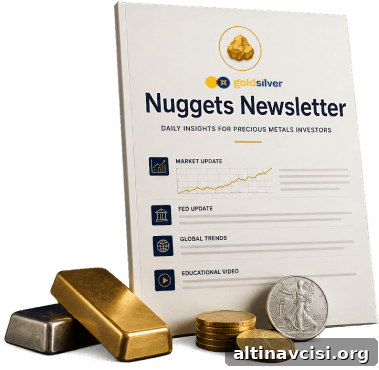
The Edge Every Investor Needs
Smarter precious metals investing starts here. The Nuggets Newsletter delivers market analysis, Fed updates, global trends, and short educational videos to help you stay informed.
Subscribe to receive concise market alerts and analysis by email. (Subscription form removed from this export.)
Can AI Deflation Offset an Energy-Driven Inflation Surge?
At his Senate Banking Committee confirmation hearing on April 21, Kevin Warsh argued that productivity gains from artificial intelligence could exert downward pressure on prices over time, potentially supporting lower interest rates. He framed the idea cautiously: “We don’t know that. We can’t bank on that.”
Warsh’s supply-side argument echoes productivity-driven disinflation episodes from previous decades, but timing is the key challenge. Headline inflation in the US is running at roughly 3.3%, and recent energy price moves—especially gasoline—are pushing near-term inflation higher. The Federal Reserve’s current projections foresee limited easing in policy rates during 2026, meaning markets will wait for clearer data before adopting a more dovish stance.
Markets tend to price policy on realized data rather than long-horizon theory. If AI-driven productivity meaningfully lowers costs across the economy, that would strengthen the case for lower rates; until then, short-term energy shocks keep upside inflation risk on the table.
What Drove US Inflation Back to 3.3% in March 2026?
Gasoline was the principal contributor. The Bureau of Labor Statistics reported headline CPI at 3.3% year-over-year for March, up from 2.4% in February, with the monthly CPI rise at 0.9%. Gasoline prices surged roughly 21.2% in the month—the largest single-month increase in decades—and accounted for a substantial portion of the overall monthly gain.
Core CPI, which excludes food and energy, remained much calmer at about 2.6% year-over-year and rose only 0.2% month-over-month, indicating that the inflation uptick was driven mainly by the energy shock rather than broad-based price acceleration. The UK experienced a similar pattern in March with headline inflation rising to 3.3% from 3.0% in February.
For holders of sound money, the dynamic is straightforward: an energy-driven spike in headline inflation reduces real purchasing power while the central bank may be reluctant to ease policy. That environment tends to increase interest in stores of value such as gold and, to some extent, silver.
How Did a Silver Mine Grow Its Resource 19% Without New Ground?
Americas Gold and Silver’s 2025 resource update, published on March 30, reported that the Galena project’s measured-and-indicated silver resources rose 19% to 87.9 million ounces, and average grade increased about 21% to 500.9 g/t. Those gains were achieved without acquisitions or new greenfield discoveries.
The company expanded resources through a year of focused drilling, geological reinterpretation, and improved modeling—essentially extracting more value from the same deposit. Consolidated measured-and-indicated resources across its US and Mexican operations grew roughly 10% to about 115.7 million ounces. This was an operational improvement rather than a financial accounting adjustment.
The timing is significant because the global silver market has shown persistent deficits. The Silver Institute recorded an approximate 95 million ounce deficit for 2025, marking the fifth straight year in which demand outpaced supply. Incremental resource gains at existing mines are therefore meaningful and represent one of the realistic ways to alleviate structural shortfalls, even if such improvements are relatively rare.
Stay On Top of Gold & Silver Prices
Get important market alerts sent to your inbox.
To receive timely market alerts, subscribe via the newsletter sign-up on the primary site. (Subscription form omitted here.)
SOURCES
1. Bloomberg — Bank of America: Gold and Silver Volatility to Persist After Price Plunge
2. Finance Magnates — Why Silver Is Going Up And Why Bank Of America Predicts $309 Price in 2026
3. CME Group — Precious Metals Margin Requirements
4. Bloomberg — CME to Shift Precious-Metals Margin Settings as Prices Swing
5. Silver Institute — World Silver Survey 2026: Supply and Demand
6. Council on Foreign Relations — What Kevin Warsh’s Confirmation Hearing Revealed About the Future of the Fed
7. NPR — Three Takeaways as Trump’s Fed Pick Faces a Confirmation Fight
8. CBS News — Kevin Warsh Faces Lawmakers in Fed Chair Confirmation Hearing
9. FedScoop — Fed Needs to Be Proactive on Cyber Risks from AI Models, Nominee Says
10. Bureau of Labor Statistics — Consumer Price Index Summary, March 2026
11. UK Office for National Statistics — Consumer Price Inflation, March 2026
12. Newsfile Corp. — Americas Gold and Silver: 2025 Resource & Reserve Update
13. Americas Gold and Silver Corporation — 2025 Resource & Reserve Update (Official Investor Relations)
14. Silver Institute — World Silver Survey 2026: Five Consecutive Deficit Years
Disclaimer: This article is for informational purposes only and does not constitute financial or investment advice. Consult a qualified financial adviser before making investment decisions.
You May Also Like:
- Before the Fed Speaks, Watch This Number for Gold
- Gold Price Today: What to Watch Before the April 29 FOMC
- What’s Driving Gold Prices? Oil, PMI, and Newmont
- Dollar Weakens, Gold Falls — and That’s Actually Bullish
- Why Chinese Silver Imports Hit a Record in 2026
- What Drives Gold Prices? 5 Forces Investors Are Watching Now
- The Gold-Silver Ratio Signal: What Silver’s Lead Means
- Gold Drops to $4,681 — Iran Ceasefire Expires Today
Popular Topics
Picked from the archive
-
01
 Topics
Gold, Silver Prices Hold Steady Ahead of Jackson Hole Summit
-
02
Topics
Gold Price to Hit $5,500 by Q1 2027? Central Bank Risk
-
03
Topics
Gold and Silver Rally After Venezuelan Shock Roils Markets
-
04
Topics
Inflation Under Trump: Fact Check on Price Changes
-
05
Topics
Key Indicator to Watch for Gold Ahead of Fed Decision
-
06
Topics
Trump Tours $2.5B Fed Renovation, Presses Powell on Rates
-
07
Topics
How the London Gold Fixing Shapes Global Gold Prices
-
08
Topics
Is Gold Overpriced or Undervalued? What 3 Models Reveal